
What Is Duct Velocity?
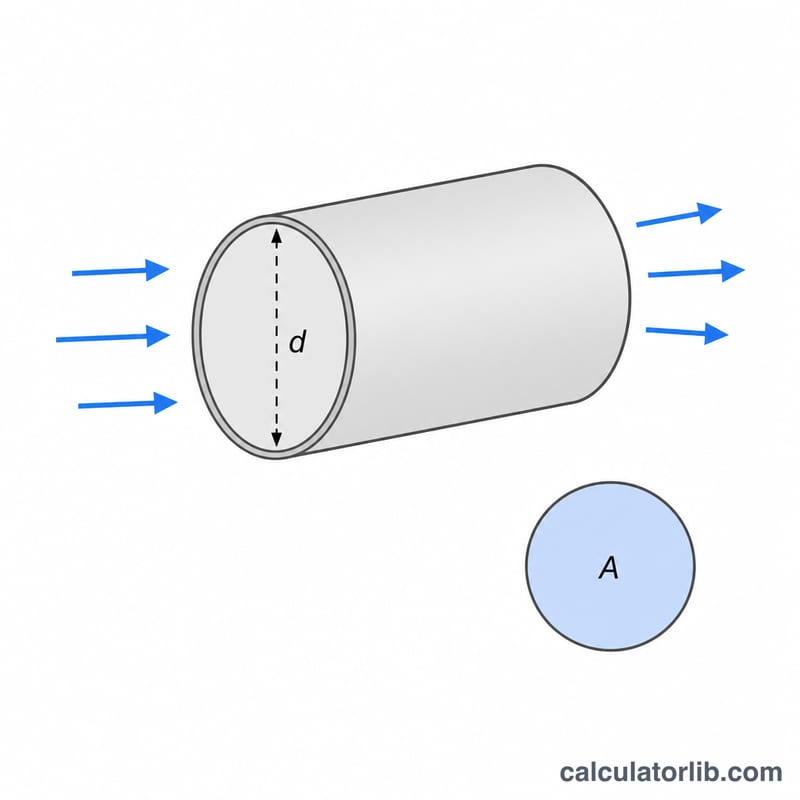
Duct velocity is the speed at which air travels through a duct, normally expressed in feet per minute (fpm). It is a key design value in HVAC: too high and you get noise, vibration and high static pressure; too low and the system may fail to carry air or particulate effectively. This calculator finds duct velocity from the airflow (CFM) and the duct's cross-sectional area, supporting both round and rectangular ducts.
How to Use It
Choose your duct shape. Enter the airflow in CFM. For a round duct, enter the diameter in inches. For a rectangular duct, enter the width and height in inches. The calculator converts the dimensions to a cross-sectional area in square feet and divides the airflow by that area to give the velocity in fpm, plus the area and an equivalent speed in meters per second.
The Formula Explained
The core relationship is Velocity (fpm) = CFM ÷ Area (ft²). CFM (cubic feet per minute) is a volume flow rate; dividing by area gives a linear speed. For round ducts the area is \(\pi r^{2}\), where the radius is half the diameter. Because duct dimensions are entered in inches, each is divided by 12 to convert to feet before computing area.
For a round duct:
$$V = \dfrac{\text{CFM}}{\pi\left(\dfrac{\text{Diameter (in)}}{24}\right)^{2}}$$For a rectangular duct:
$$V = \dfrac{\text{CFM}}{\dfrac{\text{Width (in)}}{12}\times\dfrac{\text{Height (in)}}{12}}$$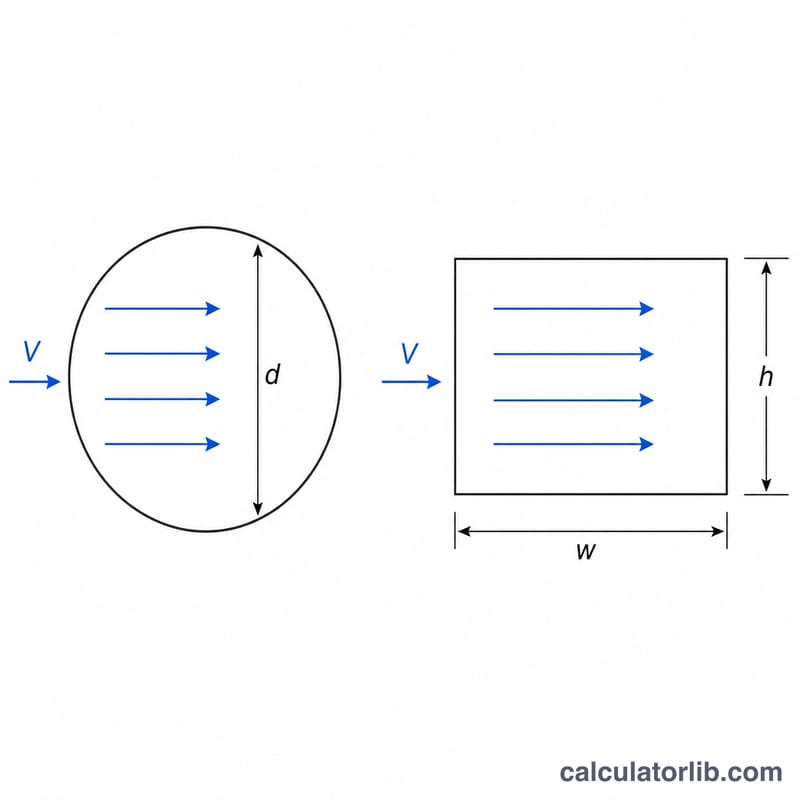
Worked Example
Suppose 400 CFM flows through an 8-inch round duct. The radius is 4 inches = 0.3333 ft, so the area is \(\pi \times 0.3333^{2} \approx 0.3491\) ft². Velocity:
$$V = \dfrac{400}{0.3491} \approx 1{,}146 \text{ fpm}$$— a typical main-trunk velocity for residential systems.
FAQ
What is a good duct velocity? Residential main ducts often target 700–1,000 fpm and branches 400–700 fpm; commercial systems run higher. Lower velocities are quieter.
Does shape change the result? Only through area. A 12×8 inch rectangular duct and an equivalent round duct of the same area produce the same velocity for a given CFM.
How do I convert fpm to m/s? Multiply fpm by 0.00508. The calculator shows this automatically.