
What Is Volumetric Flow Rate?
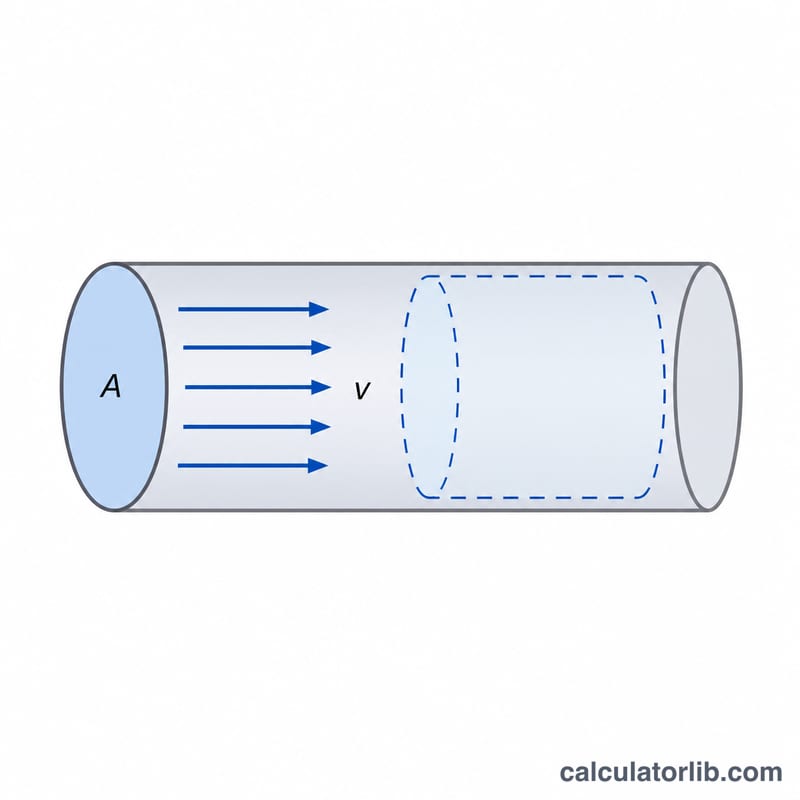
Volumetric flow rate (Q) measures the volume of fluid that passes through a given cross-section per unit of time. It is fundamental in fluid mechanics, plumbing, HVAC, hydraulics, and process engineering. The simplest relationship comes from the continuity principle: the flow rate equals the cross-sectional area of the pipe or channel multiplied by the average velocity of the fluid moving through it.
The Formula
The governing equation is $$Q = A \cdot v$$, where:
\(Q\) = volumetric flow rate (m³/s), \(A\) = cross-sectional area perpendicular to flow (m²), and \(v\) = average flow velocity (m/s). Because this calculator works in SI units, the result is in cubic meters per second, which we also convert to liters per minute (×60,000) and US gallons per minute (×15,850.32) for convenience.
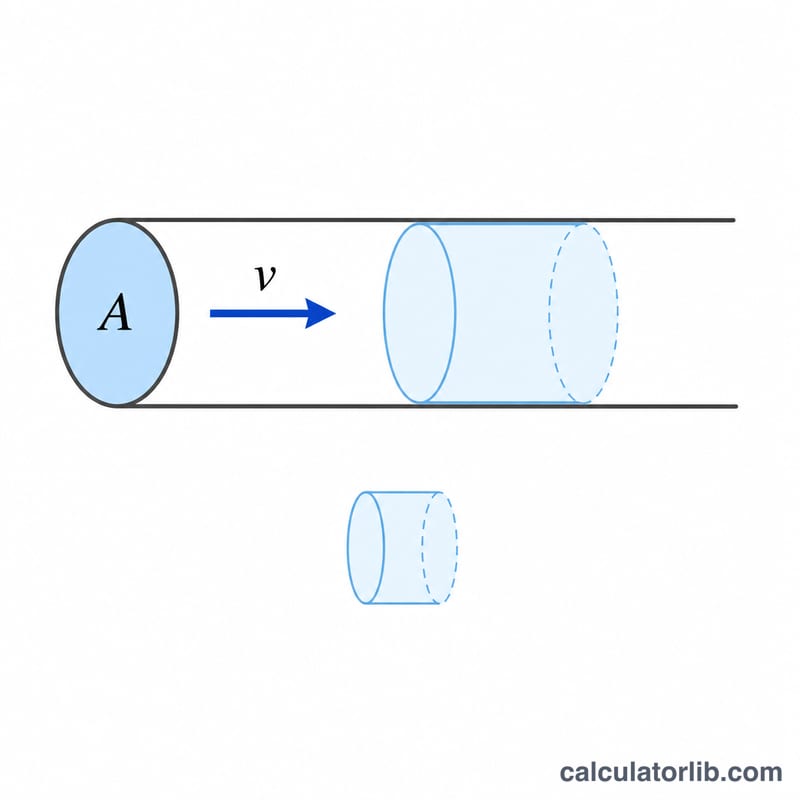
How to Use This Calculator
Enter the cross-sectional area of the pipe or duct in square meters and the average flow velocity in meters per second. For a circular pipe, compute the area as \(A = \pi \cdot r^2\) where \(r\) is the inner radius. Press calculate to get the flow rate in three common units.
Worked Example
Suppose water flows through a pipe with a cross-sectional area of 0.05 m² at an average velocity of 2 m/s. Then $$Q = 0.05 \times 2 = 0.1 \text{ m}^3/\text{s}.$$ Converting: \(0.1 \times 60{,}000 = 6{,}000\) L/min and \(0.1 \times 15{,}850.32 \approx 1{,}585\) GPM.
FAQ
How do I find the area of a round pipe? Use \(A = \pi \times (\text{diameter}/2)^2\). For a 0.2 m diameter pipe, \(A = \pi \times 0.1^2 \approx 0.0314\) m².
What velocity should I use? Use the average (mean) velocity across the cross-section, not the peak centerline velocity, which is higher in laminar flow.
Does this account for friction or turbulence? No. \(Q = A \cdot v\) is the ideal continuity relation. Pressure losses and friction require additional equations like Darcy-Weisbach.