
What Is the Radius of Gyration?
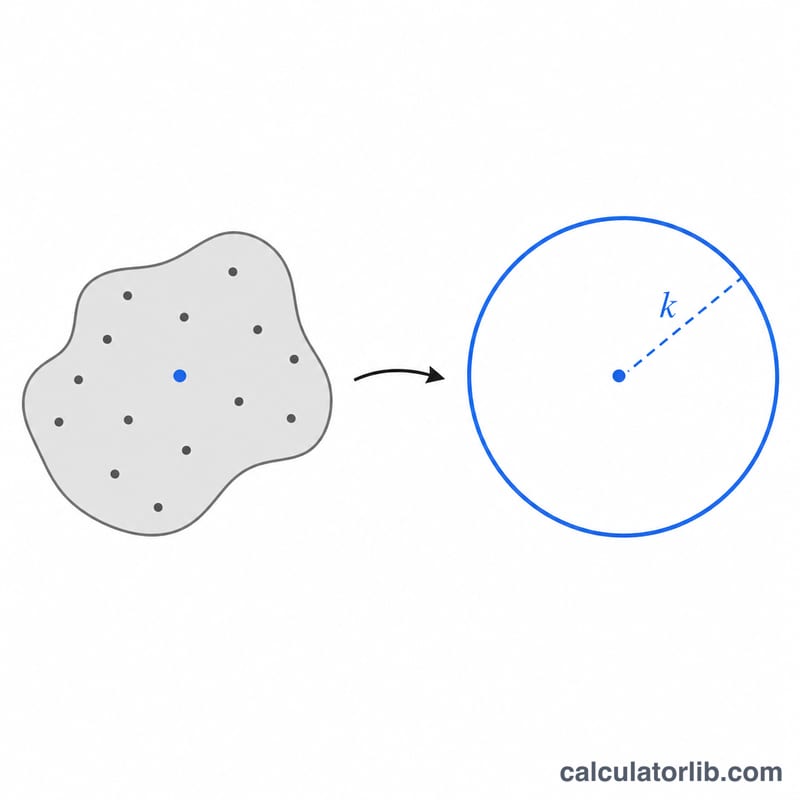
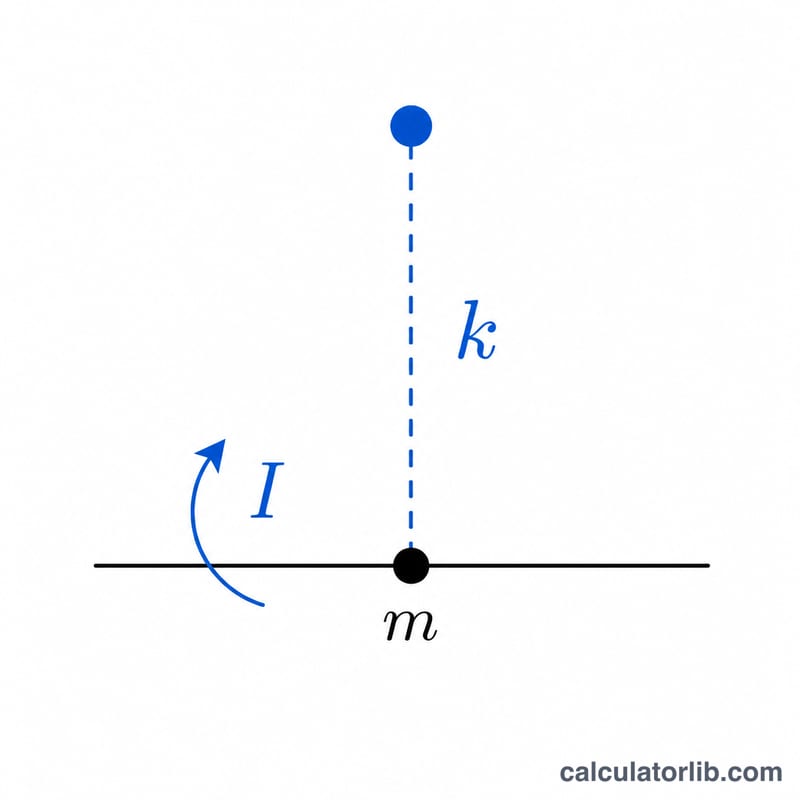
The radius of gyration, denoted k (or r), is the distance from a rotation or bending axis at which the entire mass (or area) of a body could be concentrated without changing its moment of inertia. It compactly describes how mass or area is distributed about an axis, which is fundamental in dynamics, structural engineering, and column buckling analysis.
The Formula
For a dynamic (mass) problem the radius of gyration is $$k = \sqrt{\dfrac{\text{Moment of inertia } I}{\text{Mass } m}}$$ where I is the mass moment of inertia and m is the mass. For a structural (area) problem it is $$k = \sqrt{\dfrac{\text{Moment of inertia } I}{\text{Area } A}}$$ where I is the second moment of area and A is the cross-sectional area. The two share identical mathematics — only the meaning of the inputs differs.
How to Use This Calculator
Choose whether you are working on a mass or area basis, enter the moment of inertia I, and enter the mass m or area A. The calculator returns k along with the intermediate ratio I/(m or A). Keep your units consistent: if I is in kg\(\cdot\)m² and m in kg, then k is in metres; if I is in mm⁴ and A in mm², then k is in mm.
Worked Example
A steel section has a second moment of area I = 1000 mm⁴ and cross-sectional area A = 40 mm². Then $$\frac{I}{A} = 25 \text{ mm}^2 \quad\text{and}\quad k = \sqrt{25} = 5 \text{ mm}.$$ So the radius of gyration of this section is 5 mm.
FAQ
Is radius of gyration the same for mass and area? The concept and formula are the same; the inputs differ (mass moment of inertia vs second moment of area), and the units differ accordingly.
Why does column buckling use it? The slenderness ratio of a column equals its effective length divided by its least radius of gyration, governing the critical buckling load.
Can k be larger than the body's dimensions? No — k always lies within the physical extent of the section because it is a weighted average distance of the material from the axis.