
What This Calculator Does
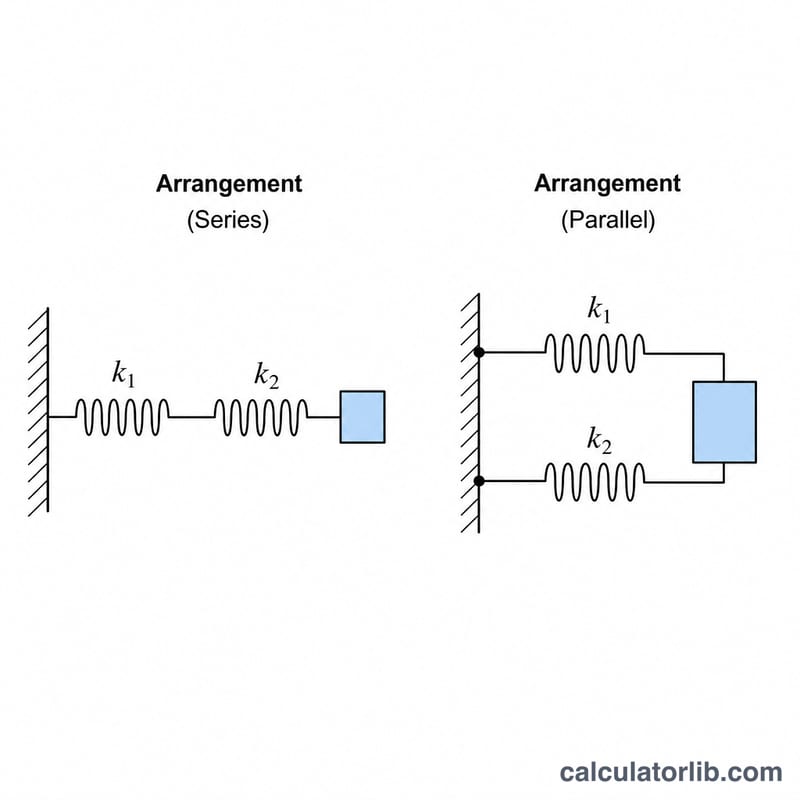
When two or more springs support a load, they can be arranged in series (end to end) or in parallel (side by side). This calculator finds the single equivalent spring constant (stiffness) that would behave exactly like the combination, for up to four springs. The spring constant k is measured in newtons per metre (N/m) and describes how much force is needed to stretch or compress a spring by one metre, following Hooke's law \(F = kx\).
How to Use It
Pick the combination type — Series or Parallel — then enter the spring constant of each spring. Spring 1 and Spring 2 are required; Spring 3 and Spring 4 are optional, so you can combine two, three, or four springs. Leave optional fields blank to ignore them. Press calculate to get the equivalent stiffness in N/m.
The Formula Explained
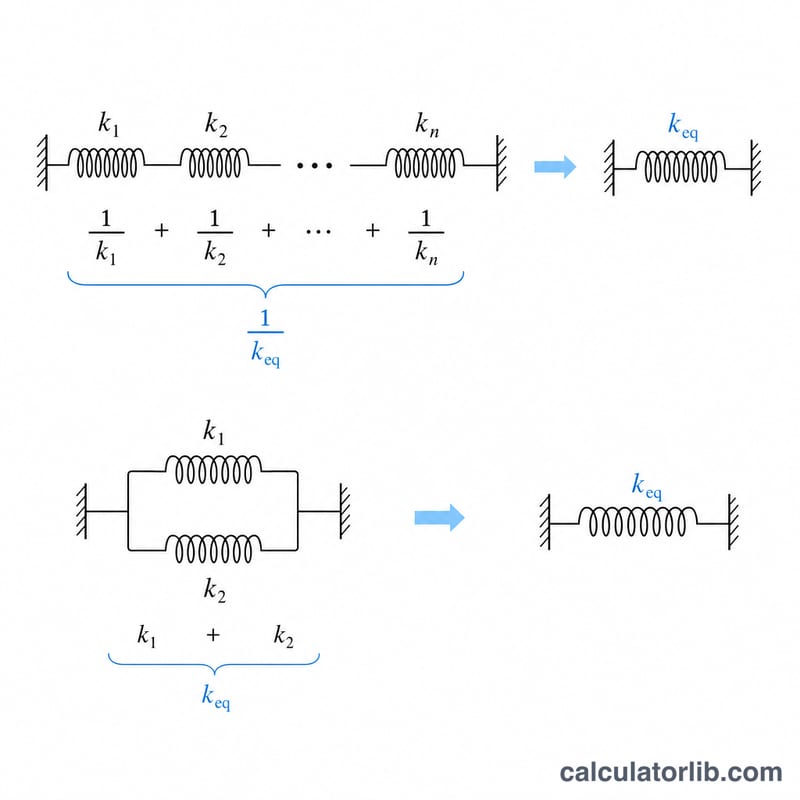
In a parallel arrangement every spring stretches by the same amount, so their forces add and stiffness simply sums: $$k_{eq} = k_1 + k_2 + \ldots$$ The combination is always stiffer than any single spring.
In a series arrangement each spring carries the same force but the extensions add, so the reciprocals add: $$\frac{1}{k_{eq}} = \frac{1}{k_1} + \frac{1}{k_2} + \ldots$$ The result is always softer (smaller \(k\)) than the weakest single spring.
Worked Example
Take two springs, \(k_1 = 100 \text{ N/m}\) and \(k_2 = 200 \text{ N/m}\). In parallel: $$k_{eq} = 100 + 200 = 300 \text{ N/m}.$$ In series: $$\frac{1}{k_{eq}} = \frac{1}{100} + \frac{1}{200} = 0.015, \quad k_{eq} = \frac{1}{0.015} \approx 66.67 \text{ N/m}.$$ The series combination is much softer than either spring alone.
FAQ
Why is series weaker than parallel? In series the springs stack their stretch, so the same force produces more total movement — meaning lower stiffness. In parallel they share the load while moving together, so they resist more.
What units should I use? Use newtons per metre (N/m). As long as every spring uses the same units, the equivalent value comes out in those same units.
Can I mix series and parallel? This tool handles a single arrangement at a time. For complex networks, reduce sub-groups step by step, using each result as one equivalent spring in the next stage.