
What Is the Water Flow Rate Calculator?
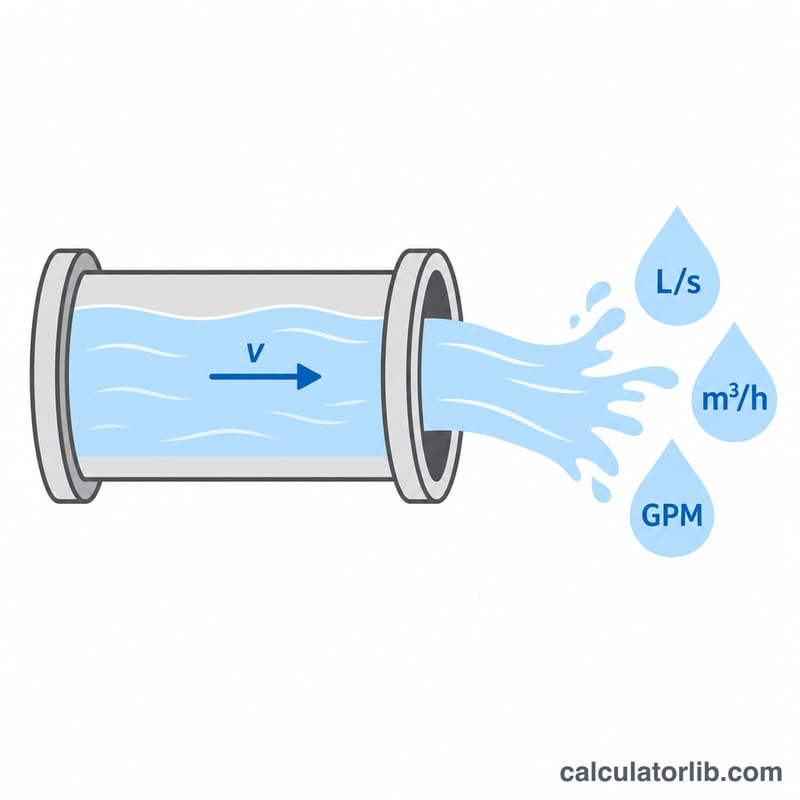
This calculator finds the volumetric flow rate of water (or any incompressible fluid) moving through a round pipe. It uses the continuity relationship between the pipe's cross-sectional area and the average flow velocity. Enter the pipe's inner diameter and the flow velocity, and the tool returns the flow rate in several common units: cubic metres per second, litres per second, litres per minute, cubic metres per hour, and US gallons per minute.
How to Use It
1. Measure the inner diameter of the pipe in millimetres (use the bore, not the outside diameter). 2. Enter the average flow velocity in metres per second. 3. Read the resulting flow rate in your preferred units. This is ideal for sizing pipes, checking pump output, and estimating delivery volumes for irrigation, plumbing, and HVAC systems.
The Formula Explained
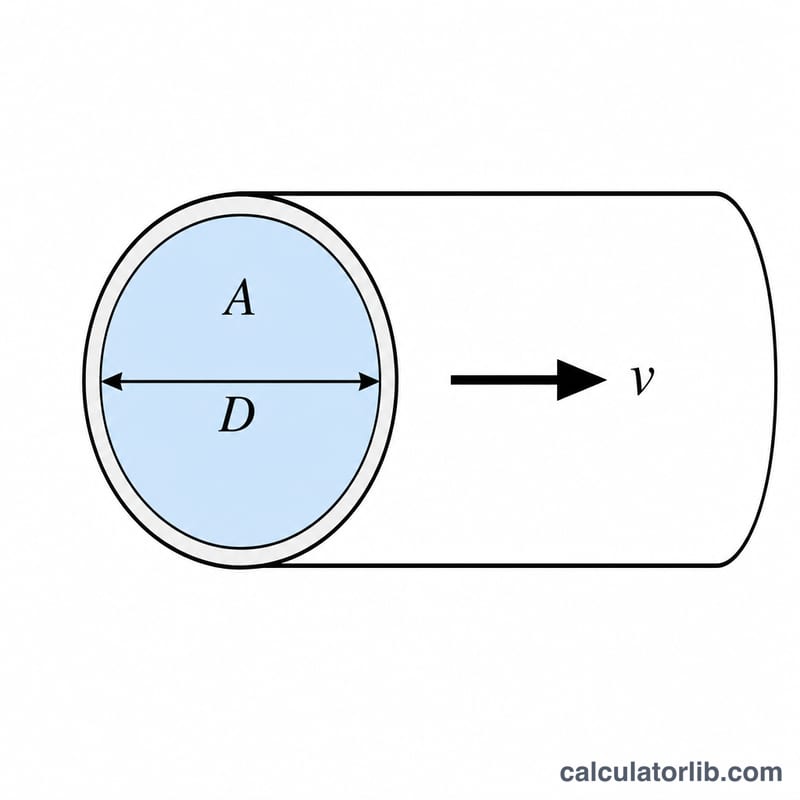
Flow rate \(Q = A \times v\), where A is the pipe's internal cross-sectional area and v is the average velocity. For a circular pipe, \(A = \frac{\pi}{4} \times D^2\). The diameter is converted from millimetres to metres before squaring, so the area comes out in m² and the flow in m³/s. The full relationship is:
$$Q = \frac{\pi}{4} \left(\frac{\text{Diameter (mm)}}{1000}\right)^2 \times \text{Velocity (m/s)}$$Multiplying by unit factors gives the other readouts (\(\times 1000\) for L/s, \(\times 60000\) for L/min, \(\times 3600\) for m³/h, \(\times 15850.3\) for US GPM).
Worked Example
A pipe with a 100 mm inner diameter carries water at 2 m/s. First, \(D = 0.1\) m, so
$$A = \frac{\pi}{4}(0.1)^2 = 0.0078540 \text{ m}^2$$Then
$$Q = 0.0078540 \times 2 = 0.0157080 \text{ m}^3/\text{s}$$which equals 15.708 L/s, about 942.5 L/min, 56.5 m³/h, or roughly 249 US GPM.
FAQ
Should I use inner or outer diameter? Always use the inner (bore) diameter — that is the true flow area.
Does this work for any liquid? Yes. \(Q = A \times v\) applies to any fluid; the geometry doesn't change. Only velocity differs.
What is a typical pipe velocity? For water supply lines, 1–2.5 m/s is common. Higher velocities cause noise, erosion, and large pressure losses.