
What Is the Bucket Fill Time Method?
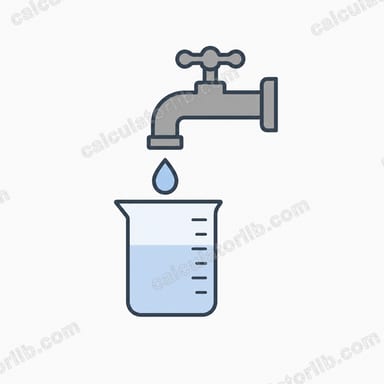
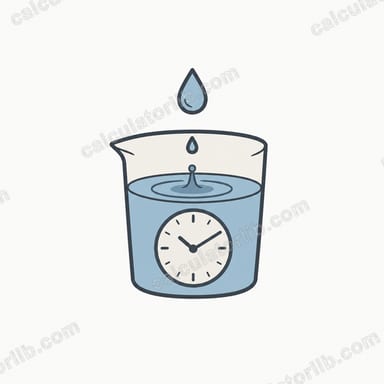
The bucket fill test is the simplest way to measure water flow rate without any meter. You time how long it takes to fill a container of known volume, then convert that to gallons per minute (GPM). It works for faucets, hoses, sump pumps, well pumps, sprinklers, and any open water source.
How to Use This Calculator
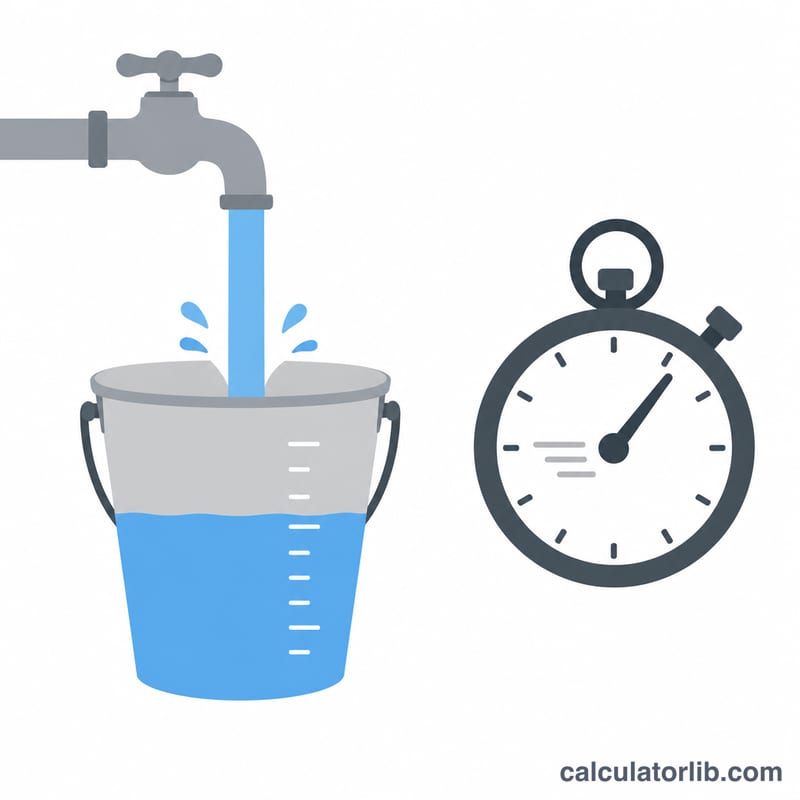
Grab a container with a known volume in gallons (a 5-gallon bucket is the classic choice). Place it under the water source, turn the flow fully on, and start a stopwatch the moment water begins entering the empty bucket. Stop timing when the bucket is full. Enter the container volume and the fill time in seconds, and the calculator returns your flow rate in gallons per minute.
The Formula Explained
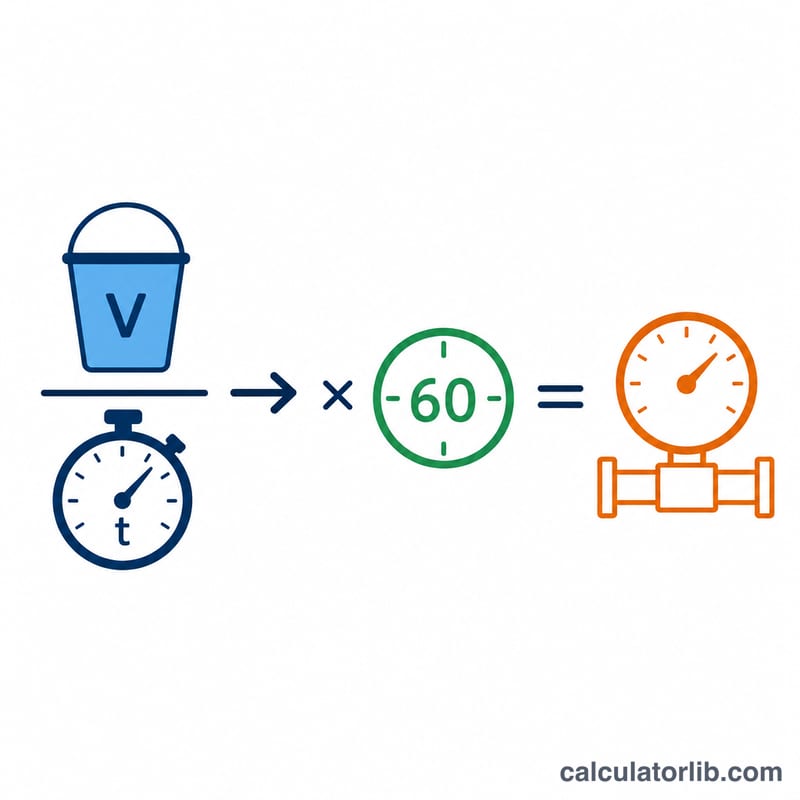
The math is a unit conversion. Volume divided by time gives gallons per second; multiplying by 60 converts to gallons per minute:
$$\text{GPM} = \frac{V_{\text{gallons}}}{t_{\text{seconds}}} \times 60$$
Because there are 60 seconds in a minute, a faster fill (smaller \(t\)) means a higher GPM, and a larger container (bigger \(V\)) at the same time also means more flow.
Worked Example
Suppose a 5-gallon bucket fills in 25 seconds. Then $$\text{GPM} = \frac{5}{25} \times 60 = 0.2 \times 60 = 12 \text{ gallons per minute.}$$ Over an hour that is \(12 \times 60 = 720\) gallons per hour.
FAQ
Why use seconds instead of minutes? Seconds give more precise timing for fast flows. A 5-gallon bucket can fill in well under a minute, so timing in seconds reduces rounding error.
How accurate is the bucket test? It is surprisingly accurate for steady flows. Repeat it 2–3 times and average the results to smooth out reaction-time error on the stopwatch.
Can I use a different container size? Yes. Any known volume works — a 1-gallon jug, a 5-gallon bucket, or a 55-gallon drum. Just enter the true volume in gallons.