
What Is HVAC Tonnage?
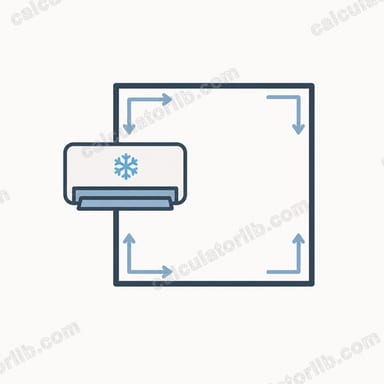
In air conditioning, a "ton" is a unit of cooling capacity, not weight. One ton equals 12,000 BTU (British Thermal Units) of heat removed per hour. This HVAC Tonnage Calculator estimates how large an air conditioner you need to comfortably cool a space based on its floor area and the cooling demand of your climate. It is a quick sizing guide for homeowners comparing units before a professional Manual J load calculation.
How to Use It
Enter the area you want to cool in square feet, then choose a BTU-per-square-foot factor that matches your situation. A factor of about 20 BTU/sq ft suits average rooms in a moderate climate. Increase it toward 25–35 for hot, sunny, or poorly insulated spaces. The calculator returns the recommended size in tons plus the total cooling load in BTU per hour.
The Formula Explained
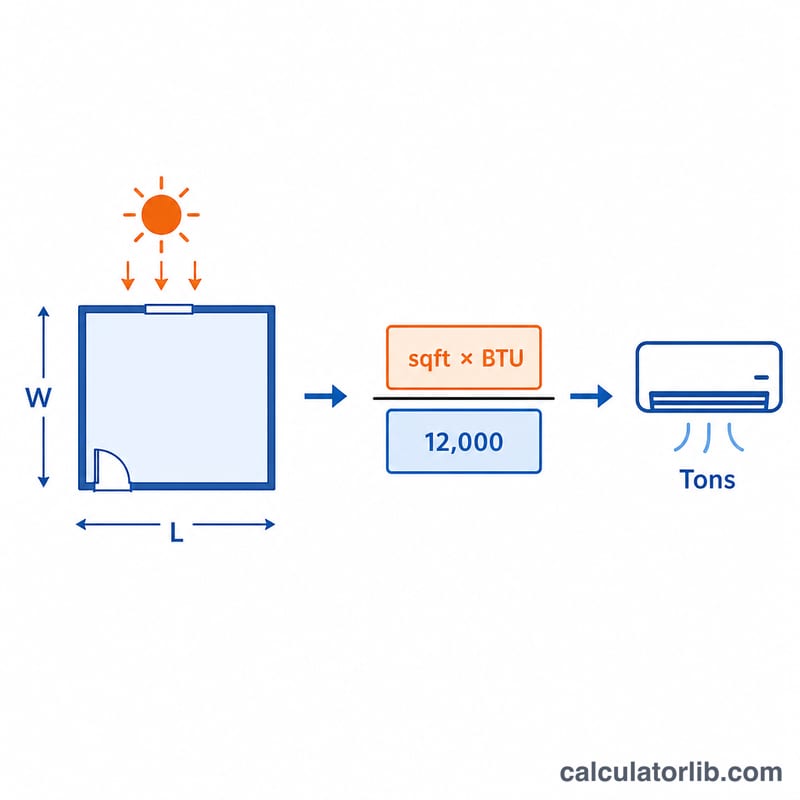
The math is simple: multiply the area by the BTU factor to get the total hourly cooling load, then divide by 12,000 (the BTUs in one ton) to convert to tons.
$$\text{Tons} = \frac{\text{Area} \times \text{BTU factor}}{12{,}000}$$
Worked Example
Suppose you want to cool a 1,500 sq ft home in a warm, sunny region, using a factor of 25 BTU/sq ft. The total load is $$1{,}500 \times 25 = 37{,}500 \text{ BTU/hr}.$$ Dividing by 12,000 gives \(3.13\) tons, so you would look at roughly a 3 to 3.5 ton system.
FAQ
Is bigger always better? No. An oversized AC short-cycles, cools unevenly, and removes less humidity, wasting energy and reducing comfort.
What BTU factor should I pick? Use ~20 for typical insulated homes in mild climates, and 25–35 for hot climates, high ceilings, large windows, or weak insulation.
Does this replace a professional load calculation? No. This is an estimate. For a final decision, get a Manual J load calculation that accounts for insulation, windows, orientation, and air infiltration.