
What is the EV kWh per 100 km Calculator?
This tool measures how much electricity your electric vehicle (EV) uses to travel 100 kilometres. Expressed as kWh/100km, it is the electric equivalent of litres per 100 km for petrol cars: lower numbers mean a more efficient vehicle. It is a universal physics ratio and applies anywhere in the world.
How to use it
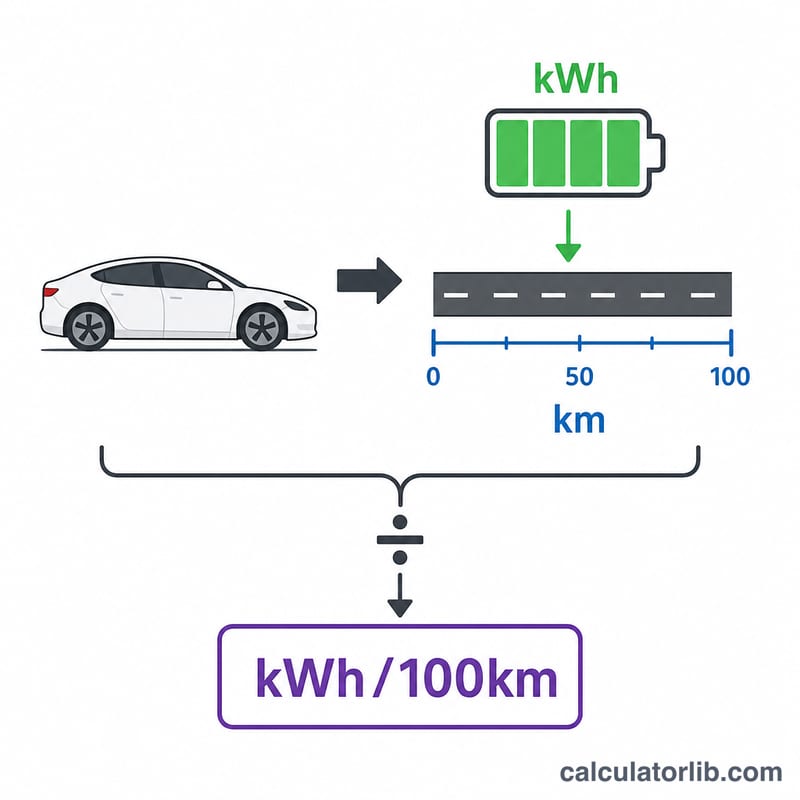
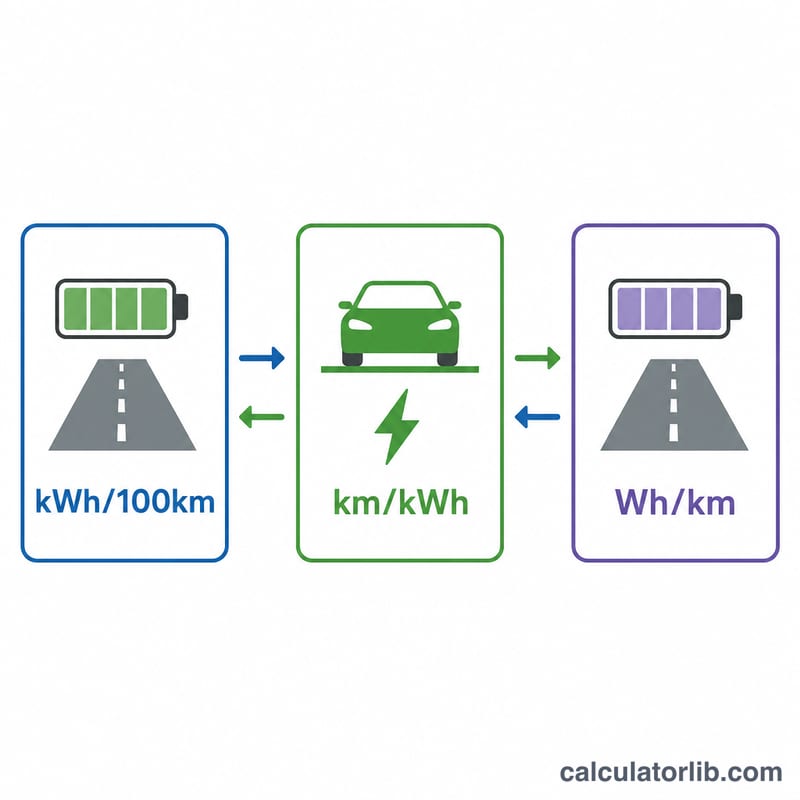
Enter the energy your car consumed (in kilowatt-hours, kWh) over a trip, then enter the distance you drove (in kilometres). The calculator returns your consumption in kWh/100km, along with two helpful extras: efficiency in km/kWh and energy per kilometre in Wh/km.
The formula explained
The core equation is simply:
$$\text{kWh/100km} = \frac{\text{kWh used}}{\text{km driven}} \times 100$$
Dividing energy by distance gives kWh per kilometre; multiplying by 100 scales it to a per-100-km basis so the figure is easy to compare between cars. The inverse, km/kWh, tells you how far you travel on a single kilowatt-hour.
Worked example
Suppose you drove 250 km and your car used 45 kWh. Consumption $$= \left(45 \div 250\right) \times 100 = 18 \text{ kWh/100km}.$$ Efficiency \(= 250 \div 45 = 5.56 \text{ km/kWh}\), and energy per km \(= 180 \text{ Wh/km}\). That is a typical figure for a mid-size EV.
FAQ
What is a good kWh/100km figure? Efficient EVs use roughly 14–18 kWh/100km; larger SUVs and high-speed driving push this to 20–25 kWh/100km.
Does this include charging losses? No. If you base the kWh on energy drawn from the wall, it will include charging losses; if you use the energy reported by the car, it reflects battery-to-wheels consumption only.
How do I convert to miles? Multiply kWh/100km by 1.609 to get kWh/100 miles, or use the km/kWh value and convert distance separately.