What is the Time to Fill Tank Calculator?
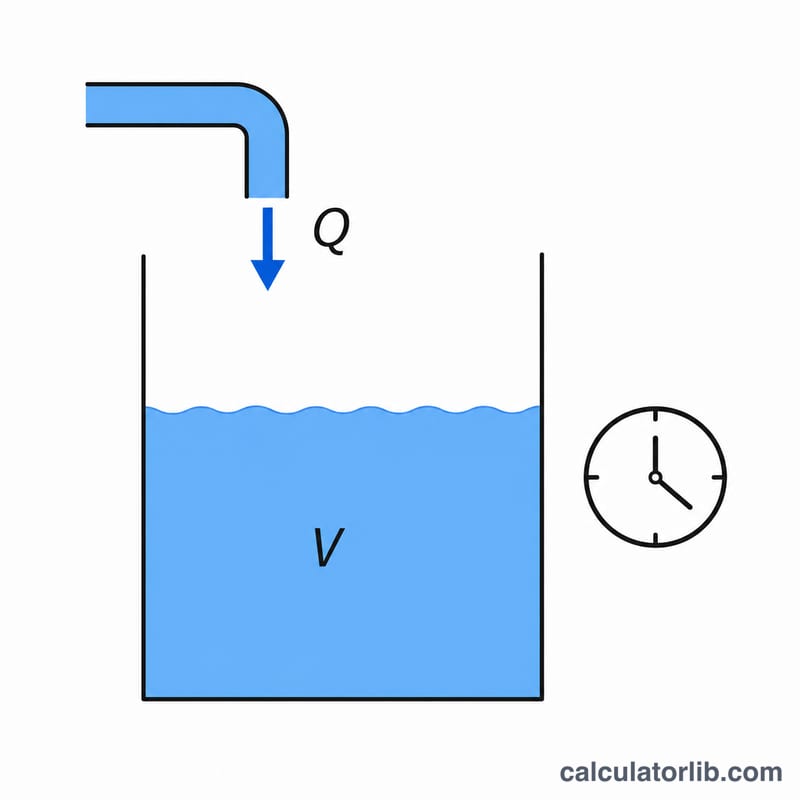
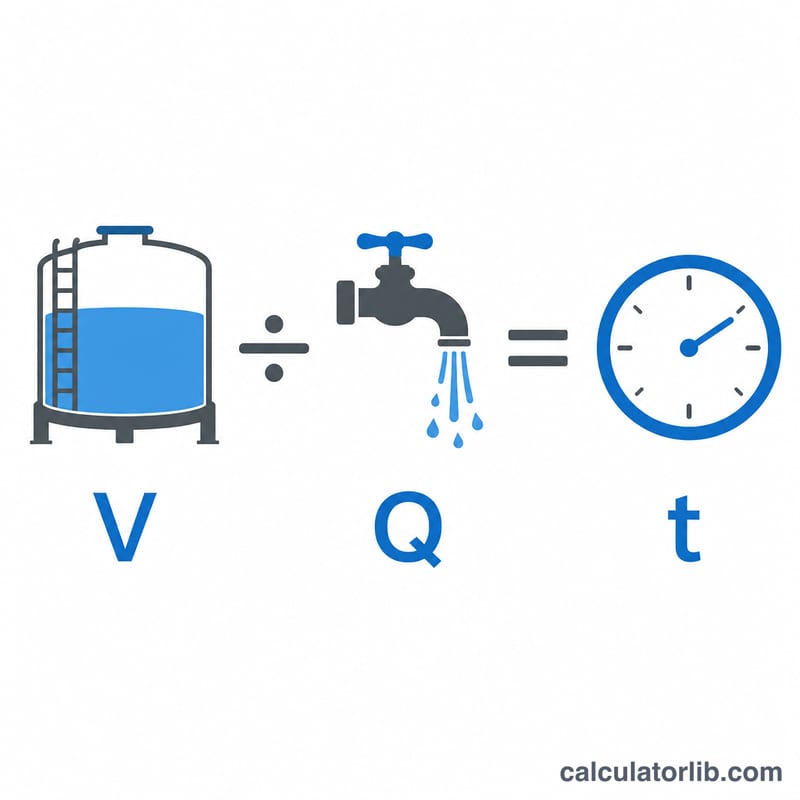
This tool tells you how long it takes to fill a tank, container, or pool given its volume and the rate at which water (or any fluid) flows in. It uses the simple relationship \(t = V / Q\), where V is volume and Q is the volumetric flow rate. The calculator handles common units for both volume (liters, US gallons, cubic meters) and flow (liters per minute, liters per second, gallons per minute, cubic meters per hour), converting everything internally for you.
How to use it
Enter the tank volume and pick its unit, then enter the flow rate and pick its unit. Press calculate. The result is shown in minutes, broken down into hours/minutes/seconds, and also expressed in total seconds and total hours so you can use whichever fits your situation.
The formula explained
Volumetric flow rate Q measures how much volume passes a point per unit time. If a tank holds V units of volume and is filled at Q units per unit time, then the fill time is simply the total volume divided by how fast it arrives:
$$t = \frac{V}{Q} = \frac{\text{Tank Volume}}{\text{Flow Rate}}$$The key is keeping units consistent, which the calculator does by converting volume to liters and flow to liters per minute before dividing.
Worked example
Suppose a 1,000 liter tank is filled at 20 liters per minute. Then
$$t = \frac{1000}{20} = 50 \text{ minutes}$$That is 0 hours, 50 minutes, 0 seconds, or 3,000 seconds total.
Volume and Flow Rate Conversion Factors
The formula \(t = V / Q\) only works when volume and flow rate use compatible units. Convert both to liters and liters per minute first, and the result is in minutes. The gallon factors below are for the US gallon unless the imperial gallon is named.
Volume
| Unit | Equivalent in liters |
|---|---|
| 1 US gallon | 3.78541 L |
| 1 imperial gallon (UK) | 4.54609 L |
| 1 cubic meter (m³) | 1000 L |
| 1 cubic foot (ft³) | 28.3168 L |
Flow rate
| Unit | Equivalent in liters per minute |
|---|---|
| 1 L/min | 1 L/min |
| 1 L/s | 60 L/min |
| 1 US gpm (gallon per minute) | 3.78541 L/min |
| 1 m³/h | 16.667 L/min (1000 ÷ 60) |
Also useful: 1 m³/h ≈ 4.403 US gpm.
Fill Time Comparison for Common Tanks and Flow Rates
Each time is calculated as \(t = V / Q\) with a constant flow rate and no allowance for losses.
| Tank | Volume | Flow rate | Fill time |
|---|---|---|---|
| Rain barrel | 200 L | 15 L/min | 200 ÷ 15 = 13.33 min (about 13 min 20 s) |
| Bathtub | 300 L | 20 L/min | 300 ÷ 20 = 15 min |
| IBC tote | 1,000 L | 50 L/min | 1000 ÷ 50 = 20 min |
| Storage tank | 10,000 L | 100 L/min | 10000 ÷ 100 = 100 min (1 h 40 min) |
| Water heater | 50 US gal | 8 gpm | 50 ÷ 8 = 6.25 min (6 min 15 s) |
| Swimming pool | 20,000 US gal | 10 gpm | 20000 ÷ 10 = 2,000 min (about 33.3 h) |
The same tank fills much faster with a higher flow rate. Doubling \(Q\) halves \(t\).
Practical Tips for Filling a Tank
- Add a safety margin of about 10-20%. Supply pressure often drops and flow can fall as the tank fills, so real fills usually take longer than \(V / Q\).
- Measure the real flow rate. Time how long the supply takes to fill a bucket of known size, such as a 10 L bucket, and divide volume by time. This is more reliable than the rating on a tap or pump.
- Use usable capacity, not nominal volume. Leave headspace of roughly 5-10%, so enter the usable volume into the calculator.
- Account for the supply line. Hose length, inner diameter, fittings, elevation and supply pressure all reduce the flow. Long, narrow hoses deliver noticeably less than short, wide ones.
- Protect against overflow on long fills. Use a float valve, timer-based shutoff or overflow line, and do not leave a long fill unattended.
FAQ
Does this work for draining a tank? Yes, if the drain flow rate is roughly constant, the same formula gives the emptying time.
What if the flow rate varies? This calculator assumes a steady flow. For variable flow, use an average rate or split the fill into stages.
Why convert to liters per minute? Mixing units (e.g. gallons of volume with liters of flow) would give a wrong answer, so the tool standardizes both quantities before computing \(t = V / Q\).