What is water heater recovery time?
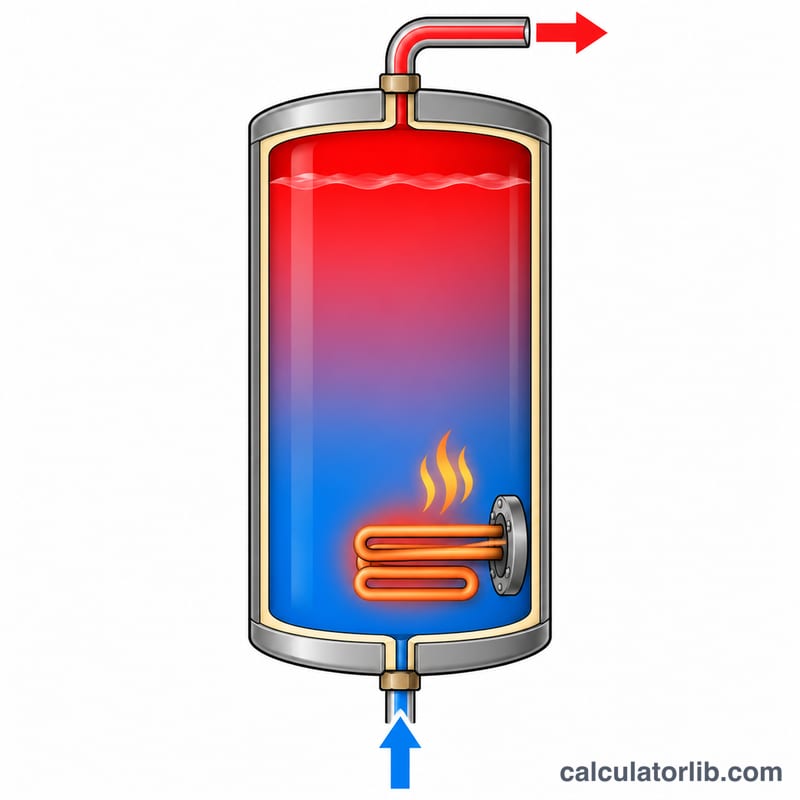
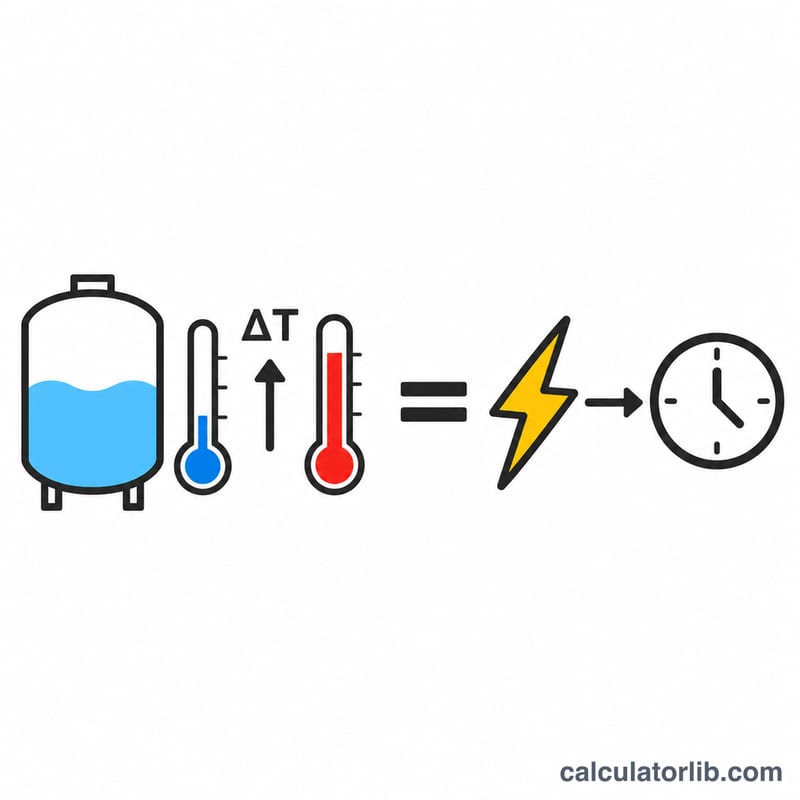
Recovery time is how long a water heater needs to bring a full tank of cold incoming water up to the set temperature. It matters when you size a heater, compare an electric element with a different wattage, or wonder why the shower runs cold after back-to-back use. This calculator uses US units: gallons, degrees Fahrenheit and kilowatts.
How to use the calculator
Enter the tank capacity in gallons, the heating power in kW (for a typical electric tank, the element wattage that runs at once, such as 4.5 kW), the incoming water temperature and your target temperature. Set the efficiency near 100% for electric resistance heaters, or lower for gas units, which often run 60-80%.
The formula explained
One gallon of water weighs about 8.34 lb, and one BTU raises one pound of water by 1 °F. One kilowatt delivers 3,412.14 BTU per hour.
$$t = \frac{V \times 8.34 \times \Delta T}{P \times 3412.14 \times \eta}$$Here \(V\) = tank volume in gallons, \(\Delta T\) = temperature rise in °F, \(P\) = power in kW, \(\eta\) = efficiency as a fraction and \(t\) = time in hours.
Worked example
A 50-gallon tank with a 4.5 kW element, heated from 40 °F to 130 °F (\(\Delta T = 90\)) at 100% efficiency:
$$\text{Heat} = 50 \times 8.34 \times 90 = 37{,}530\,\text{BTU}$$$$t = \frac{37530}{4.5 \times 3412.14} = \frac{37530}{15354.63} \approx 2.44\,\text{h}$$That is roughly 2 hours 27 minutes, or a recovery rate of about 20.5 gallons per hour.
Typical Water Heater Sizes, Power and Temperatures
The ranges below are typical for residential storage-tank water heaters, mostly in North America (US units: gallons, °F, BTU). Your own unit's nameplate or EnergyGuide label is always the best source for exact values.
| Input | Typical range | Notes |
|---|---|---|
| Tank capacity | 30–80 gal | Small homes and apartments often use 30–40 gal. Larger households commonly use 50–80 gal. 40 and 50 gal are very common nominal sizes. |
| Electric element power | 3.0, 3.8, 4.5, 5.5 kW | These are common element ratings. 4.5 kW at 240 V is the most common in US tanks. Many tanks have two elements, and often only one runs at a time, so check the label for the actual heating power. |
| Efficiency (electric resistance) | ≈ 100% | Nearly all electrical input becomes heat in the water. Standby losses through the tank walls are not counted in this figure. |
| Efficiency (gas tank) | ≈ 60–80% | Recovery efficiency is often at the upper end of this range, and overall efficiency including standby loss is lower. Gas input is rated in BTU/h. Divide by 3,412.14 to get kW (for example, 40,000 BTU/h ≈ 11.7 kW). |
| Inlet (cold) water temperature | ≈ 40–70 °F | Colder in winter and in northern climates, warmer in summer and in southern climates. |
| Thermostat setpoint | ≈ 120 °F (common) | 120 °F is the setting often cited by the US Department of Energy (for energy savings) and the US Consumer Product Safety Commission (to reduce scald risk). Some units are set higher by the installer or manufacturer. Check your local guidance and the manufacturer's instructions. |
Electric Element Output at a 65 °F Rise
For orientation, the table shows heat output at 100% efficiency. It also shows the gallons of water heated per hour for a 65 °F rise (for example, 55 °F inlet to 120 °F setpoint), using \(\text{GPH} = \dfrac{ \text{BTU/h}}{8.34 \times \Delta T}\).
| Element power | Heat output (BTU/h) | Approx. gallons per hour |
|---|---|---|
| 3.0 kW | 10,236 | ≈ 18.9 |
| 3.8 kW | 12,966 | ≈ 23.9 |
| 4.5 kW | 15,355 | ≈ 28.3 |
| 5.5 kW | 18,767 | ≈ 34.6 |
For example, a 50 gal tank at 4.5 kW and 100% efficiency needs \(50 \times 8.34 \times 65 = 27{,}105\) BTU. That is about 1.77 hours at 15,355 BTU/h, ignoring standby losses and any draw during heating.
This is general information for estimating purposes, not professional advice. Water heater installation, wiring and thermostat settings should follow the manufacturer's instructions and local codes, and may need a licensed professional.
FAQ
Does standby heat loss change the result?
Slightly. This is an ideal estimate; real tanks lose some heat through the walls, so actual times run a little longer.
Do two elements heat at the same time?
Most residential electric heaters run only one element at a time, so use the power of a single element unless your model states otherwise.
How can I shorten recovery time?
Use higher power, a smaller temperature rise (lower setpoint or warmer inlet water), or a larger or second heater.