What this calculator does
This tool estimates how much screen printing ink a job will use. You enter the print size, how much of that area the artwork actually covers, how many prints you will make, how many colors (screens) are in the design, a waste allowance, and the spread rate of your ink. It returns the total in US gallons, quarts, fluid ounces and liters so you can order the right amount.
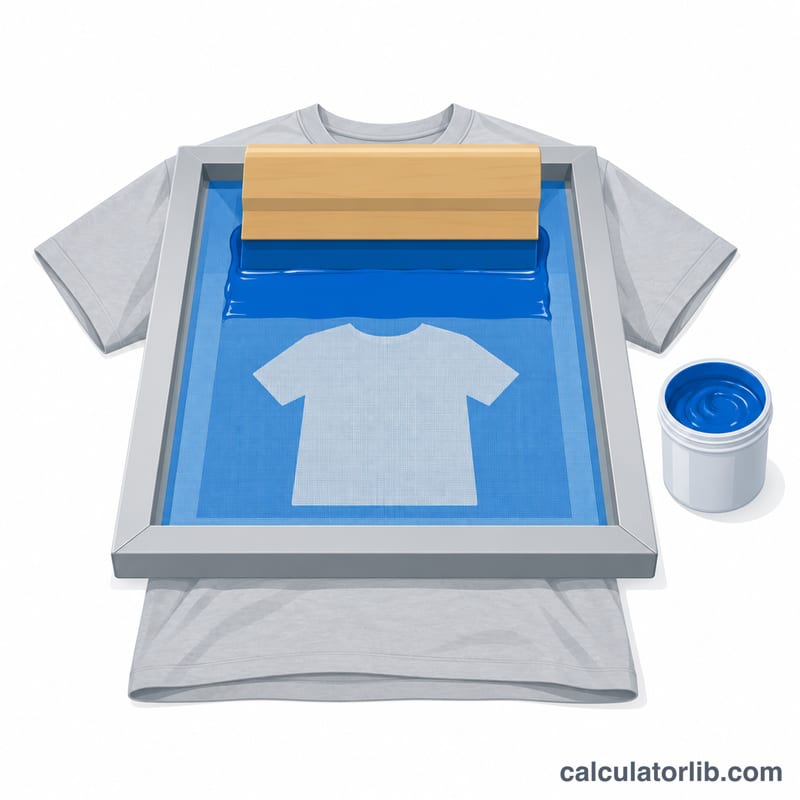
How to use it
Measure the image width and height in inches, not the shirt or screen size. Enter the percentage of that rectangle the ink really fills; a solid block is 100%, a small logo inside a large box may be 30 to 50%. Enter the number of screens, since each color needs its own ink. Add 10 to 20% for flooding, test prints, cleanup and spoilage. The spread rate is how many square feet one gallon covers with your mesh and ink type, so use the figure from your supplier data sheet and adjust it from your own press results.
The formula explained
Each print covers \(W \times H \times c\) square inches, where \(c\) is artwork coverage as a fraction. Multiply by the quantity \(N\) and number of screens \(S\), divide by 144 to get square feet, add waste \(w\), and divide by the spread rate \(R\) in square feet per gallon.
$$V = \frac{W \times H \times c \times N \times S \times (1 + w)}{144 \times R}$$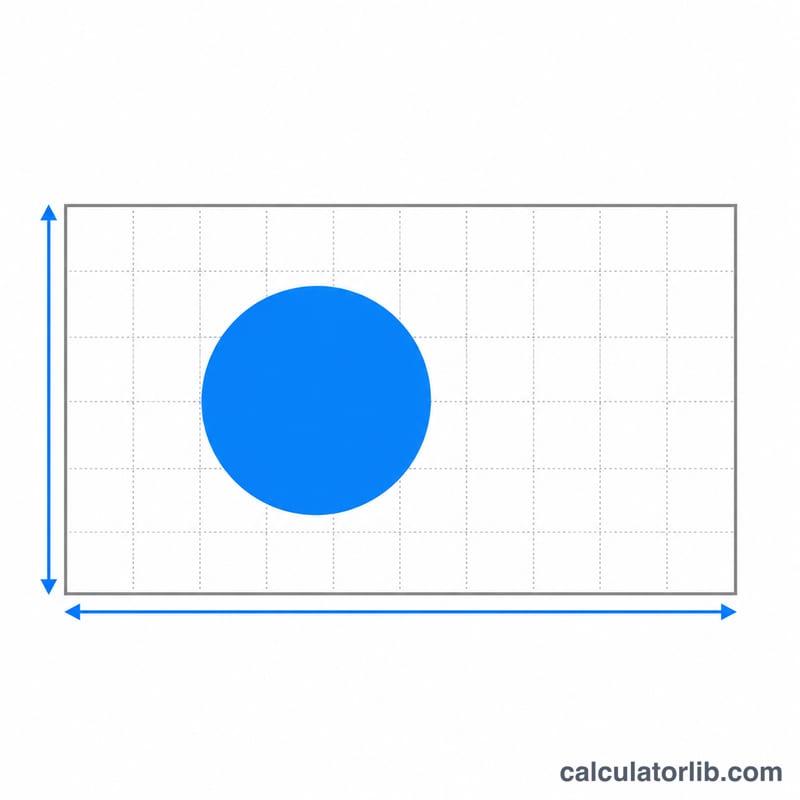
Worked example
A 10 by 12 inch full-coverage print, 100 pieces, one color, 10% waste and a spread rate of 1,000 sq ft per gallon:
$$V = \frac{10 \times 12 \times 1 \times 100 \times 1 \times 1.10}{144 \times 1000} = 0.0917\,\text{gal}$$That is about 0.367 quarts, or 11.7 fluid ounces.
Typical Ink Spread Rates and Waste Allowances
Spread rate is the area one US gallon of ink covers at a normal deposit, in sq ft per gallon. The figures below are rough, general industry ballparks only. Real values vary with supplier, ink formulation, mesh count and thread diameter, emulsion thickness, squeegee durometer and pressure, off-contact, substrate and press setup. Always confirm with the ink's technical data sheet, and ideally run a test print and weigh the ink used.
| Ink type | Lower mesh (about 110-160) | Medium mesh (about 180-230) | Fine mesh (about 250-305) |
|---|---|---|---|
| Plastisol (standard) | ~900-1,500 sq ft/gal | ~1,500-2,200 sq ft/gal | ~2,200-3,000 sq ft/gal |
| Water-based | ~1,200-2,000 sq ft/gal | ~2,000-3,000 sq ft/gal | ~3,000+ sq ft/gal |
| Discharge | ~1,200-2,000 sq ft/gal | ~2,000-2,800 sq ft/gal | rarely used |
| Specialty / underbase (high-opacity white, puff, metallic) | ~600-1,200 sq ft/gal | ~1,000-1,600 sq ft/gal | ~1,500-2,200 sq ft/gal |
Lower mesh counts lay down a thicker deposit, so the ink covers less area per gallon. Higher mesh counts deposit less ink and stretch further.
Typical waste allowance
- Long, simple runs (1-2 colors, 500+ prints): about 10%.
- Typical multi-color jobs: about 12-15% (setup, registration prints, flood strokes, screen cleanup).
- Short runs, many colors, or underbase and specialty inks: about 15-20% or more, because setup losses are a larger share of the total.
Ink left on screens, in squeegee trays and in mixing containers counts as waste. Reclaimed or reused ink can lower the real figure.
Ink Use Across Common Print Scenarios
Each row uses the calculator formula: area in sq ft = width × height ÷ 144 × coverage ÷ 100 × prints × screens × (1 + waste ÷ 100), then gallons = area ÷ spread rate. The spread rates are illustrative assumptions, not measured values.
| Scenario | Print size (in) | Coverage | Screens | Prints | Waste | Spread (sq ft/gal) | Ink area incl. waste (sq ft) | Gallons | Fluid oz | Liters |
|---|---|---|---|---|---|---|---|---|---|---|
| Small left-chest logo | 4 × 4 | 50% | 1 | 500 | 10% | 1,500 | 30.56 | 0.0204 | 2.6 | 0.077 |
| Full-front 4-color design | 12 × 14 | 60% | 4 | 200 | 15% | 1,500 | 644.0 | 0.429 | 55.0 | 1.63 |
| Large solid back print with underbase (2 screens) | 14 × 16 | 85% | 2 | 100 | 20% | 1,000 | 317.3 | 0.317 | 40.6 | 1.20 |
| Event tee, 1 color, long run | 10 × 12 | 40% | 1 | 1,000 | 10% | 1,800 | 366.7 | 0.204 | 26.1 | 0.77 |
Example substitution (large back print)
$$A = \frac{14 \times 16}{144} \times \frac{85}{100} \times 100 \times 2 \times \left(1 + \frac{20}{100}\right) \approx 317.3 \text{ sq ft}$$
$$G = \frac{317.3}{1000} \approx 0.317 \text{ gal} \approx 0.317 \times 128 \approx 40.6 \text{ fl oz}$$
Notice how the 4-color job needs far more ink than the small logo even with fewer prints. Area, color count and spread rate drive the total. Treat results as planning estimates and round up when ordering.
Ink Volume Conversion Table
| Unit | Equivalent |
|---|---|
| 1 US gallon | 4 quarts = 128 US fl oz = 3.785 L |
| 1 US quart | 32 US fl oz = 0.946 L |
| 1 US fl oz | 29.57 mL |
| 1 liter | 33.81 US fl oz = 0.264 US gal |
| 1 sq ft | 144 sq in |
| 1 sq ft per US gallon | ≈ 0.0245 m² per liter |
| 1 m² per liter | ≈ 40.7 sq ft per US gallon |
| 1,000 sq ft per US gallon | ≈ 24.5 m² per liter |
These are US customary units (US gallon and US fluid ounce). The UK imperial gallon (4.546 L) is a different size, so check which one a supplier's data sheet uses. Inks are often sold by weight (pounds or kilograms), so check the product's density if you need to convert volume to weight.
FAQ
What spread rate should I use?
It depends on mesh count, emulsion thickness, ink type and squeegee pressure. Start with your supplier figure, then print a small run, weigh the ink used and update the rate.
Do I multiply by colors?
Yes. Each color is a separate screen and uses its own ink, so enter the number of screens. For an underbase plus colors, count the underbase as a screen.
Is the result exact?
No. It is a planning estimate. Real consumption varies with the press operator, fabric absorbency and ink waste, so keep a small reserve.