What is welding preheat?
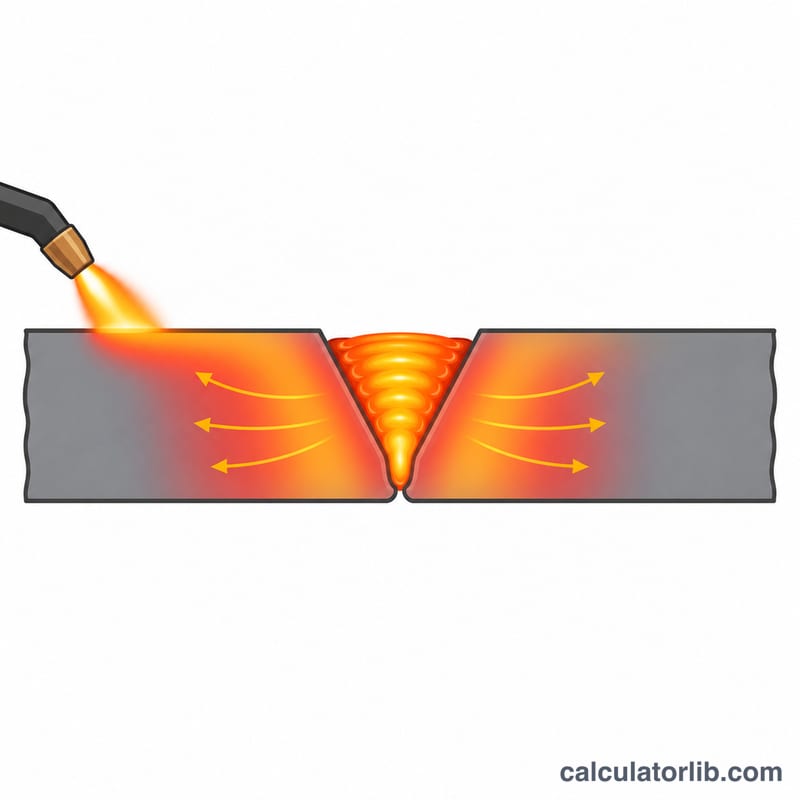
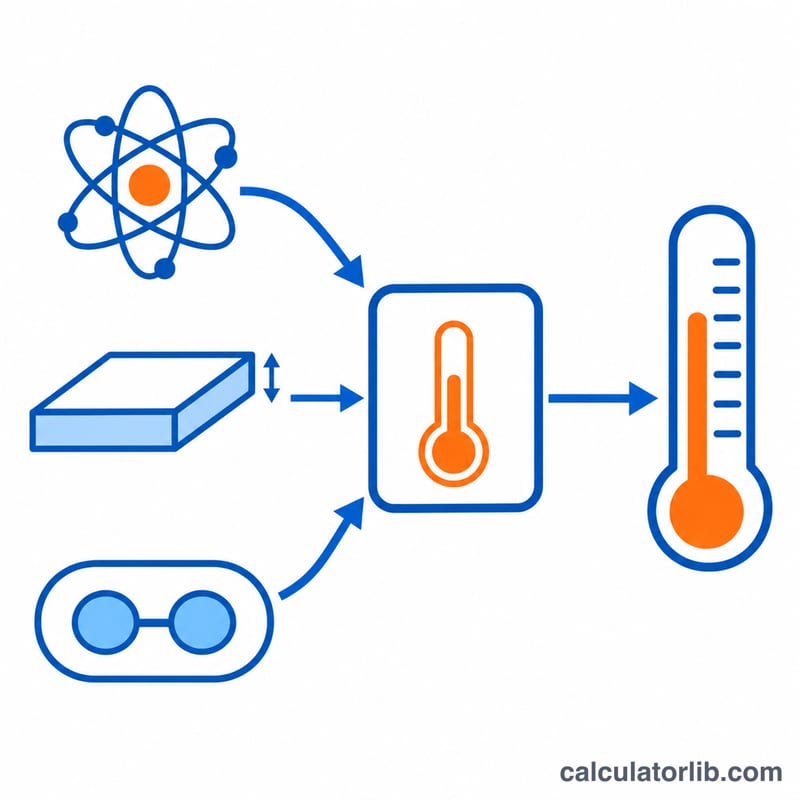
Preheating means warming the base metal before welding. In carbon and low-alloy steels it slows the cooling rate of the heat-affected zone, avoids hard martensite and lets hydrogen escape, which is the main defence against hydrogen-induced cold cracking. This calculator gives an engineering estimate of the minimum preheat temperature from three inputs: the IIW carbon equivalent, the combined plate thickness, and the diffusible hydrogen level of the weld metal. It is a general guide and not a substitute for your welding procedure specification, code requirements (AWS D1.1, EN 1011-2) or a procedure qualification.
How to use it
Enter the carbon equivalent from the mill certificate (IIW: C + Mn/6 + (Cr+Mo+V)/5 + (Ni+Cu)/15), the combined thickness at the joint in mm, and the diffusible hydrogen of your consumable in ml/100 g (about 5 for low-hydrogen electrodes, 10 or more for cellulosic types). The result is the minimum preheat and interpass temperature in °C and °F.
The formula explained
Thickness raises the effective carbon equivalent because thicker plate cools faster:
$$CE_T = CE_{IIW}\,(1 + 0.005\,t)$$
The base preheat follows a square-root law, and a hydrogen correction is added:
$$T_p = 350\sqrt{CE_T - 0.25} + 62\,H^{0.35} - 100$$
Here \(t\) is thickness in mm and \(H\) is diffusible hydrogen in ml/100 g. If \(CE_T \le 0.25\) the base term is zero, and the result is never negative.
Worked example
A steel with \(CE_{IIW} = 0.45\), 25 mm thick, welded with 5 ml/100 g hydrogen:
$$CE_T = 0.45 \times (1 + 0.005 \times 25) = 0.50625$$
$$T_p = 350\sqrt{0.25625} + 62 \times 5^{0.35} - 100 \approx 177.2 + 8.9 = 186.1\,{}^{\circ}\text{C}$$
That is about 366.9 °F.
Typical Hydrogen Levels and Carbon Equivalent Ranges
Diffusible hydrogen classes
Diffusible hydrogen in deposited weld metal (HD) is measured per EN ISO 3690 and expressed in ml per 100 g of weld metal. EN 1011-2 groups it into levels, summarized here in three broad classes. Use the actual value for your consumable and storage condition as the calculator's hydrogen input.
| Class | HD (ml/100 g) | Typical consumables (indicative) |
|---|---|---|
| Low hydrogen | ≤ 5 | Properly dried basic (low-hydrogen) SMAW electrodes, solid-wire GMAW, and some SAW fluxes and flux-cored wires |
| Medium hydrogen | 5 – 10 | Many SAW flux/wire combinations, some flux-cored and metal-cored wires |
| High hydrogen | 10 – 15 (and above) | Rutile SMAW electrodes (often above 15 in practice); cellulosic electrodes, which are typically well above 15 |
These are typical ranges only. Actual levels depend on the manufacturer's data, flux or electrode drying and storage, shielding gas dew point and surface contamination. Use the manufacturer's certified HD figure when available.
IIW carbon equivalent
The IIW formula is \(CE = C + \frac{Mn}{6} + \frac{Cr+Mo+V}{5} + \frac{Ni+Cu}{15}\), with elements in weight percent. EN 1011-2 uses this form, which it calls CEV.
| Steel (EN 10025-2 non-alloy structural) | Maximum CEV, up to 30 mm thickness |
|---|---|
| S235JR | 0.35 |
| S275JR | 0.40 |
| S355J2 | 0.45 |
Actual mill values are often lower than these maxima, so check the mill certificate.
General weldability guidance
- CE below about 0.35: usually easy to weld, and preheat is often unnecessary for thin sections with low-hydrogen processes.
- CE about 0.35–0.45: preheat depends on thickness, hydrogen and restraint.
- CE above about 0.45: preheat is commonly needed, and hydrogen control becomes important.
These are rules of thumb from IIW and EN 1011-2 practice. The CE-based approach is generally intended for C-Mn and low-alloy steels, not for all steel types such as high-alloy or very low-carbon steels.
Interpreting Your Preheat Result
The result is a minimum preheat temperature, which also acts as the minimum interpass temperature during welding. It applies to the joint area, not to the whole plate. Codes specify where to measure it. AWS D1.1 (US), for example, requires the minimum temperature within 75 mm (3 in) of the weld, and at least a distance equal to the thickest part joined. EN 1011-2 (Europe) also uses a zone of about 75 mm on each side of the weld. Check the temperature on the surface, ideally on the side opposite the heat source, using contact thermometers or temperature-indicating crayons.
A zero result
The calculator returns 0 °C when the sum is not positive. This happens when \(CE_T\) is at or below 0.25, so the first term is zero, and the hydrogen term is negative. The hydrogen term is negative for \(H\) below about 3.9 ml/100 g. A zero result means the formula does not predict a cold-cracking need for preheat. It does not mean the steel can be welded cold. Minimum ambient or material temperature limits, moisture and code minimums can still apply.
Maximum interpass temperature
Too much heat can also harm the joint. Interpass temperatures for carbon-manganese structural steels are often limited to roughly 200–250 °C. Quenched and tempered or thermomechanically rolled steels are often limited to lower values set by the steel producer. The specified maximum comes from the WPS and the material specification, not from this calculator.
What changes the real requirement
- Restraint: stiff or highly restrained joints raise residual stress and generally need higher preheat than the formula suggests.
- Heat input: low heat input (small stringer beads) cools quickly and increases the need for preheat, while higher heat input slows cooling.
- Ambient temperature: cold, damp or windy conditions remove heat faster, and moisture adds hydrogen.
- Joint geometry and thickness: combined thickness and the number of heat-flow paths affect cooling rate.
- Hydrogen control: consumable drying, storage and clean surfaces directly affect the hydrogen input.
This estimate is a screening tool built on an empirical formula. The governing requirements are the preheat tables or methods in the applicable code (for example AWS D1.1 or EN 1011-2) and the qualified welding procedure specification (WPS) for the job.
FAQ
Does this replace code tables? No. Use it for screening and always confirm against the governing code or a qualified procedure.
What else affects preheat? Joint restraint, heat input, ambient temperature and moisture also matter. Higher restraint or lower heat input calls for more preheat.
Why does low hydrogen reduce preheat? Less hydrogen in the weld means less to diffuse into the heat-affected zone, so a lower temperature is enough to prevent cracking.