What Is Welding Heat Input?
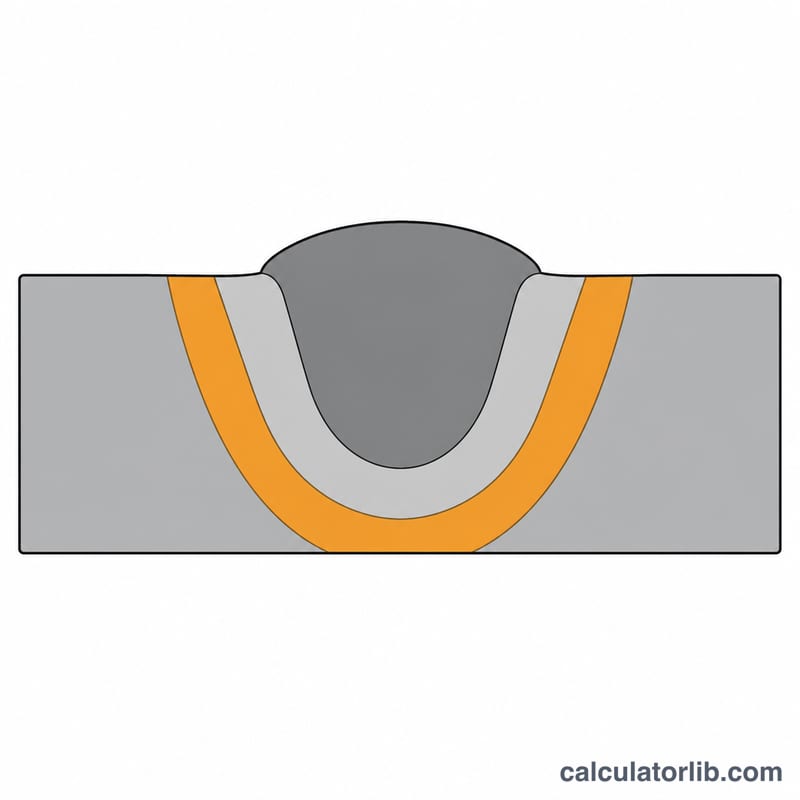
Heat input is the amount of thermal energy delivered to the joint per unit length of weld, usually expressed in kilojoules per millimetre (kJ/mm). It is one of the most important variables in arc welding because it governs cooling rate, the size of the heat affected zone (HAZ), grain growth, hardness and residual distortion. Welding procedure specifications (WPS) and codes such as AWS and ISO frequently set minimum and maximum heat input limits to guarantee mechanical properties.
The Formula
Heat input combines the electrical arc power with the speed at which the torch travels, then scales by an arc (thermal) efficiency factor \(\eta\):
$$\text{HI} = \frac{\eta \times V \times I \times 60}{S \times 1000}$$Here \(V\) = arc voltage in volts, \(I\) = welding current in amps, \(S\) = travel speed in mm/min, and \(\eta\) is a dimensionless efficiency (about 0.8 for MIG/MAG and SMAW, 0.6 for TIG, and near 1.0 for submerged arc). The factor 60 converts per-minute speed to seconds and the 1000 converts joules to kilojoules.
How to Use the Calculator
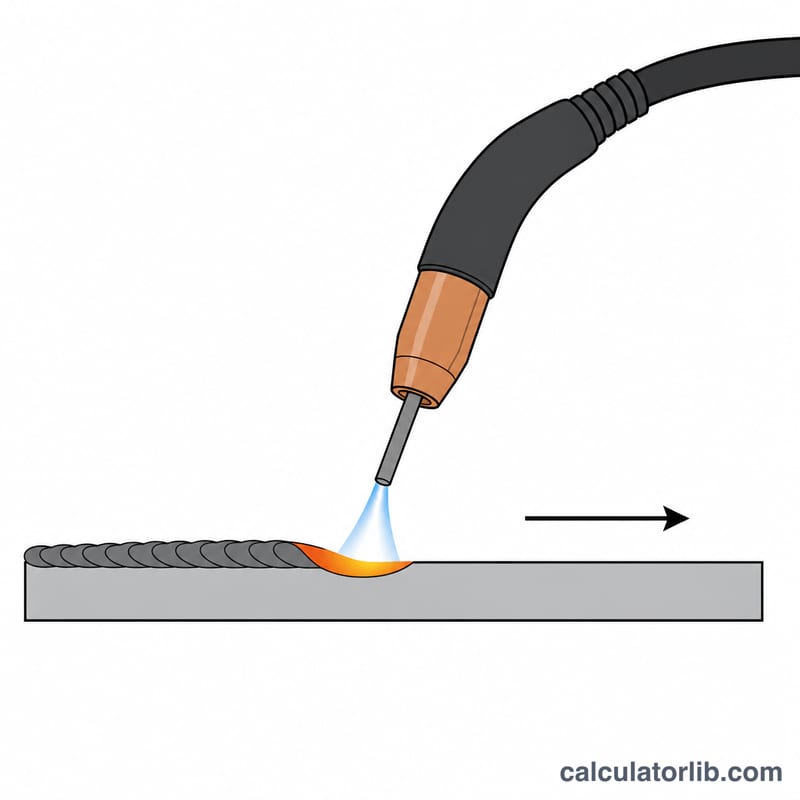
Enter the measured arc voltage, welding current and travel speed, then choose an efficiency between 0 and 1 for your process. The tool returns the net heat input, the raw arc power \(P = V \times I\), and the gross heat input at 100% efficiency so you can compare against code limits.
Worked Example
Suppose \(V = 25\) V, \(I = 200\) A, \(S = 300\) mm/min and \(\eta = 0.8\). The gross value is:
$$\frac{25 \times 200 \times 60}{300 \times 1000} = \frac{300000}{300000} = 1.0\,\text{kJ/mm}$$Applying efficiency: \(\text{HI} = 0.8 \times 1.0 = 0.8\,\text{kJ/mm}\), with an arc power of \(25 \times 200 = 5000\,\text{W}\).
Arc Efficiency Factors by Welding Process
The arc (thermal) efficiency \(\eta\) is the fraction of the electrical arc energy that actually enters the workpiece as heat. It is a required multiplier in the heat-input formula \(\text{HI} = \dfrac{V \times I \times 60}{v \times 1000} \times \eta\). The values below follow the transfer-efficiency convention used in EN 1011-1 (and the equivalent AWS/ISO guidance), which is an international standard rather than a single national one. Always use the \(\eta\) value your applicable code or WPS specifies, as conventions can differ.
| Welding process | Typical range of \(\eta\) | Recommended value |
|---|---|---|
| SMAW / MMA (manual metal arc, stick) | 0.75 – 0.85 | 0.8 |
| MIG/MAG — GMAW (gas metal arc) | 0.75 – 0.85 | 0.8 |
| FCAW (flux-cored arc) | 0.75 – 0.85 | 0.8 |
| TIG / GTAW (gas tungsten arc) | 0.55 – 0.65 | 0.6 |
| SAW (submerged arc) | 0.90 – 1.00 | 1.0 |
| Plasma arc (PAW) | 0.55 – 0.65 | 0.6 |
Note that TIG and plasma have the lowest efficiencies because a larger share of the arc energy is lost to the surroundings and the electrode, whereas submerged arc is highest because the flux blanket confines the heat. Under EN 1011-1, SAW is commonly taken as \(\eta = 1.0\).
Travel Speed Unit Conversions
The heat-input formula in this tool expects travel speed in mm/min. If your welding parameters are recorded in other units, convert them first. The base relationships are: \(1\ \text{cm/min} = 10\ \text{mm/min}\), \(1\ \text{in/min} = 25.4\ \text{mm/min}\), and \(1\ \text{mm/s} = 60\ \text{mm/min}\).
| From | Multiply by | Result (mm/min) |
|---|---|---|
| 1 cm/min | 10 | 10 mm/min |
| 1 in/min | 25.4 | 25.4 mm/min |
| 1 mm/s | 60 | 60 mm/min |
| 12 in/min | 25.4 | 304.8 mm/min |
| 5 mm/s | 60 | 300 mm/min |
| 25 cm/min | 10 | 250 mm/min |
The heat-input result can likewise be reported in different length units. Because \(1\ \text{in} = 25.4\ \text{mm}\), the output conversion is:
$$1\ \text{kJ/mm} = 25.4\ \text{kJ/in}$$
So a heat input of \(1.5\ \text{kJ/mm}\) equals \(1.5 \times 25.4 = 38.1\ \text{kJ/in}\). Convert your inputs to mm/min before calculating, then convert the answer only if your code or WPS reports heat input per inch.
Typical Heat Input Ranges by Process
The bands below are indicative ranges commonly seen in practice for each process and application. They are not limits in themselves — the binding minimum and maximum heat input for any joint is set by the applicable Welding Procedure Specification (WPS) and code, and it varies with the base material, thickness and required properties.
| Process / application | Typical heat input (kJ/mm) |
|---|---|
| TIG / GTAW — thin section | 0.2 – 0.8 |
| MIG/MAG — GMAW | 0.5 – 2.5 |
| SMAW / MMA (stick) | 1 – 3 |
| SAW (submerged arc) | 2 – 5 |
Worked example. For a MIG/MAG weld run at \(25\ \text{V}\), \(200\ \text{A}\), a travel speed of \(300\ \text{mm/min}\) and an efficiency of \(0.8\):
$$\text{HI} = \frac{25 \times 200 \times 60}{300 \times 1000} \times 0.8 = \frac{300000}{300000} \times 0.8 = 0.8\ \text{kJ/mm}$$
This gives a heat input of 0.8 kJ/mm, which sits within the typical MIG/MAG band above.
Codes such as AWS D1.1 (US structural steel), ISO 15614 and EN 1011 govern how heat input is qualified and limited. Higher heat input generally widens the heat-affected zone (HAZ) and increases distortion, while very low heat input can cause hardening and cracking risk in some steels. Treat these ranges as a starting reference only, and always defer to the applicable WPS and code for your material and thickness.
FAQ
Does higher heat input improve welds? Not always. Too much heat coarsens grains, softens the HAZ and increases distortion; too little causes fast cooling, cracking and lack of fusion.
Should I include efficiency? Codes often use the arc energy (100% efficiency); use efficiency only when your specification asks for true heat input.
What units does this use? Volts, amps and mm/min inputs give kJ/mm output. Convert speed to mm/min first if it is given in cm/min or in/min.