What this calculator does
The Granite Area to Linear Meter Calculator turns a slab area measured in square meters into a length in linear meters for a strip of fixed width. Stone shops, fabricators, and installers often price or cut granite as continuous strips (for example countertops, backsplashes, or stair treads), so knowing how many running meters a given area yields is essential for quoting jobs and ordering material.
The formula explained
Linear meters equal the area divided by the strip width, with the width first converted from centimeters to meters. The core relationship is:
$$\text{L} = \frac{A}{w/100}$$
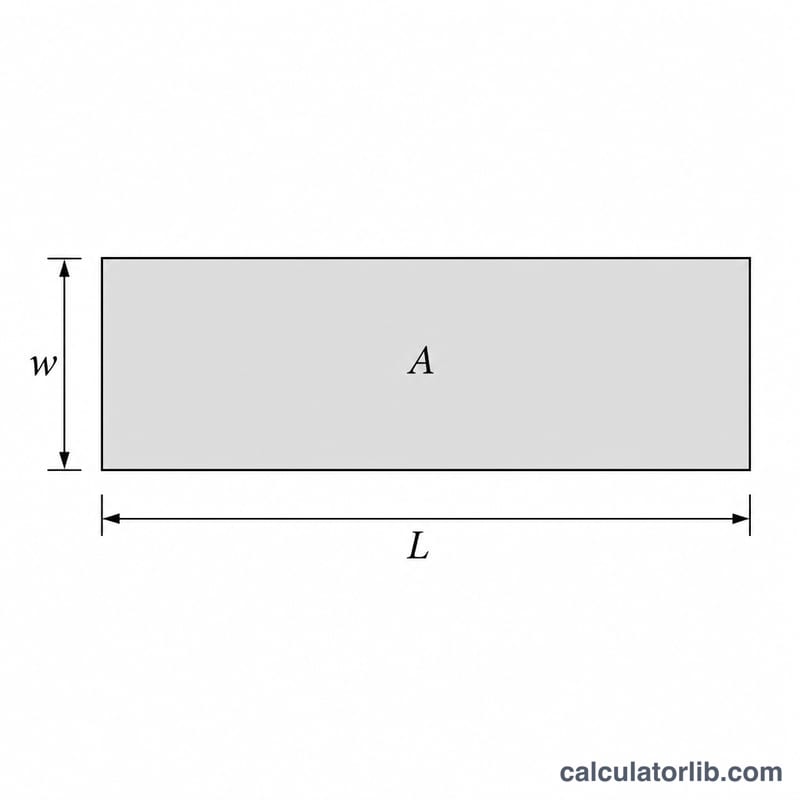
where \(A\) = slab area in square meters (m²), \(w\) = strip width in centimeters (cm), and \(L\) = resulting length in linear meters (lm). Because \(w/100\) converts the width into meters, an equivalent shortcut is \( L = \frac{100 \times A}{w} \).
How to use it
Enter the total slab area in square meters and the width of the strip you plan to cut in centimeters. The calculator returns the linear meters that area provides at that width. A wider strip yields fewer linear meters from the same area, while a narrower strip yields more.
Worked example
Suppose you have \(A = 3\ \text{m}^2\) of granite and you cut strips \(w = 15\ \text{cm}\) wide. Convert the width to meters, \(15/100 = 0.15\ \text{m}\), then divide:
$$L = \frac{3}{0.15} = 20\ \text{linear meters}$$
So a 3 m² slab produces 20 running meters of 15 cm strip.
Practical Recommendations
The linear-meter figure this calculator produces is a theoretical yield that assumes zero material loss. In real fabrication, plan around these steps before ordering:
- Add a waste allowance. Saw kerf (the width removed by each cut), chipping and offcuts consume material. Add roughly 5–10% to your linear-meter result — use the higher end for intricate layouts or many short pieces. For a 15 m theoretical result, a 10% allowance means planning for about 16.5 m.
- Round up to a purchasable length. Granite is sold and cut in whole, practical lengths, so round the final figure up rather than down. A calculated 7.5 m almost always means ordering 8 m of usable strip.
- Account for slab-length constraints and seams. A single slab has a maximum length, so a long linear run may need to be split across pieces. Plan seam locations in advance — ideally at less visible or lower-stress points — and add a small extra allowance for the material lost at each seam.
- Verify the fabricator's usable width. Confirm that the strip width you entered is actually achievable from the slabs on hand, after edge trimming and squaring. Usable width is often a little less than the nominal slab width, which changes your yield.
Order the rounded-up, waste-adjusted quantity rather than the raw calculator output, and confirm the final cut list with your fabricator before purchase.
FAQ
Does this account for cutting waste? No. It gives the theoretical yield. Add a waste allowance (often 5–10%) for saw kerf and offcuts.
Can I use a different width unit? The strip width is entered in centimeters; the tool converts it to meters internally, so enter 15 for 15 cm.
What if the width is in meters already? Multiply by 100 before entering, or simply enter the value in centimeters (e.g. 0.6 m = 60 cm).