What this calculator does
Buying a home or evaluating a development site means looking past the advertised size to the real usable space. This tool converts zoning ratios into the actual usable floor area each unit receives. You enter the total land area (in ping), the building coverage ratio, the floor area ratio, the shared common-area ratio, and the number of units, and it returns the net usable area per unit along with the total buildable area and an estimate of the number of floors.
The formula explained
The gross buildable floor area equals the land area multiplied by the floor area ratio. Subtracting the common-area share and dividing by the number of units gives each unit its net usable area:
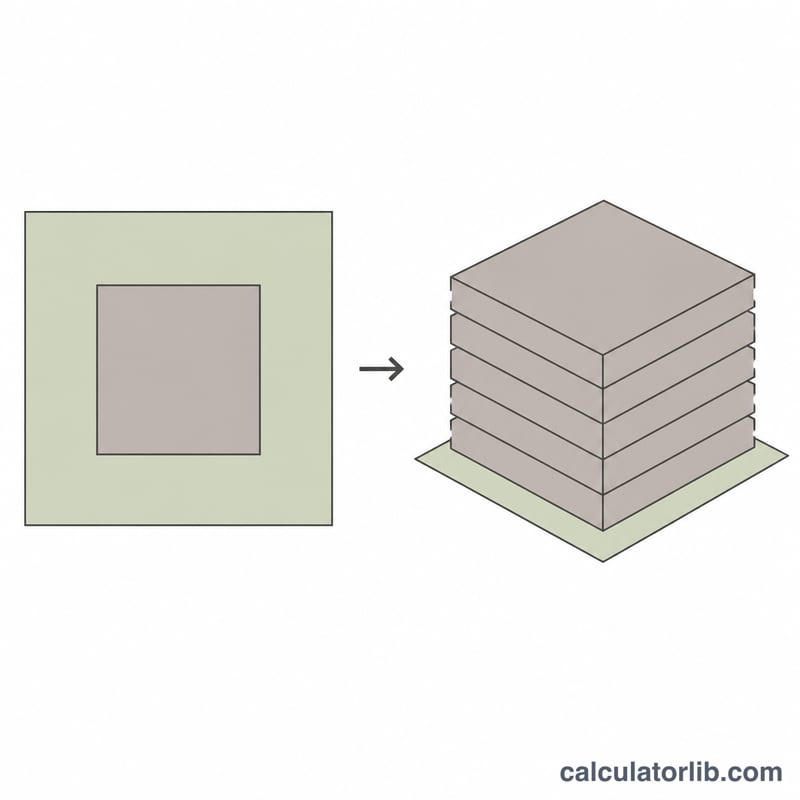
$$U = \frac{A \times \frac{R_f}{100} \times \left(1 - \frac{P}{100}\right)}{N}$$Here \(A\) = total land area in ping, \(R_f\) = floor area ratio (%), \(P\) = shared common-area ratio (%), and \(N\) = number of units. The building coverage ratio \(R_c\) sets the footprint per floor, \(A \times \tfrac{R_c}{100}\), and the floor count is approximated by \(F = \tfrac{R_f}{R_c}\).
How to use it
Enter the site data from a land-use certificate or sales brochure. The coverage ratio and floor area ratio come from the zoning district; the common-area ratio (public-facility ratio) is disclosed by the developer, often between 25% and 35% for modern buildings.
Worked example
For a 100 ping site with a 50% coverage ratio, 300% floor area ratio, 30% common-area ratio, and 10 units:
$$A \times \tfrac{R_f}{100} = 100 \times 3.00 = 300\ \text{ping}$$$$U = \frac{300 \times (1 - 0.30)}{10} = \frac{210}{10} = 21\ \text{ping}$$The footprint is \(100 \times 0.50 = 50\) ping and the design supports about \(\tfrac{300}{50} = 6\) floors.
Unit Conversion Table
The ping (坪) is a traditional East Asian unit of area used mainly in Taiwan (and, under other names, in Japan and Korea) for land and real-estate measurements. It is not part of the metric system, so land area and the net usable area produced by this calculator are often converted into square meters (m²) or square feet (ft²) for comparison. The standard conversion factors are:
- 1 ping = 3.3058 m²
- 1 ping ≈ 35.583 ft²
To convert a value in ping, multiply by the factor: \(A_{m^2} = A_{\text{ping}} \times 3.3058\) and \(A_{ft^2} = A_{\text{ping}} \times 35.583\). The rows below convert a few common areas so you can translate both an input land area and the net usable-area result.
| Area (ping) | Square meters (m²) | Square feet (ft²) |
|---|---|---|
| 1 | 3.3058 | 35.583 |
| 21 | 69.42 | 747.24 |
| 50 | 165.29 | 1,779.15 |
| 100 | 330.58 | 3,558.30 |
| 300 | 991.74 | 10,674.90 |
Example: a net usable area of 21 ping equals \(21 \times 3.3058 = 69.42\) m², or \(21 \times 35.583 = 747.24\) ft².
Key Terms & Definitions
The following terms describe the inputs and concepts behind this calculator. The building coverage ratio and floor area ratio are governed by local zoning rules (in Taiwan, 建蔽率 and 容積率), so the permitted values depend on your jurisdiction and land-use zone.
- Building coverage ratio (\(R_c\)) — the fraction of the land occupied by the building's footprint: \(R_c = \dfrac{\text{Building Footprint}}{\text{Land Area}}\). It caps how much of the ground the building may cover; usually expressed as a percentage.
- Floor area ratio (\(R_f\), FAR) — total floor area of all stories divided by the land area: \(R_f = \dfrac{\text{Total Floor Area}}{\text{Land Area}}\). It caps the total buildable floor area and, combined with land area, gives the gross floor area \(\text{Total Floor Area} = \text{Land Area} \times R_f\).
- Common-area / public-facility ratio (\(P\)) — the share of gross floor area taken up by shared spaces such as lobbies, corridors, stairwells, elevators and equipment rooms: \(P = \dfrac{\text{Common Area}}{\text{Gross Floor Area}}\). In Taiwan this is the 公設比. A higher \(P\) leaves less private usable area.
- Gross vs. net usable area — gross (registered) area includes each unit's share of common areas; net usable area is what remains for private use after removing that share: \(\text{Net} = \text{Gross} \times (1 - P)\).
- Ping (坪) — the area unit used here, where 1 ping = 3.3058 m² (about 35.583 ft²). Common in Taiwan, Japan and Korea for property measurement.
- Unit — one dwelling or sellable lot into which the net usable floor area is divided. The number of units \(N\) determines the per-unit result: \(\text{Area per Unit} = \dfrac{\text{Net Usable Area}}{N}\).
FAQ
Is the result gross or net area? It is net usable area, because the common-area ratio has already been deducted.
Why include the coverage ratio? It defines the footprint and, with the floor area ratio, estimates the number of floors.
Can I use square meters? Yes, if every area input uses the same unit; the output will then be in that unit rather than ping.