
What is the Building Coverage Ratio?
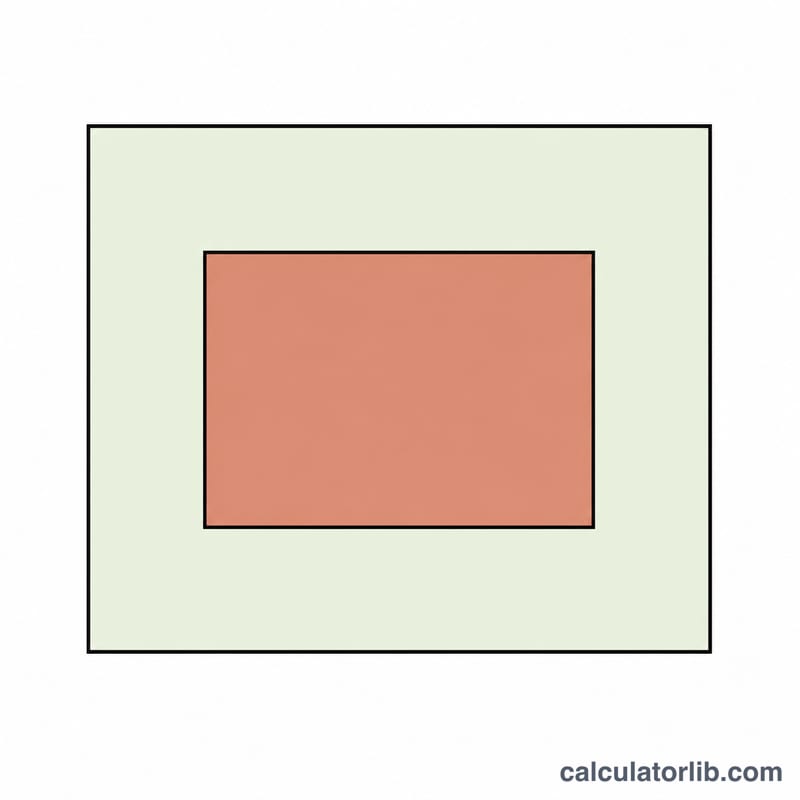
The building coverage ratio (romanized from Japanese as kenpeiritsu) is a zoning concept used in Japan under the Building Standards Act. It expresses how much of a plot of land is covered by the building when viewed from directly above. While the calculation here is universal arithmetic, the legal limits and the precise definition of "building area" are specific to Japanese regulation. This tool only computes the actual ratio; it does not check whether your value satisfies any zone's legal maximum.
How to use it
Enter your site (lot) area and your building (footprint) area, both in square meters. The calculator divides the building area by the site area, multiplies by 100, and returns the percentage. Both inputs must use the same unit so the result is dimensionless.
The formula
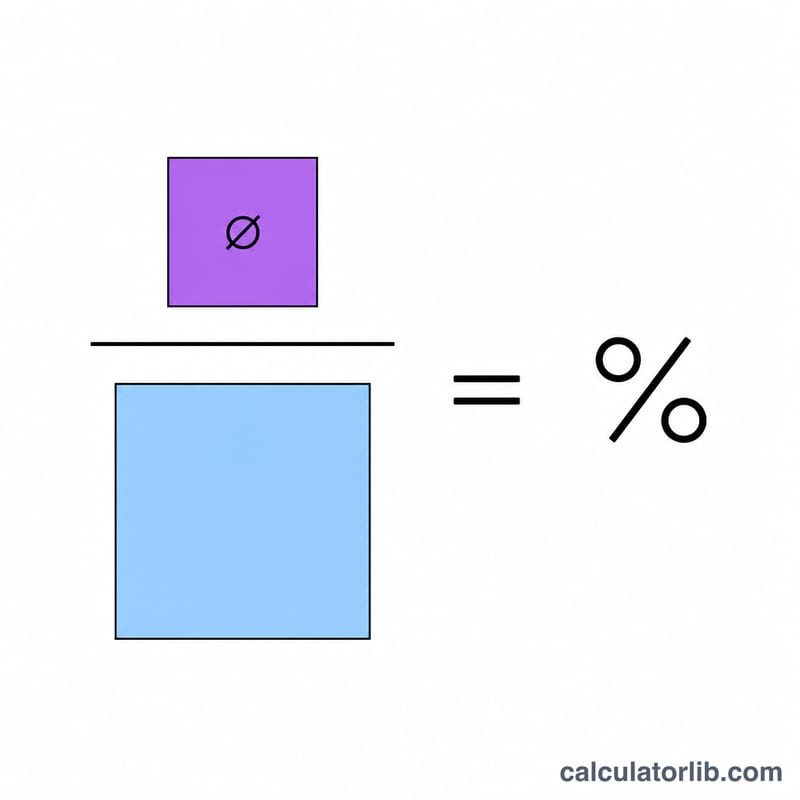
Building coverage ratio (%) = building area ÷ site area × 100. Following the convention of Japanese real-estate listings, the result is rounded up at the third decimal place, i.e. ceiling to two decimal places: result = ceil(ratio × 100) / 100.
$$\text{BCR} = \frac{\text{Building Area (m}^2\text{)}}{\text{Site Area (m}^2\text{)}} \times 100\%$$
Worked example
For a site area of 100 m² and a building area of 60 m²:
$$60 \div 100 \times 100 = 60.00\%$$so the coverage ratio is 60%. To show the rounding, a 150 m² site with a 47 m² building gives
$$47 \div 150 \times 100 = 31.3333\ldots\%$$which rounds up to 31.34%.
Legal Building Coverage Ratio Limits by Use Zone
In Japan, the maximum building coverage ratio (建蔽率, kenpeiritsu) is set by the Building Standards Act (建築基準法) according to the use zone (用途地域, yōto chiiki) in which a site is located. Within the ranges allowed by national law, each local government designates the specific figure that applies to a given parcel, so you must confirm the exact value for your site with the municipal city-planning office. The table below lists the 13 use zones and the coverage-ratio values that may be designated for each.
| Use zone (yōto chiiki) | Permitted BCR options |
|---|---|
| Category I Low-rise Exclusive Residential | 30 / 40 / 50 / 60% |
| Category II Low-rise Exclusive Residential | 30 / 40 / 50 / 60% |
| Category I Medium-to-high-rise Exclusive Residential | 30 / 40 / 50 / 60% |
| Category II Medium-to-high-rise Exclusive Residential | 30 / 40 / 50 / 60% |
| Category I Residential | 50 / 60 / 80% |
| Category II Residential | 50 / 60 / 80% |
| Quasi-residential | 50 / 60 / 80% |
| Neighborhood Commercial | 60 / 80% |
| Commercial | 80% |
| Quasi-industrial | 50 / 60 / 80% |
| Industrial | 50 / 60% |
| Exclusive Industrial | 30 / 40 / 50 / 60% |
| Field-use / unzoned residential protection (Tanaen-jūkyo) | 30 / 40 / 50 / 60% |
Standard relaxations (+10% additions)
The designated figure can be increased under specific conditions, with the additions accumulating where more than one applies:
| Condition | Adjustment |
|---|---|
| Corner lot (kakuchi) designated by the specified administrative agency | +10% |
| Fireproof building (taikako kenchikubutsu) in a fire-prevention district (bōka chiiki) | +10% |
| Both of the above together | +20% |
As a special case, where a designated coverage ratio of 80% coincides with a fire-prevention district and the building is fireproof, the coverage-ratio limit is lifted entirely (effectively 100%), allowing full footprint coverage subject to other restrictions.
FAQ
What counts as "building area"? Under Japanese rules it is the area enclosed by the centerline of the building's outer walls or columns seen from above. Eaves, awnings, and cantilevered balconies that project 1 m or more are only counted for the portion beyond 1 m from their tip.
Can the ratio exceed 100%? Mathematically yes, but a value above 100% means the building footprint is larger than the lot, which usually signals a data-entry error.
How is this different from floor area ratio? Floor area ratio (yousekiritsu) is total floor area across all storeys divided by site area, while coverage ratio uses only the footprint. They are separate measures.