
What is the Isentropic Flow Calculator?
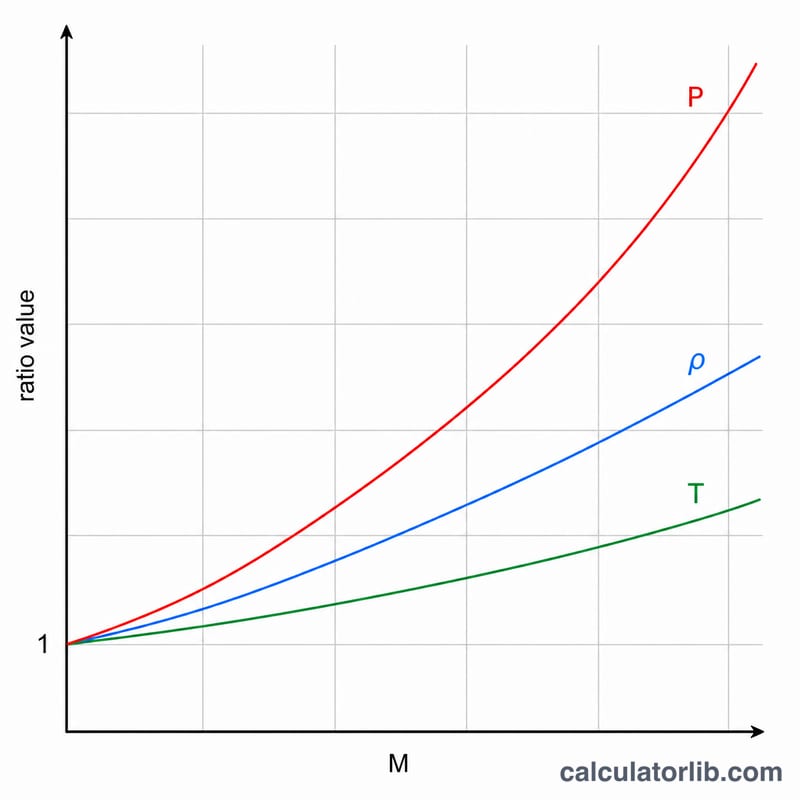
This tool computes the stagnation (total) to static property ratios for a compressible gas undergoing isentropic (reversible, adiabatic) flow. Given the local Mach number M and the gas specific heat ratio γ, it returns the temperature ratio \(T_0/T\), pressure ratio \(P_0/P\) and density ratio \(\rho_0/\rho\), along with their reciprocals. These relationships are fundamental in aerodynamics, nozzle and diffuser design, and gas dynamics.
How to use it
Enter the Mach number (the ratio of flow speed to the local speed of sound) and the specific heat ratio of the gas. Use \(\gamma = 1.4\) for air and diatomic gases at moderate temperatures, \(\gamma \approx 1.667\) for monatomic gases (helium, argon), and \(\gamma \approx 1.3\) for combustion products. Press calculate to get all property ratios.
The formula explained
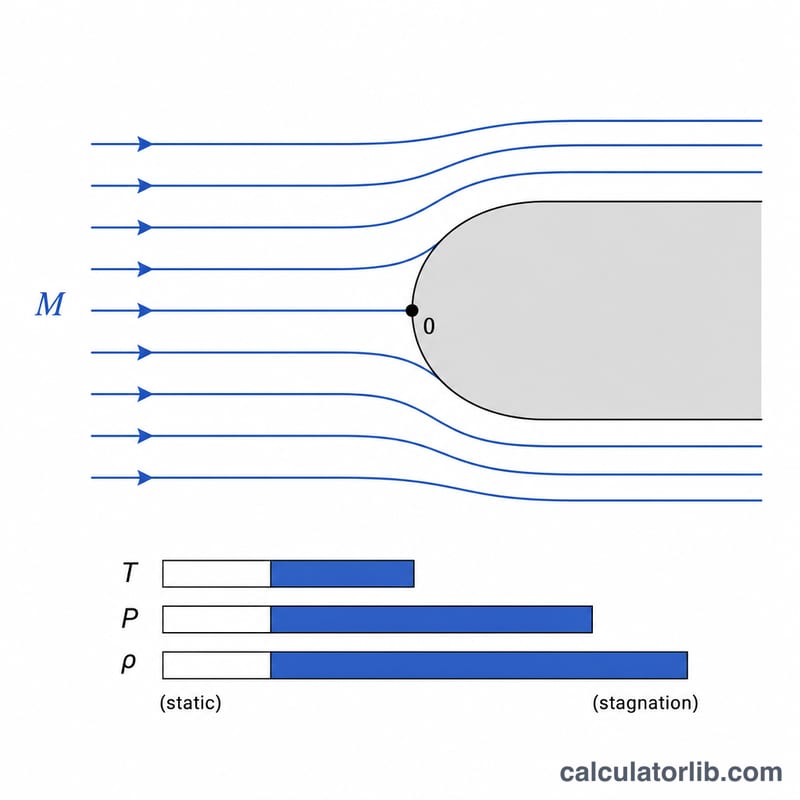
The energy equation for adiabatic flow gives $$\frac{T_0}{T} = 1 + \frac{\gamma - 1}{2}\,\text{M}^{2}$$ Because the flow is also isentropic, pressure and density follow the polytropic relations $$\frac{P_0}{P} = \left(\frac{T_0}{T}\right)^{\frac{\gamma}{\gamma - 1}}$$ and $$\frac{\rho_0}{\rho} = \left(\frac{T_0}{T}\right)^{\frac{1}{\gamma - 1}}$$ Stagnation properties are what the flow would reach if brought isentropically to rest.
Worked example
For \(M = 2\) and \(\gamma = 1.4\): $$\frac{T_0}{T} = 1 + 0.2\cdot 4 = 1.8$$ Then \(P_0/P = 1.8^{3.5} \approx 7.824\) and \(\rho_0/\rho = 1.8^{2.5} \approx 4.347\). So a flow at Mach 2 has stagnation pressure about 7.8 times its static pressure.
FAQ
What is "stagnation" pressure? It is the pressure the gas would have if decelerated isentropically to zero velocity — measured, for example, by a pitot tube.
Does this work above Mach 1? Yes, the isentropic relations hold throughout subsonic and supersonic flow, but not across a shock wave, which is non-isentropic.
Why does γ matter? \(\gamma\) sets how energy partitions between translation and internal modes, directly scaling how strongly density and pressure rise with Mach number.