
What Is the Manning Pipe Flow Calculator?
This tool computes the steady, uniform open-channel or gravity flow in a circular pipe using the Manning equation. Given the pipe diameter, channel slope, Manning roughness coefficient and how full the pipe is, it returns the discharge \(Q\), the average velocity \(V\), the flow cross-sectional area, the hydraulic radius and the depth of flow. It works for sewers, culverts, storm drains and any circular conduit flowing by gravity. This version uses SI units (meters, m³/s).
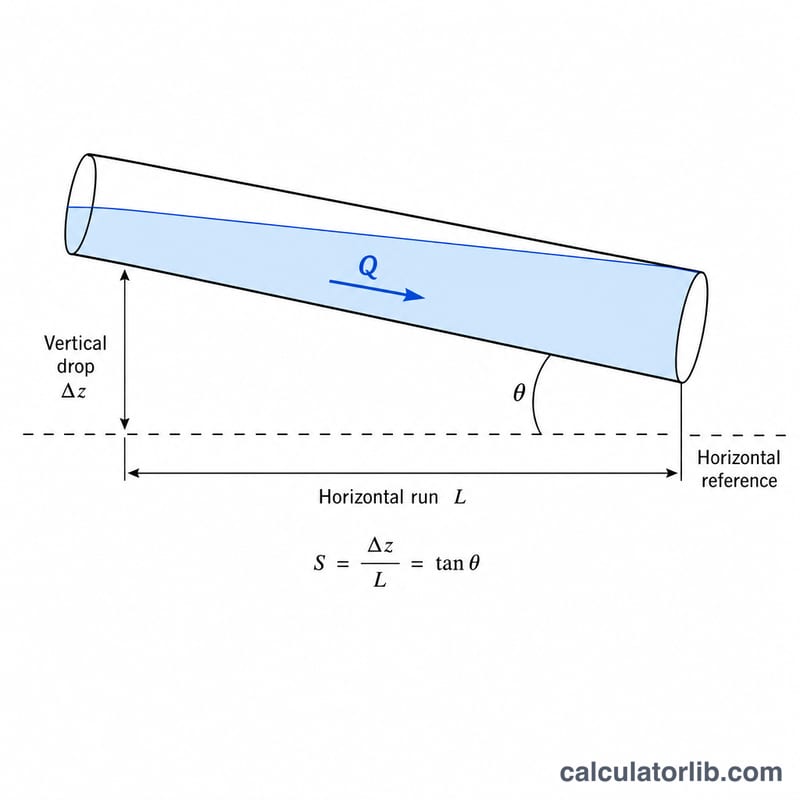
The Manning Equation
The discharge is given by:
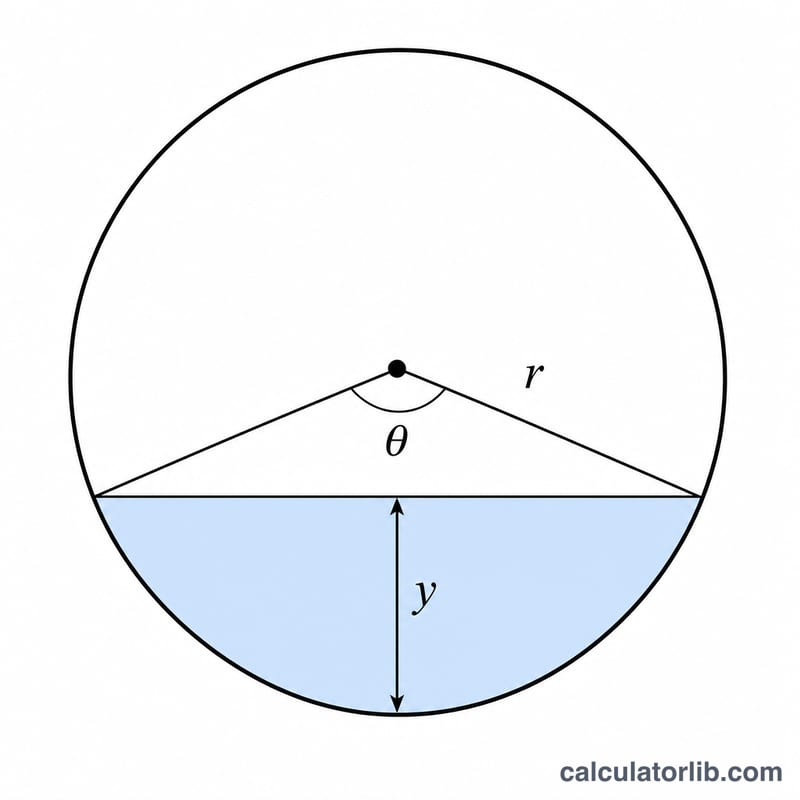
$$Q = \frac{1}{n} A R^{2/3} S^{1/2}$$where \(n\) = Manning roughness coefficient, \(A\) = flow area (m²), \(R\) = hydraulic radius (m), and \(S\) = slope (m/m). For a partially full circular pipe of radius \(r\) and central angle \(\theta\) of the wetted arc:
$$A = \frac{r^2}{2}\left(\theta - \sin\theta\right), \quad P = r\,\theta, \quad R = \frac{A}{P}$$The angle follows from the fill ratio via \(\cos(\theta/2) = (r - y)/r\), where \(y\) is the flow depth.
How to Use It
Enter the inner diameter, the longitudinal slope, the roughness coefficient (about 0.013 for concrete or PVC), and the fill ratio (1 = full, 0.5 = half full). The calculator solves the geometry and applies Manning to give flow and velocity.
Worked Example
For \(D = 0.5\,\text{m}\), \(S = 0.01\), \(n = 0.013\), full pipe (\(\theta = 2\pi\)):
$$A = \pi r^2 = \pi (0.25)^2 = 0.19635\,\text{m}^2$$$$R = \frac{D}{4} = 0.125\,\text{m}$$$$V = \frac{1}{0.013}(0.125)^{2/3}(0.01)^{1/2} = 1.922\,\text{m/s}$$$$Q = V \times A = 0.3774\,\text{m}^3/\text{s}$$FAQ
What is the hydraulic radius? It is the flow area divided by the wetted perimeter, a measure of channel efficiency.
Why does a pipe carry more flow at ~94% full than 100% full? Near full, the wetted perimeter grows faster than the area, reducing R and velocity, so peak discharge occurs slightly below full.
What units does this use? SI units: diameter and slope in meters, output in m³/s and m/s. The Manning coefficient n is dimensionless.