
What is a gear inches calculator?
Gear inches is the classic way cyclists compare gearing across bikes regardless of drivetrain layout. It expresses each gear as the diameter (in inches) of a hypothetical directly-driven wheel that would move you the same distance per pedal stroke. A higher number means a harder, faster gear; a lower number means an easier, climbing gear.
The formula
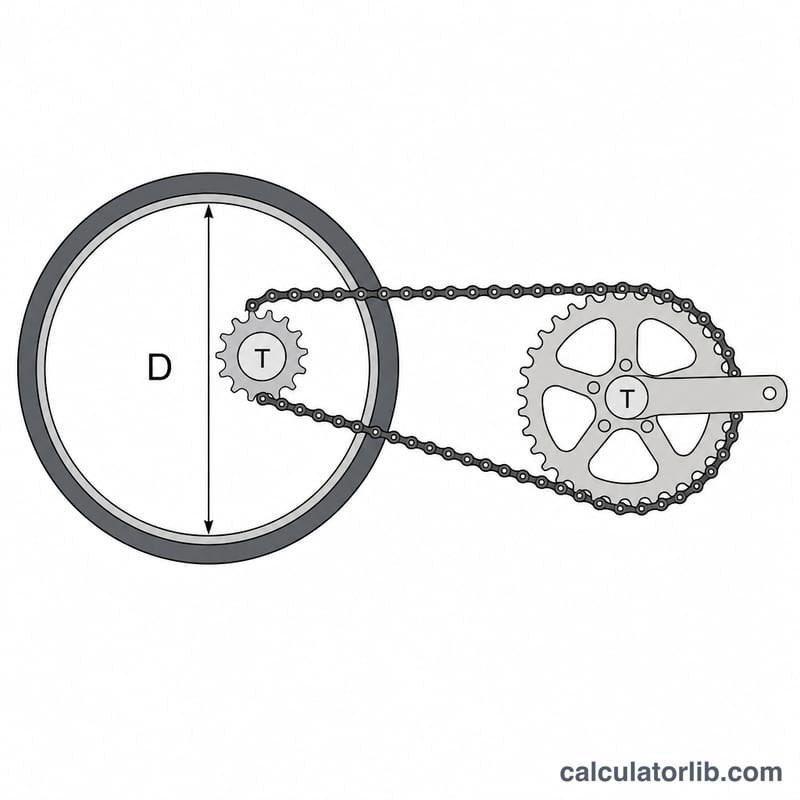
The calculation multiplies the drive wheel diameter by the ratio of front chainring teeth to rear cog teeth:
$$G = D \times \frac{C}{R}$$where \(G\) = gear inches, \(D\) = wheel diameter in inches (including tyre), \(C\) = chainring teeth and \(R\) = rear cog (sprocket) teeth. Typical road wheels are about \(27\) inches; common mountain wheels run \(26\)–\(29\) inches.
How to use it
Enter your wheel diameter in inches, the number of teeth on the front chainring, and the number of teeth on the rear cog. The tool returns the gear inches, the raw gear ratio, and the development — how far you roll in metres for one full turn of the cranks.
Worked example
For a 27-inch wheel with a 48-tooth chainring and a 16-tooth cog:
$$G = 27 \times \frac{48}{16} = 27 \times 3 = 81 \ \text{gear inches}$$The development is then:
$$L = 81 \times \pi \times 0.0254 \approx 6.46 \ \text{m per crank revolution}$$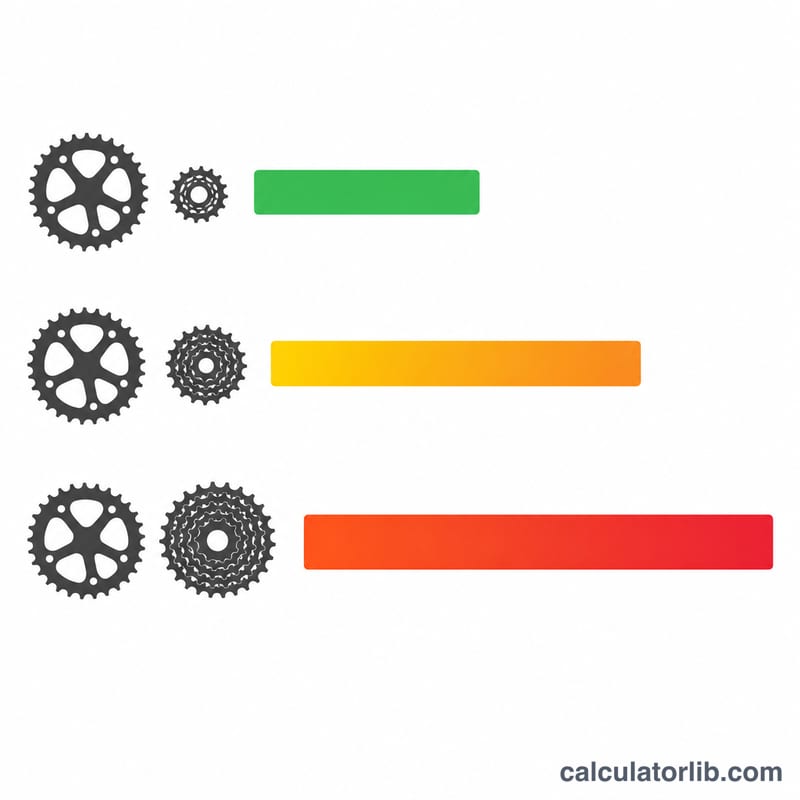
FAQ
Should I include the tyre in wheel diameter? Yes. Use the inflated overall diameter (rim plus tyre) for an accurate result.
What is a good gear inches range? Roughly 20–30 for steep climbs and 90–125 for fast flat riding; most all-round gears fall between these.
What is "development"? It is the rollout distance per pedal revolution. Multiply gear inches by \(\pi\) for inches, or by \(\pi \times 0.0254\) for metres.