
What Is a Board Foot?
A board foot is the standard unit of volume for pricing rough and dimensional lumber in North America. One board foot equals a piece 12 inches wide, 12 inches long, and 1 inch thick — that is 144 cubic inches of wood. This calculator converts any board dimensions into board feet and multiplies by your price per board foot to give the total cost of your order.
The Formula
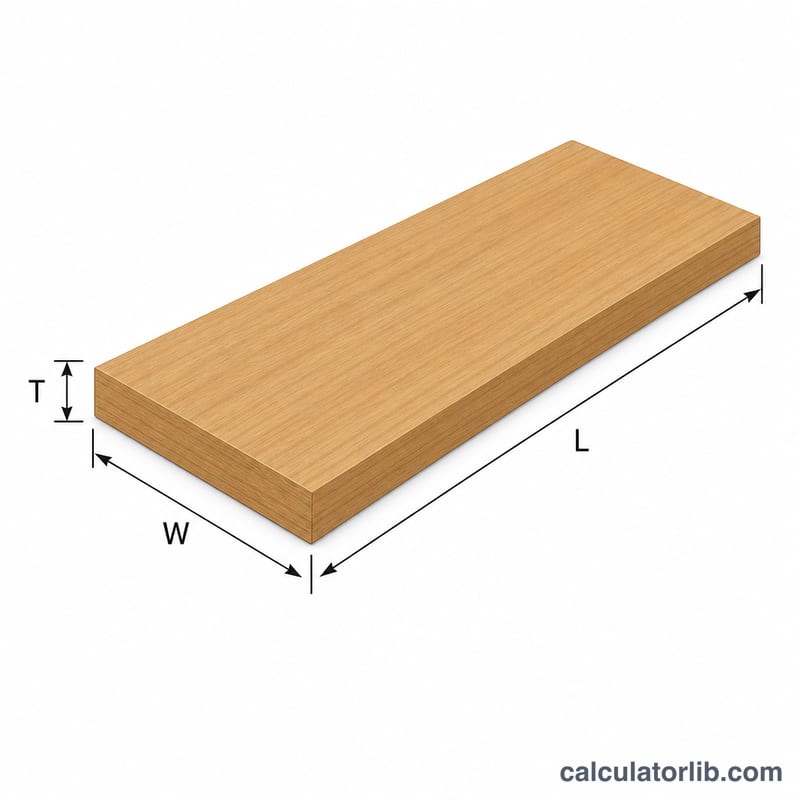
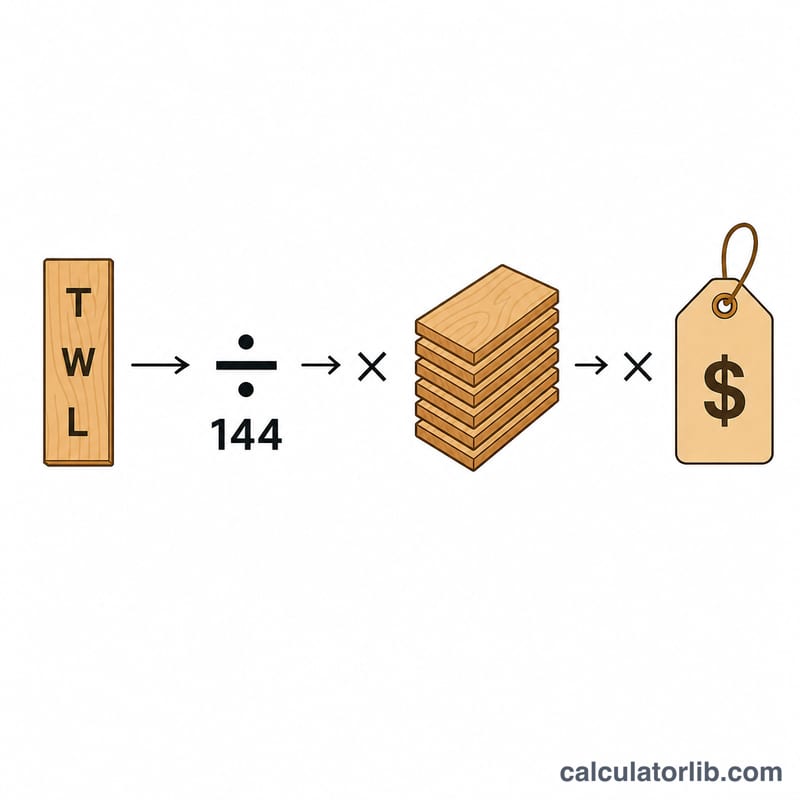
With thickness \(T\), width \(W\) and length \(L\) all measured in inches, the board feet of a single board is:
$$BF = \frac{T \times W \times L}{144}$$Multiply by the number of boards \(Q\) and the price per board foot \(P\) to get total cost:
$$\text{Cost} = \frac{T \times W \times L}{144} \times Q \times P$$If your length is given in feet, multiply it by 12 first, or use the equivalent formula \(BF = \tfrac{T \times W \times L_{ft}}{12}\).
How to Use It
Enter the nominal or actual thickness and width in inches, the length in inches, how many boards you need, and the price your supplier charges per board foot. The calculator returns board feet per board, total board feet, cost per board, and the grand total.
Worked Example
Suppose you buy 10 boards that are 1 inch thick, 6 inches wide, and 96 inches long, at $4.50 per board foot.
$$BF = \frac{1 \times 6 \times 96}{144} = 4\ \text{BF per board}$$Total board feet \(= 4 \times 10 = 40\ \text{BF}\), so the total cost is:
$$\text{Cost} = 40 \times 4.50 = \$180.00$$Nominal vs. Actual Lumber Dimensions
Softwood lumber is sold by nominal size (the rough-sawn dimension named on the tag) but delivered at a smaller actual size after drying and surfacing (S4S). Board-foot volume in this calculator is based on the dimensions you enter, so it matters which set of numbers your supplier bills. The table below lists the standard surfaced dimensions for common dry softwood boards.
| Nominal Size | Actual Thickness | Actual Width |
|---|---|---|
| 1×4 | 3/4" | 3-1/2" |
| 1×6 | 3/4" | 5-1/2" |
| 2×4 | 1-1/2" | 3-1/2" |
| 2×6 | 1-1/2" | 5-1/2" |
| 2×8 | 1-1/2" | 7-1/4" |
| 2×10 | 1-1/2" | 9-1/4" |
| 2×12 | 1-1/2" | 11-1/4" |
A board foot equals 144 cubic inches: \(1\text{ BF} = 1\text{ in} \times 12\text{ in} \times 12\text{ in}\). By long-standing trade convention, board-foot volume for dimensional lumber is figured from nominal thickness and width (length in feet), which is why a nominal 2×4 is counted as more wood than its actual 1-1/2" × 3-1/2" face suggests. Hardwoods, by contrast, are usually tallied from actual rough dimensions.
Cost Across Common Lumber Orders
The board feet in one piece is \(\frac{T \times W \times L_{in}}{144}\), where thickness and width are in inches and length is converted to inches. Equivalently, with length in feet, \(\text{BF} = \frac{T \times W \times L_{ft}}{12}\). The examples below use nominal sizes (as lumber is typically tallied) and representative prices; multiply board feet per piece by quantity, then by price per board foot.
| Order | T × W (nominal in) | Length | Qty | BF per board | Total BF | Price/BF | Total Cost |
|---|---|---|---|---|---|---|---|
| 1×6×8ft | 1 × 6 | 8 ft | 10 | 4.0 | 40.0 | $2.50 | $100.00 |
| 2×4×8ft | 2 × 4 | 8 ft | 20 | 5.333 | 106.67 | $1.80 | $192.00 |
| 2×6×10ft | 2 × 6 | 10 ft | 12 | 10.0 | 120.0 | $2.10 | $252.00 |
| 1×8×12ft | 1 × 8 | 12 ft | 6 | 8.0 | 48.0 | $3.20 | $153.60 |
Worked check for the 2×6×10ft row: \(\frac{2 \times 6 \times 120}{144} = 10\) BF per board, \(10 \times 12 = 120\) total BF, and \(120 \times \$2.10 = \$252.00\). Note the length 120 in is the 10-foot board expressed in inches.
Practical Buying Tips
- Buy 10–15% extra. Saw kerf, trimmed ends, knots, splits and cutting mistakes all consume material. If your project needs 100 board feet net, order roughly 110–115 BF so you are not short mid-build.
- Confirm nominal vs. actual billing. Ask whether the supplier tallies board feet from nominal sizes (typical for softwood dimensional lumber) or actual surfaced dimensions (common for hardwood). Enter the matching numbers so your cost estimate lines up with the invoice.
- Round up to stock lengths. Lumber comes in standard increments (8, 10, 12, 14, 16 ft). Plan cut lists around these so you minimize offcuts — sometimes a longer board yields less waste than two shorter ones.
- Allow for trim and end-checking. Board ends often develop checks (small splits) as they dry; trimming an inch or two off each end is normal. Factor this into both length and waste allowance.
- Inspect before buying. Sight down each board for crook, bow, cup and twist, and reject heavily defective pieces — paying per board foot for warped stock you can't use is wasted money.
- Compare on price per board foot, not per piece. A board-foot basis lets you compare different sizes and species fairly. Use the calculator to convert quoted per-piece prices to per-BF before deciding.
This is general guidance for estimating and purchasing lumber; actual yields vary by species, grade, moisture content and project. Verify dimensions and pricing with your supplier before placing an order.
FAQ
Is a board foot the same as a linear foot? No. A linear foot only measures length, while a board foot measures volume and depends on thickness and width too.
Should I use nominal or actual dimensions? Rough lumber is usually sold on nominal dimensions; surfaced (S4S) lumber is often priced on nominal but measures smaller. Ask your supplier which they bill on.
Does length have to be in inches? This tool expects inches. For a 8 ft board, enter 96 inches.