
What Is the Decking Board Calculator?
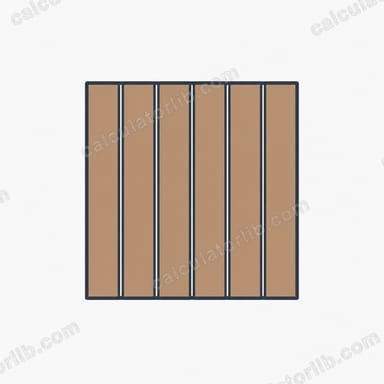
This calculator estimates how many decking boards you need to cover a deck. It works for any unit of board (timber, composite, or PVC) and accounts for the small gap left between boards for drainage and expansion, plus a waste allowance for off-cuts and mistakes. Dimensions are entered in feet for the deck and board length, and inches for board width and gap — the standard mix used by most lumber suppliers.
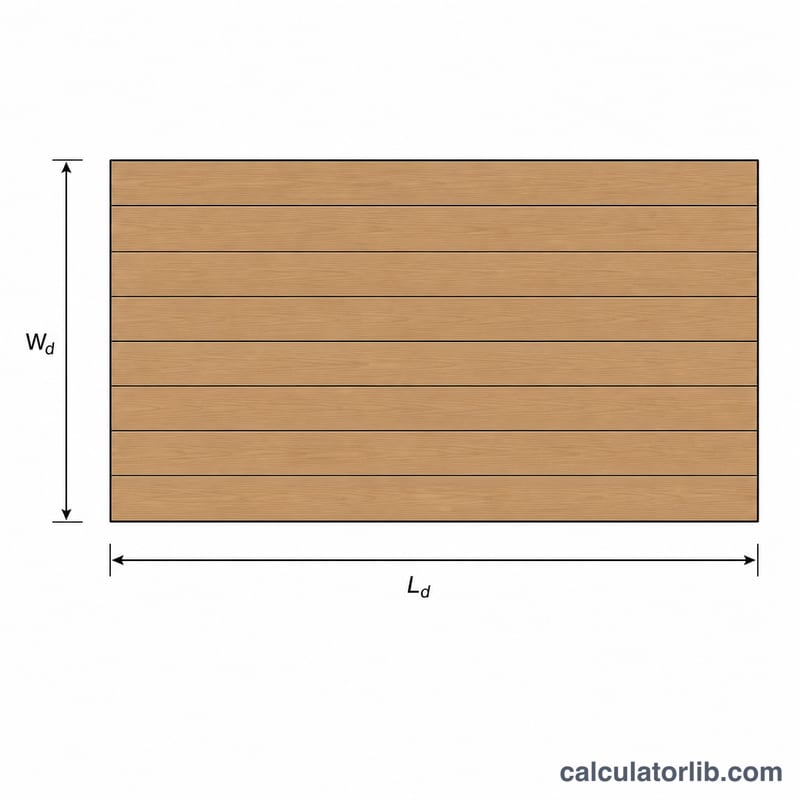
How to Use It
Enter your deck length and width in feet to define the area. Enter the length of one board (feet) and its actual face width (inches) — note that a "6-inch" board is usually 5.5 in actual width. Set the gap between boards (commonly 1/8 to 1/4 inch) and a waste allowance (10% is typical, 15% for diagonal or herringbone patterns). The tool returns the total number of boards, rounded up.
The Formula Explained
Each board covers an area equal to its length multiplied by its effective width — the actual width plus the gap, since that gap is space the board "claims." Converting the inch measurements to feet, one board covers \(\frac{W_b + g}{12} \times L_b\) square feet. Dividing the deck area by this coverage gives the raw board count, which is then increased by the waste factor and rounded up to a whole board.
$$\text{Boards} = \left\lceil \frac{A}{C} \times \left(1 + \frac{\text{Waste (\%)}}{100}\right) \right\rceil$$$$\text{where}\quad \left\{ \begin{aligned} A &= \text{Deck Length (ft)} \times \text{Deck Width (ft)} \\ C &= \frac{\text{Board Width (in)} + \text{Gap (in)}}{12} \times \text{Board Length (ft)} \end{aligned} \right.$$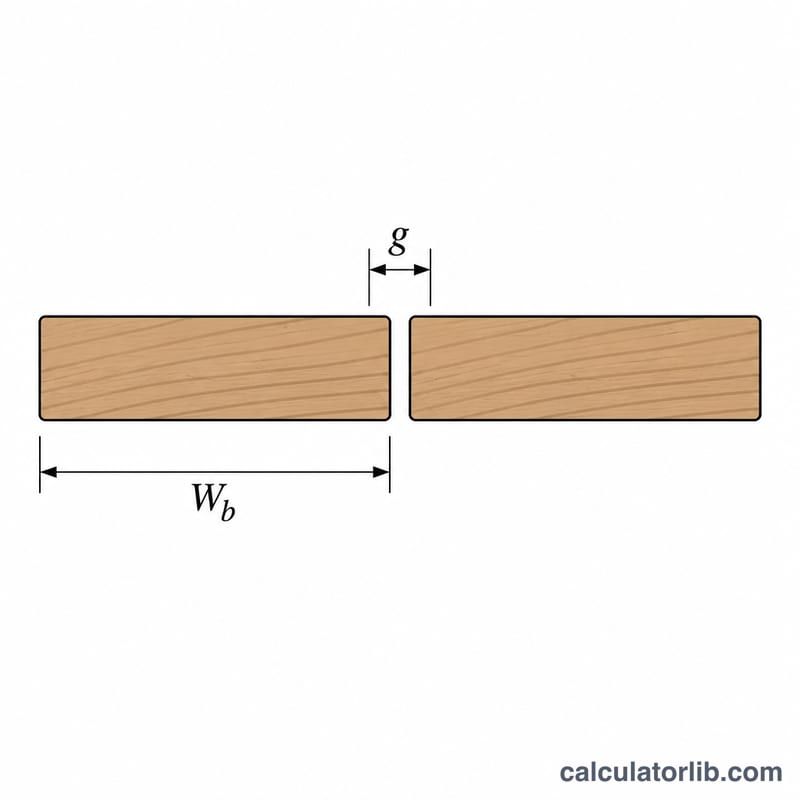
Worked Example
A 20 ft × 12 ft deck has an area of 240 sq ft. Using 12 ft boards that are 5.5 in wide with a 0.25 in gap: effective width = \((5.5 + 0.25)/12 = 0.479\) ft, so each board covers \(0.479 \times 12 = 5.75\) sq ft. That gives \(240 / 5.75 = 41.7\) boards. With a 10% waste allowance: \(41.7 \times 1.10 = 45.9\), rounded up to 46 boards.
FAQ
Should I include the gap? Yes — the gap reduces how much area each board covers, so ignoring it underestimates the board count.
How much waste should I add? Use 10% for straight runs, 15% or more for diagonal/picture-frame layouts or short, busy decks.
Does this account for joists or framing? No, it only estimates surface deck boards. Framing lumber must be calculated separately.