
What this calculator does
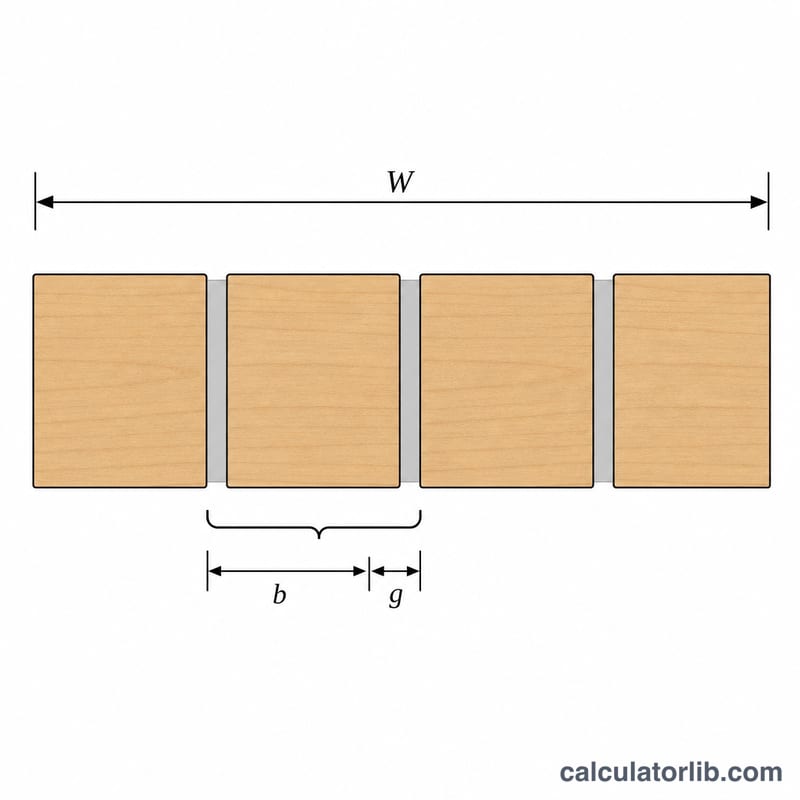
This tool estimates how many decking boards you need to cover a rectangular deck. It accounts for the actual width of each board, the small gap left between boards for drainage and expansion, and the standard length of the boards you plan to buy. The result is rounded up to whole boards so you never come up short on material.
How to use it
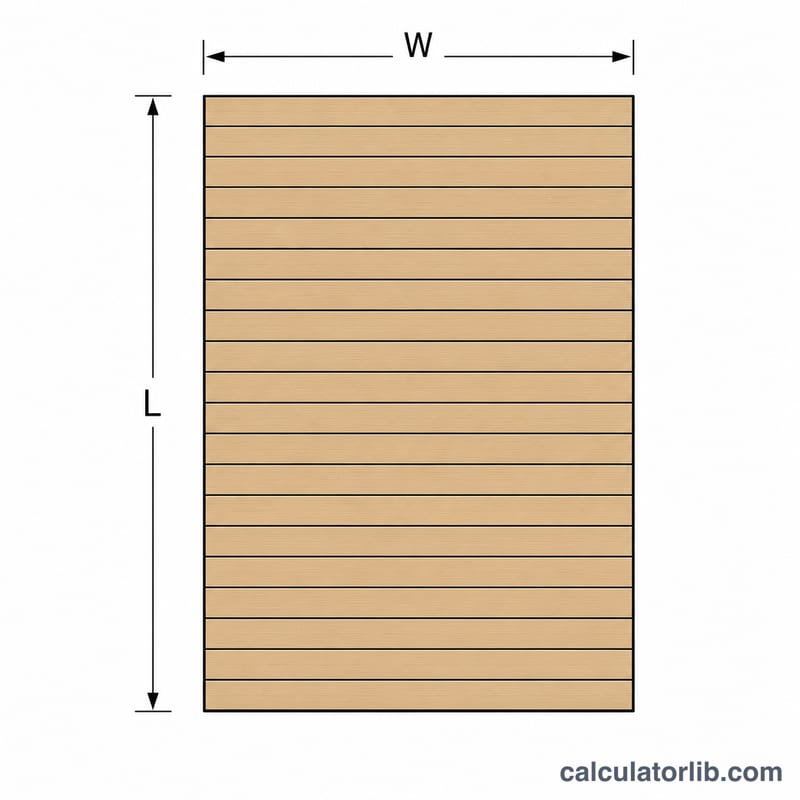
Enter the deck's overall width and length in feet. Then enter the width of a single decking board in inches (a common 2×6 board is about 5.5 in wide), the standard length of a board in feet (often 8, 12, or 16 ft), and the gap you want between boards in inches (typically 1/8 in to 1/4 in). Click calculate to get the number of boards, plus the number of rows and how many boards make up each row.
The formula explained
First the deck width is converted to inches and divided by the effective board width (board width plus gap). Rounding up gives the number of rows that run the length of the deck. Each row needs enough boards to span the deck length, so we divide deck length by board length. Multiplying rows by boards-per-row and rounding up yields the total boards required.
Worked example
For a 12 ft × 16 ft deck with 5.5 in boards, a 0.25 in gap, and 8 ft board lengths: deck width 12 ft = 144 in; effective board width = 5.5 + 0.25 = 5.75 in; rows = ceil(144 / 5.75) = ceil(25.04) = 26. Boards per row = 16 / 8 = 2. Total = ceil(26 × 2) = 52 boards.
$$\text{Deck width} = 12 \text{ ft} = 144 \text{ in}$$
$$\text{Effective board width} = 5.5 + 0.25 = 5.75 \text{ in}$$
$$\text{Rows} = \lceil 144 / 5.75 \rceil = \lceil 25.04 \rceil = 26$$
$$\text{Boards per row} = 16 / 8 = 2$$
$$\text{Total} = \lceil 26 \times 2 \rceil = 52 \text{ boards}$$
FAQ
Should I add extra for waste? Yes — buy roughly 10% more than the result to cover cuts, mistakes, and damaged boards.
Does this include the deck frame? No, it only estimates surface decking boards, not joists, beams, or fasteners.
What gap should I use? Most installers leave 1/8 in to 1/4 in between boards for drainage and seasonal movement; check your board manufacturer's guidance.