
What the Deck Stair Calculator Does
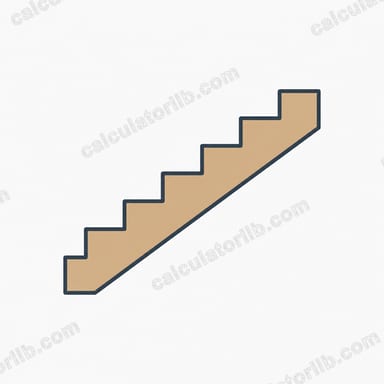
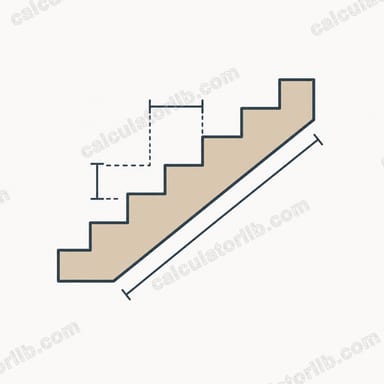
This free calculator helps you plan the stairs that connect your deck to the ground. By entering three simple measurements, it works out how many steps you need, the exact height of each step, the total horizontal distance the stairs will cover, and the length of the diagonal stringer board that supports the treads. Measurements are in inches, following common U.S. deck-building conventions.
The Inputs Explained
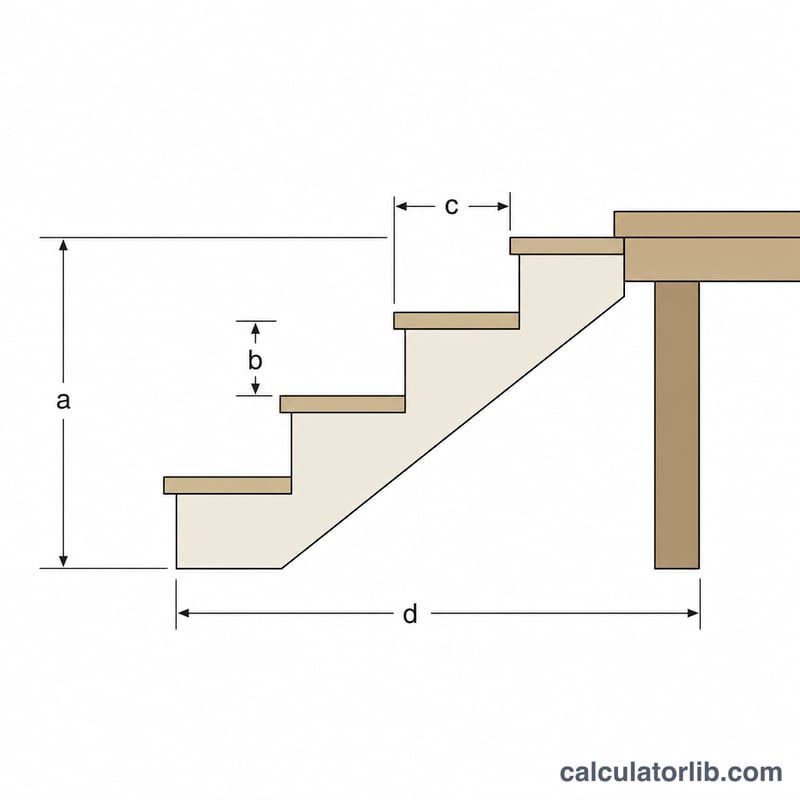
- Total Rise (inches): The vertical distance from the top of the deck surface down to the ground or landing where the stairs will rest.
- Run per Step (inches): The horizontal depth of each tread (how far you step forward on each step). A typical comfortable run is 10–11 inches.
- Desired Riser Height (inches): The target height of each individual step. Many building codes cap risers around 7.75 inches, so 7 inches is a common goal.
The Formula Behind the Results
The calculator uses straightforward geometry:
- Number of Steps = round up of \(\left\lceil \dfrac{\text{Total Rise}}{\text{Desired Riser Height}} \right\rceil\). Rounding up ensures no single riser exceeds your target.
- Actual Riser Height = \(\dfrac{\text{Total Rise}}{\text{Number of Steps}}\). This evens out the height so every riser is identical.
- Total Run = \((\text{Number of Steps} - 1) \times \text{Run per Step}\). The top step lands on the deck, so there is one fewer tread than risers.
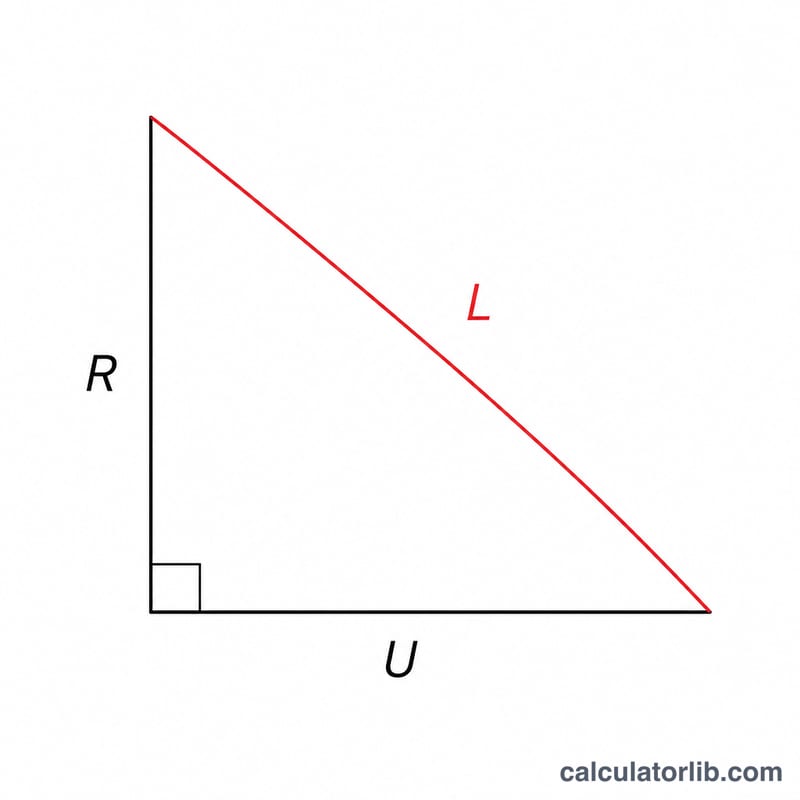
- Stringer Length = \(\sqrt{\text{Total Rise}^{2} + \text{Total Run}^{2}}\) — the Pythagorean diagonal of the staircase.
$$ L = \sqrt{R^{2} + T^{2}} $$
$$ \text{where}\quad \left\{ \begin{aligned} N &= \left\lceil \dfrac{\text{Total Rise}}{\text{Riser Height}} \right\rceil \\ R &= \text{Total Rise} \\ T &= (N - 1)\cdot \text{Run per Step} \end{aligned} \right. $$
Worked Example
Suppose your deck sits 36 inches above the ground, you want a 10-inch run per step, and a desired riser height of 7 inches.
- Number of Steps = \(\lceil 36 \div 7 \rceil = \lceil 5.14 \rceil =\) 6 steps
- Actual Riser Height = \(36 \div 6 =\) 6 inches per riser
- Total Run = \((6 - 1) \times 10 =\) 50 inches
- Stringer Length = \(\sqrt{36^{2} + 50^{2}} = \sqrt{1296 + 2500} = \sqrt{3796} \approx\) 61.6 inches
So you would cut a stringer about 61.6 inches long, with six equal 6-inch risers and five 10-inch treads.
Frequently Asked Questions
Why is the actual riser height different from what I entered? Because the number of steps must be a whole number, the total rise is divided evenly across the rounded-up step count, giving a slightly smaller, uniform riser.
Why is the total run based on steps minus one? The uppermost riser meets the deck edge, so there is always one more riser than there are horizontal treads.
Is the stringer length the board I need to buy? It is the diagonal cut line. Buy a board a few inches longer to allow for end cuts and the attachment to the deck and ground.