What the Lumber Calculator Does
This Lumber Calculator works out how much wood you have in three different units at once: board feet, cubic feet, and cubic meters. It is built around the board-foot measurement system used widely in the United States and Canada for buying and pricing rough and dimensional lumber. Enter the dimensions of a single board and the number of boards, and the calculator returns the total volume for the whole batch — handy for estimating material costs, planning a delivery, or comparing quotes.
The Input Fields
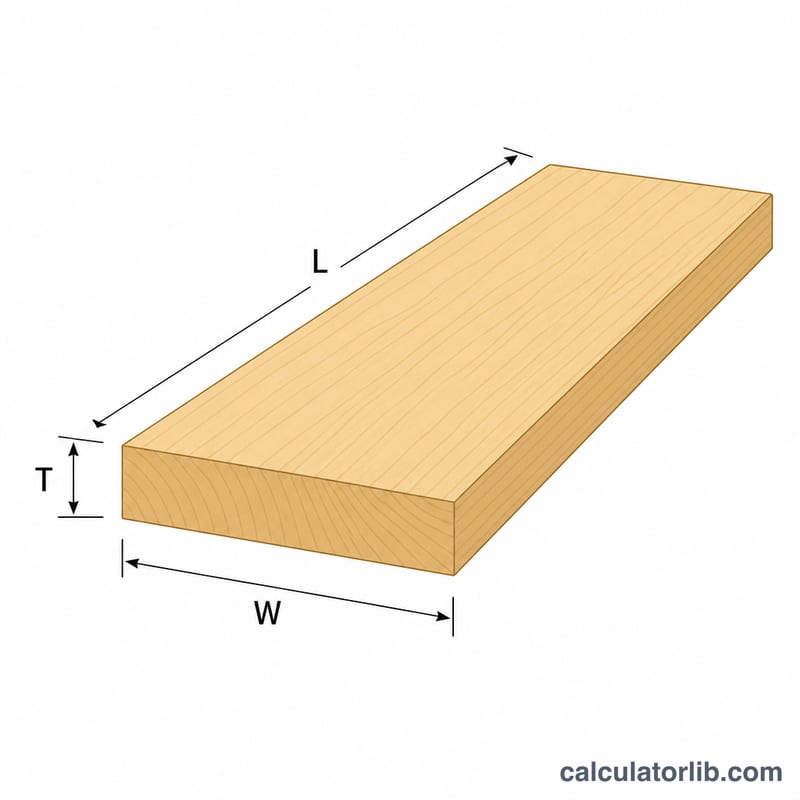
- Length (feet) — the length of one board measured in feet.
- Width (inches) — the face width of the board in inches.
- Thickness (inches) — how thick the board is, in inches.
- Quantity — how many identical boards you are calculating.
Note the mixed units: length is entered in feet while width and thickness are in inches. This matches how lumber is traditionally described (for example, a "2×4×8" board).
The Formula
The core calculation is the standard board-foot formula:
- Board feet = (Length × Width × Thickness × Quantity) ÷ 144
- Cubic feet = Board feet ÷ 12
- Cubic meters = Cubic feet × 0.0283168
The standard board-foot formula is:
$$\text{Board Feet} = \frac{\text{Length (ft)} \times \text{Width (in)} \times \text{Thickness (in)} \times \text{Quantity}}{144}$$The 144 divisor converts the mixed feet-and-inches figures into board feet (one board foot equals 144 cubic inches of wood, i.e. \(1\ \text{ft} \times 12\ \text{in} \times 1\ \text{in}\)). Dividing by 12 turns board feet into true cubic feet, and the 0.0283168 factor converts cubic feet to cubic meters.
Worked Example
Suppose you have 10 boards, each 8 feet long, 6 inches wide, and 2 inches thick.
- Board feet = \((8 \times 6 \times 2 \times 10) \div 144 = 960 \div 144 =\) 6.67 board feet
- Cubic feet = \(6.67 \div 12 =\) 0.556 cubic feet
- Cubic meters = \(0.556 \times 0.0283168 =\) 0.0157 cubic meters
You could then multiply the board feet by your supplier's per-board-foot price to estimate the cost.
Nominal vs. Actual Lumber Dimensions
The sizes below apply to surfaced softwood dimensional lumber sold in the United States and Canada. A "2x4" is named by its rough, nominal size before drying and planing, so the finished piece is smaller. Board feet are commonly priced and calculated from the nominal size, so a nominal board-foot count is higher than the true wood volume you receive.
Board feet for a piece: \(\text{BF} = \frac{T(\text{in}) \times W(\text{in}) \times L(\text{ft})}{12}\), which is the same as using length in inches and dividing by 144.
| Nominal size | Actual size (in) | BF per linear ft (nominal) | BF per 8 ft piece (nominal) | BF per 8 ft piece (actual) |
|---|---|---|---|---|
| 1x4 | 3/4 x 3-1/2 | 0.333 | 2.67 | 1.75 |
| 1x6 | 3/4 x 5-1/2 | 0.500 | 4.00 | 2.75 |
| 1x8 | 3/4 x 7-1/4 | 0.667 | 5.33 | 3.63 |
| 1x12 | 3/4 x 11-1/4 | 1.000 | 8.00 | 5.63 |
| 2x4 | 1-1/2 x 3-1/2 | 0.667 | 5.33 | 3.50 |
| 2x6 | 1-1/2 x 5-1/2 | 1.000 | 8.00 | 5.50 |
| 2x8 | 1-1/2 x 7-1/4 | 1.333 | 10.67 | 7.25 |
| 2x10 | 1-1/2 x 9-1/4 | 1.667 | 13.33 | 9.25 |
| 2x12 | 1-1/2 x 11-1/4 | 2.000 | 16.00 | 11.25 |
| 4x4 | 3-1/2 x 3-1/2 | 1.333 | 10.67 | 8.17 |
Example: a 2x4 that is 8 ft long is \(\frac{2 \times 4 \times 8}{12} = 5.33\) BF nominal, but only \(\frac{1.5 \times 3.5 \times 8}{12} = 3.50\) BF of actual wood.
Board Feet Conversion Table
| Unit | Equivalent |
|---|---|
| 1 board foot | 144 cubic inches = 0.08333 cubic feet = 0.002360 cubic meters = 2.36 liters |
| 1 cubic foot | 12 board feet |
| 1 cubic meter | about 423.8 board feet |
| 1 cubic meter | 35.3147 cubic feet |
| Board feet | Cubic feet | Cubic meters |
|---|---|---|
| 1 | 0.0833 | 0.00236 |
| 10 | 0.8333 | 0.0236 |
| 50 | 4.167 | 0.1180 |
| 100 | 8.333 | 0.2360 |
| 1000 | 83.33 | 2.360 |
To convert, divide board feet by 12 for cubic feet, or multiply board feet by 0.00236 for cubic meters.
Practical Tips for Ordering Lumber
- Add for waste: include roughly 10-15% extra for waste, saw cuts, and defects such as knots, splits, and warp. Use more for hardwood, figured grain, or projects with many angled or complex cuts.
- Round up to whole boards: lumber is sold in standard lengths, commonly 8, 10, 12, and 16 ft. Plan your cuts against these lengths and round the piece count up.
- Check nominal vs. actual pricing: confirm whether the supplier calculates board feet from nominal or actual dimensions. The difference can be 25-35% for common sizes such as 2x4 and 2x6 (see the table above).
- Compare pricing units: framing lumber is typically priced per piece or per linear foot, while hardwood is usually priced per board foot. Convert everything to one unit before comparing quotes.
- Consider moisture and surfacing: kiln-dried (KD) and green lumber differ in size and will shrink or move as they dry. Rough-sawn boards are thicker than surfaced (S4S, surfaced four sides) boards, so check what thickness you will have after planing.
- Mind your inputs: enter length, width, thickness, and quantity in the units the calculator asks for. Use the nominal dimensions to match how a supplier quotes, or actual dimensions to estimate real wood volume.
Frequently Asked Questions
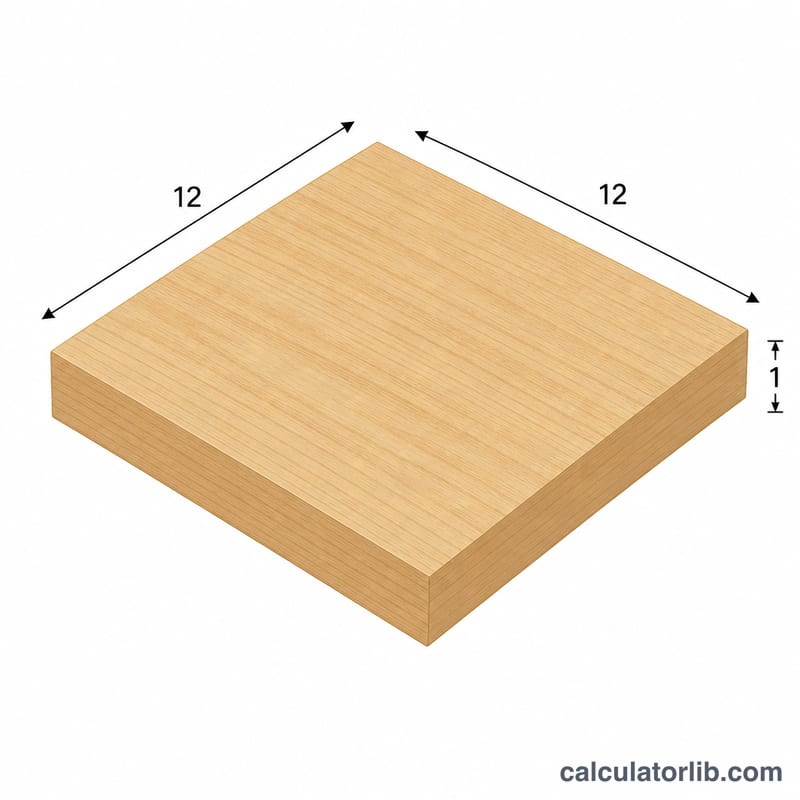
What is a board foot? A board foot is a volume of lumber equal to 144 cubic inches — for example, a piece 1 foot long, 12 inches wide, and 1 inch thick. It is the standard unit for pricing hardwood and softwood in North America.
Should I use nominal or actual dimensions? For accurate volume, use the actual finished dimensions. A "2×4" is really about 1.5 × 3.5 inches after planing, so entering the nominal 2 and 4 will overstate the volume slightly.
Why is length in feet but width and thickness in inches? This mirrors how lumber is normally specified and described in the trade, and the formula's divisor of 144 is set up to handle that mix automatically.