
What Is a French Drain Calculator?
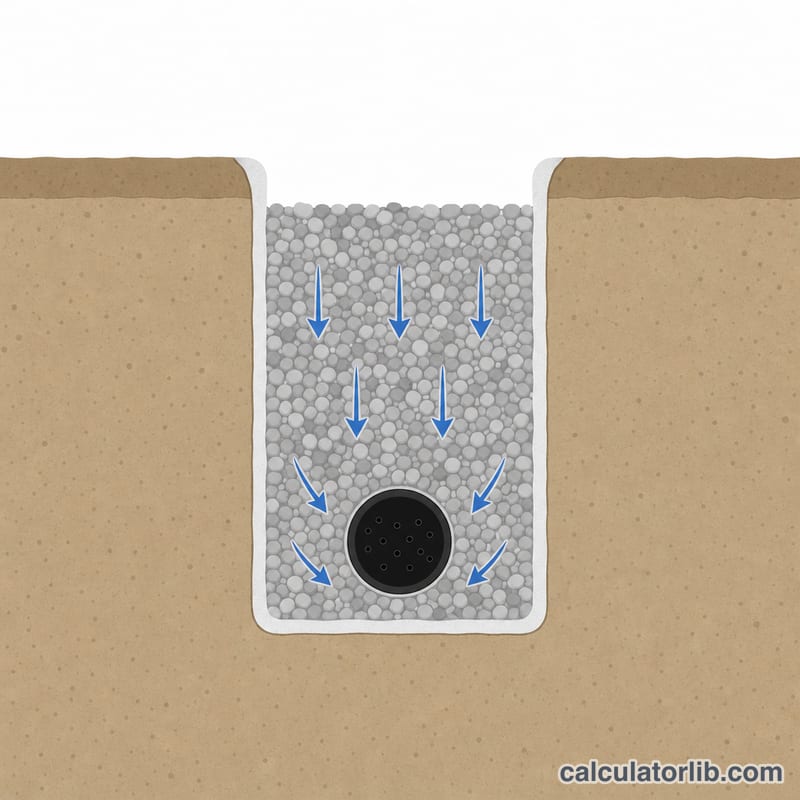
A French drain is a gravel-filled trench with a perforated pipe that redirects surface and groundwater away from a problem area such as a foundation, patio, or soggy lawn. This calculator estimates how much gravel you need to fill the trench, expressed in cubic yards — the unit landscaping suppliers use when selling and delivering aggregate.
How to Use It
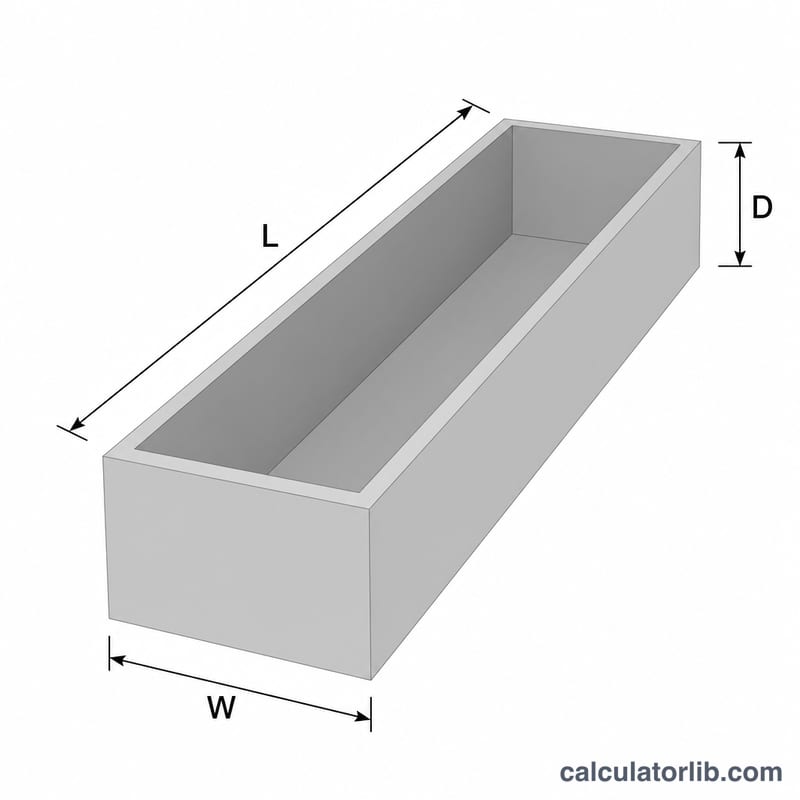
Enter the trench length in feet, and the trench width and depth in inches. The calculator converts width and depth to feet, multiplies all three dimensions to get the trench volume in cubic feet, and divides by 27 to give cubic yards. It also estimates the approximate gravel weight in US tons so you can plan delivery.
The Formula Explained
Volume of a rectangular trench is length × width × depth. Because there are 27 cubic feet in one cubic yard, we divide by 27:
$$\text{Gravel (yd}^3) = \frac{\text{Length (ft)} \times \dfrac{\text{Width (in)}}{12} \times \dfrac{\text{Depth (in)}}{12}}{27}$$, where every dimension is in feet. Inches are converted by dividing by 12.
Worked Example
Suppose your trench is 50 ft long, 12 in (1 ft) wide, and 18 in (1.5 ft) deep. Volume = \(50 \times 1 \times 1.5 = 75 \text{ ft}^3\). Dividing by 27 gives ≈ 2.78 cubic yards of gravel. At roughly 1.4 tons per yard, that's about 3.89 US tons.
FAQ
Should I order extra gravel? Yes — order about 5–10% extra to allow for compaction and uneven trench walls.
What gravel size is best? Washed 3/4-inch (clean) stone is common because it drains well and resists clogging.
Does this include the pipe volume? No. The pipe displaces a small amount of gravel, so this estimate is slightly conservative, which is usually preferred.