
What Is the Drywall Sheet Calculator?
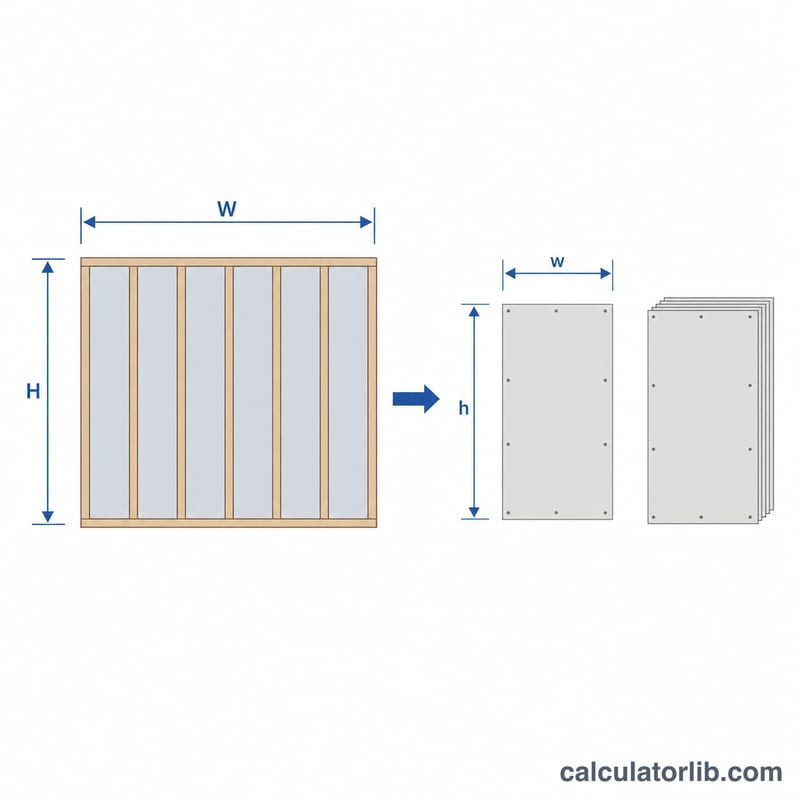
This tool estimates how many drywall (gypsum board) sheets you need to cover a given wall or ceiling area. Enter your total surface area, pick a standard sheet size, and add a waste allowance for cuts, mistakes, and odd corners. The calculator rounds up to the next whole sheet because you can't buy a fraction of a panel.
How to Use It
First, measure the total area you want to cover in square feet (length \(\times\) height for each wall, summed). Choose your sheet size — a 4\(\times\)8 panel covers 32 sq ft, a 4\(\times\)12 covers 48 sq ft. Set a waste allowance; 10% is typical for simple rooms, 15% or more for rooms with many windows, doors, or angles.
The Formula Explained
The math is straightforward: $$\text{Sheets} = \left\lceil \frac{\text{Area} \times \left(1 + \text{Waste\%}\right)}{\text{Sheet Area}} \right\rceil$$ The waste factor inflates your measured area to account for offcuts. Dividing by the area of one sheet gives the raw count, and the ceiling function rounds up so you always have enough material.
Worked Example
Suppose you have 500 sq ft to cover, using 4\(\times\)12 sheets (48 sq ft each) with a 10% waste allowance. Adjusted area = \(500 \times 1.10 = 550\) sq ft. Raw sheets = \(550 \div 48 = 11.46\), which rounds up to 12 sheets. Total coverage = \(12 \times 48 = 576\) sq ft.
FAQ
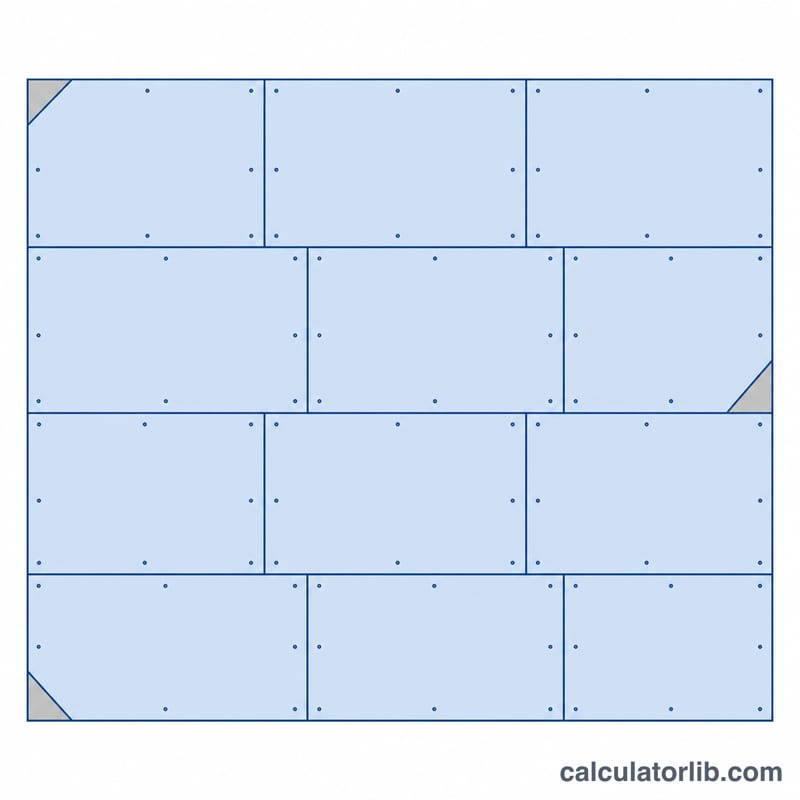
How much waste should I add? Use about 10% for plain rectangular rooms and 15–20% for complex layouts with many openings.
Do I count window and door openings? For a quick estimate you can include them; the waste allowance usually absorbs small openings. Subtract only large openings.
What about ceilings? Ceilings use the same calculation — just include the ceiling square footage in your total area.