What this calculator does
This tool is built around US customary units (square feet, gallons, pounds) and the US/Canada GA-214 finish levels, so quantities match what a North American supply house sells. It turns a drywall surface area into the amount of ready-mixed joint compound ("mud") you need to tape and finish the job, converts that into whole boxes, buckets or pails, and also estimates the joint tape required. Buying mud by guesswork usually means a second trip to the store mid-coat or three stiffening buckets left in the garage.
How to use it
Add up every surface that will be taped and finished: walls plus ceilings. A 4 x 8 sheet is 32 sq ft and a 4 x 12 sheet is 48 sq ft, so sheet count times sheet size is a quick shortcut. Pick the finish level your painter expects, leave the waste allowance near 10% (raise it for cut-up rooms or hot, dry conditions), then choose the container you actually buy.
The formula explained
Coverage is linear in area, so the model uses a gallons-per-100-square-feet rate \(R\) that rises with the number of coats: \(R = 0.6\) for Level 2, \(0.85\) for Level 3, \(1.1\) for Level 4 and \(1.7\) for Level 5, where a full skim coat covers the whole board rather than just the joints.
$$G = \frac{A}{100} \times R \times \left(1 + \frac{w}{100}\right)$$Here \(A\) = surface area in sq ft and \(w\) = waste percent. Weight uses about 13.7 lb per gallon of ready-mixed compound, and tape is estimated at 0.5 linear ft per sq ft of board.
Worked example
A 1,000 sq ft basement finished to Level 4 with a 10% waste allowance, bought in 4.5 gallon boxes:
$$G = \frac{1000}{100} \times 1.1 \times 1.10 = 12.1\ \text{gal}$$$$N = \left\lceil \frac{12.1}{4.5} \right\rceil = 3\ \text{boxes}$$That is roughly 166 lb of mud and about 500 linear ft of tape, or one standard roll.
GA-214 Drywall Finish Levels at a Glance
Finish levels are defined by GA-214, Recommended Levels of Finish for Gypsum Board, Glass Mat and Fiber-Reinforced Gypsum Panels, published by the Gypsum Association in the United States. It is a US industry reference document; other countries use their own conventions (for example BS 8212 practice in the UK), so confirm the specification that applies to your project before buying material.
| Level | What is done to joints, fasteners and surface | Typically specified for | Rate used by this calculator (gal per 100 sq ft) |
|---|---|---|---|
| 0 | No taping, finishing or accessories — bare board only. | Temporary construction, mock-ups, or where the finish is not yet determined. | Not costed (no compound) |
| 1 | Tape set in joint compound at all joints and interior angles; tool marks and ridges are acceptable. Surface need not be free of excess compound. | Concealed areas — plenums above ceilings, attics, service corridors. | Taping only — not costed by this tool |
| 2 | Tape embedded in compound plus one thin skim coat left over joints, interior angles, fasteners and accessories (bead, trim). | Water-resistant backer board and other tile substrates, garages, warehouses and storage where appearance is not critical. | 0.6 |
| 3 | Taping plus one additional separate coat over joints, angles, fasteners and accessories; surface free of tool marks and ridges. | Heavy or medium textures (spray or hand applied) and heavy-grade wall coverings. | 0.85 |
| 4 | Taping plus two additional separate coats over joints and angles, and three separate coats over fastener heads and accessories; smooth and free of tool marks and ridges. | Flat paints, light textures and lightweight wall coverings — the common residential default. | 1.1 |
| 5 | Everything in Level 4 plus a thin skim coat of joint compound (or a manufacturer-approved coating) over the entire surface. | Gloss, semi-gloss, enamel or other non-flat paints, and surfaces under severe (critical) lighting such as large windows or wall grazing. | 1.7 |
Levels 0 and 1 are not offered in the level selector because neither produces a meaningful compound quantity: Level 0 uses none, and Level 1 is a tape-embedding coat only. If you need a Level 1 estimate, use Level 2 and treat the result as generous.
The calculator multiplies the chosen rate by your area and then applies the waste allowance, so a 1,200 sq ft Level 4 job at 10% waste works out as \(G = \frac{1200}{100} \times 1.1 \times 1.10 = 14.52\) gallons, or 14.52 gal. Taking the same wall area to Level 5 instead raises it to \(\frac{1200}{100} \times 1.7 \times 1.10 = 22.44\) gallons — roughly 55% more mud for the skim coat.
Container Sizes, Weights and Powder Equivalents
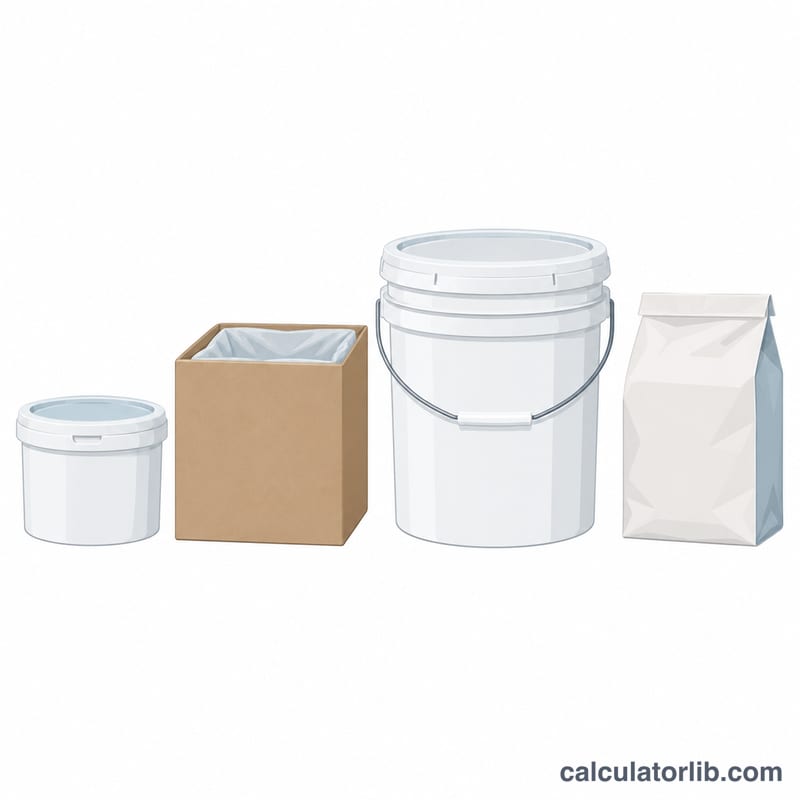
These are common US ready-mixed joint compound packages, and all volumes are US gallons. Weights are derived from the 13.7 lb per gallon figure this calculator assumes for all-purpose ready-mix; printed label weights vary by a few pounds because lightweight ("plus 3" type) compounds are less dense.
| Container | Nominal volume | Approx. weight at 13.7 lb/gal | Typical label weight |
|---|---|---|---|
| Quart tub | 0.25 gal | ~3.4 lb | ~3–3.5 lb (patch repairs) |
| Gallon pail | 1 gal | ~13.7 lb | ~12–14 lb |
| Pail | 3.5 gal | ~48 lb | ~45 lb |
| Box / carton | 4.5 gal | ~61.7 lb | ~61–62 lb |
| Bucket | 5 gal | ~68.5 lb | ~61 lb lightweight to ~68 lb all-purpose |
Dry powder equivalents
Setting-type and dry all-purpose compounds mix at roughly 9–10 lb of powder per mixed gallon, so convert the calculator's gallon figure with \(\text{bags} = \frac{G \times 9.5}{\text{bag weight (lb)}}\) and round up. Exact yield is printed on the bag and depends on how much water you add, so treat these as planning numbers.
| Powder bag | Approx. mixed volume | Covers at Level 4 (1.1 gal/100 sq ft, no waste) |
|---|---|---|
| 18 lb | ~1.8–2.0 gal | ~165–180 sq ft |
| 25 lb | ~2.5–2.8 gal | ~230–250 sq ft |
| 50 lb | ~5.0–5.5 gal | ~455–500 sq ft |
Board area and tape quick conversions
If you know the sheet count rather than the area, multiply by the board face area below. Standard US panels are 4 ft wide.
| Sheet size | Area per sheet | 10 sheets | 25 sheets |
|---|---|---|---|
| 4 × 8 ft | 32 sq ft | 320 sq ft | 800 sq ft |
| 4 × 9 ft | 36 sq ft | 360 sq ft | 900 sq ft |
| 4 × 10 ft | 40 sq ft | 400 sq ft | 1,000 sq ft |
| 4 × 12 ft | 48 sq ft | 480 sq ft | 1,200 sq ft |
Joint tape is estimated at 0.5 linear ft per sq ft of board, so \(T = 0.5 \times A\). One 250 ft roll therefore covers about 500 sq ft and one 500 ft roll about 1,000 sq ft.
| Area | Tape needed | 250 ft rolls | 500 ft rolls |
|---|---|---|---|
| 500 sq ft | 250 ft | 1 | 1 |
| 1,000 sq ft | 500 ft | 2 | 1 |
| 1,200 sq ft | 600 ft | 3 | 2 |
| 2,000 sq ft | 1,000 ft | 4 | 2 |
A 1,000 sq ft Level 5 skim job at 10% waste comes to \(\frac{1000}{100} \times 1.7 \times 1.10 = 18.7\) gallons, or 18.7 gal — four 5-gallon buckets once rounded up, plus 500 ft of tape.
Practical Buying and Application Notes
The result is a material estimate only: how much compound and tape to put in the cart. It says nothing about labour, framing, fastening or finish quality, and it does not replace the product data sheet or the finish level your drawings call for.
- Buy whole containers — the tool already rounds up. The container count is a ceiling of gallons divided by your chosen size, so 14.52 gal in 4.5 gal boxes becomes 4 boxes (18 gal) rather than 3.23. Mixing sizes is often cheaper than over-buying: one 4.5 gal box plus a gallon pail beats a second box when you are only a gallon short.
- Keep about 10% waste, and raise it when conditions justify it. Ten percent covers normal pan scrapings, mud that skins over and the odd dropped knife-load. Push it to 15–20% for cut-up rooms with many short joints and inside corners, lots of butt joints, ceilings, patch-heavy remodels, or hot and dry conditions (or a running fan or heater) that stiffen mud in the pan before you can use it.
- Round tape to the next whole roll. Tape is cheap and useless in half-measures. Paper tape is the general-purpose choice and is stronger in folded inside corners; self-adhesive fiberglass mesh is easier for patching and on butt joints, but bed it with a setting-type compound rather than ready-mix, because mesh relies on the harder set coat for strength.
- Split the total across coats so no single coat is shorted. As a working division of the gallons, plan roughly 30% for the bed (tape-embedding) coat, 35% for the fill coat and 35% for the finish coat at Level 4; at Level 5 reserve a separate allowance for the skim coat over the whole surface. Running out mid-finish-coat is what causes visible lap lines.
- Thin for the finish coat instead of buying more. A finish coat goes on best slightly thinned — add water a small splash at a time and mix thoroughly, following the manufacturer's maximum. Thinning stretches the mud you already have and leaves less to sand.
- Protect leftovers. Smooth the surface, skim a little water on top, seal the lid and keep the container off a cold floor. Ready-mixed compound is water-based and is ruined by freezing — store it above freezing, and do not use a pail that has frozen and thawed, as it will be lumpy and will not bond properly.
- Order the rest separately. This calculator does not estimate corner bead, screws, panels, primer, sanding screens or sponges, dust masks or mixing paddles. Count corners and board edges for bead, and buy sanding supplies by grit (typically 120–150 for finish sanding) alongside the mud.
Yields differ between all-purpose, lightweight, topping and setting-type compounds, and between a sprayed and a hand-troweled finish, so check your actual consumption after the first coat and adjust before the next buying trip.
FAQ
Does setting-type (hot) mud change the numbers? The volume of finished mud is similar, but powder is sold by weight: about 1 gallon of mixed mud comes from roughly 9-10 lb of setting compound, so divide the gallons by that ratio when buying bags.
Why is Level 5 so much higher? Levels 2-4 only coat joints, corners and fasteners. Level 5 adds a thin skim across the entire surface, which nearly doubles consumption.
Should I round up to the next container? Yes. The calculator already rounds containers up, and leftover mud keeps for months in a sealed bucket, while running short forces a joint to dry in two sessions.