What this calculator does
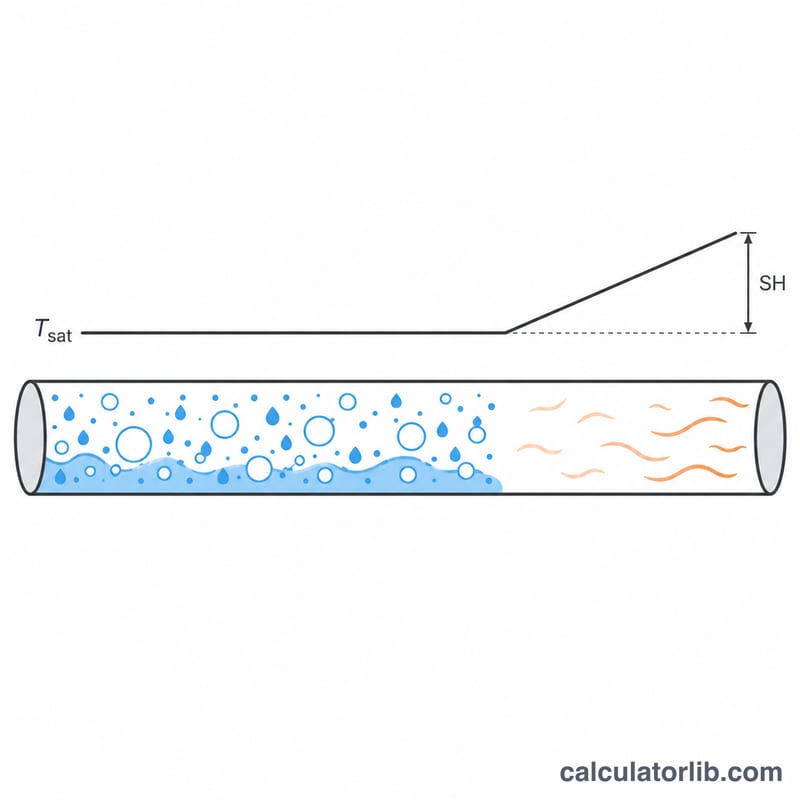
Superheat is how many degrees the refrigerant vapour leaving the evaporator has risen above its boiling point at the pressure it is under. It is the single most useful number for judging the charge of a fixed-orifice air conditioner and for checking a TXV or EEV. This tool works in US service units (psig and degrees F) and converts your suction pressure into a saturation temperature for R-410A, R-22, R-32, R-134a, R-407C or R-404A, then compares the measured superheat against a target.
How to use it
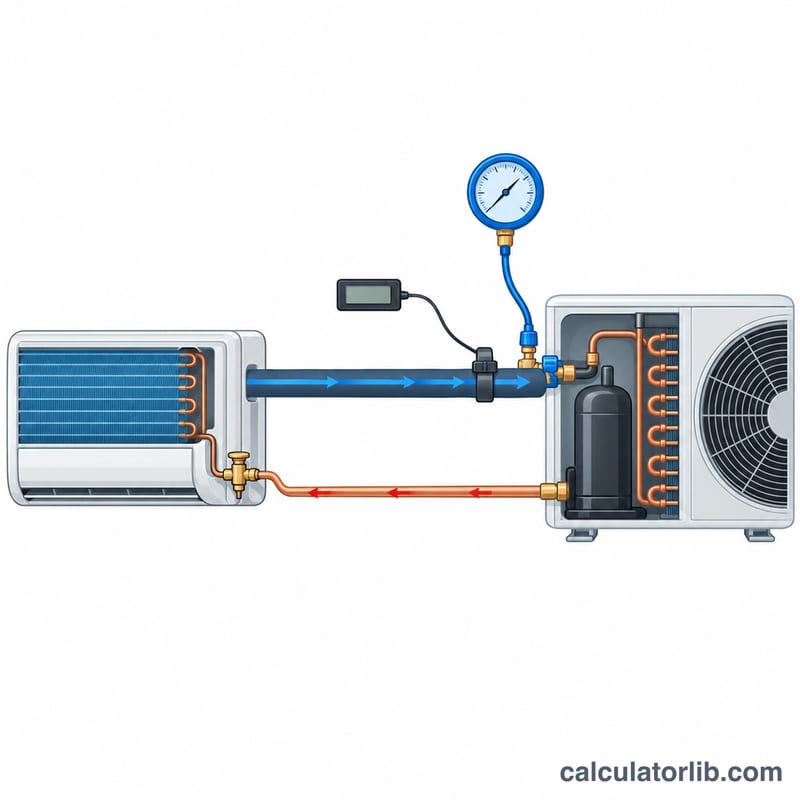
Run the system at least 15 minutes so it stabilises. Read the suction pressure at the service port, then clamp a well-insulated thermocouple on the suction line about 6 inches from the service valve. Enter both values, pick the refrigerant, and choose the metering device. For a fixed orifice also enter indoor wet bulb (at the return) and outdoor dry bulb; for a TXV or EEV enter the manufacturer target, usually 10 degrees F.
The formula
Actual superheat is simply
$$\text{SH} = T_{\text{line}} - T_{\text{sat}}$$where \(T_{\text{line}}\) = suction line temperature and \(T_{\text{sat}}\) = saturation temperature. The saturation temperature is found from an Antoine-type fit of each refrigerant pressure-temperature curve, with \(P\) in psig:
$$T_{\text{sat}} = \frac{B}{A - \log_{10}(P + 14.7)} - C$$The fixed-orifice target uses the classic superheat chart approximation \(\text{SH}_{\text{target}} = (3 \times \text{WB} - 80 - \text{DB})/2\).
Worked example
R-410A, suction 118 psig, line temperature 55 degrees F, fixed orifice, 63 degrees F indoor wet bulb, 85 degrees F outdoor dry bulb:
$$T_{\text{sat}} = \frac{1279.3}{5.24134 - \log_{10}(132.7)} - 370.36 = 39.9^\circ\text{F}$$$$\text{SH} = 55 - 39.9 = 15.1^\circ\text{F}, \quad \text{SH}_{\text{target}} = \frac{189 - 80 - 85}{2} = 12^\circ\text{F}$$A deviation of about +3 degrees F is inside the 5 degree window, so the charge is acceptable.
Target Superheat Chart for Fixed-Orifice Systems
A fixed-orifice metering device (piston/flowrator or capillary tube) does not control superheat, so the correct superheat depends on the load. The target is estimated from the indoor wet-bulb temperature entering the evaporator and the outdoor dry-bulb temperature at the condenser:
$$SH_{target} = \frac{3 \times WB_{indoor} - 80 - DB_{outdoor}}{2}$$
This linear approximation is the target-superheat relationship used in North American residential HVAC service practice (it appears in US manufacturer service literature and utility quality-installation programs); it is not an international standard, and where equipment documentation gives its own charging chart, that documentation always wins. The grid below is computed directly from the formula above, with a 5 °F floor applied.
| Indoor WB (°F) | DB 65 °F | DB 75 °F | DB 85 °F | DB 95 °F | DB 105 °F | DB 115 °F |
|---|---|---|---|---|---|---|
| 55 | 10.0 * | 5.0 | n/a | n/a | n/a | n/a |
| 58 | 14.5 * | 9.5 | n/a | n/a | n/a | n/a |
| 60 | 17.5 * | 12.5 | 7.5 | n/a | n/a | n/a |
| 62 | 20.5 * | 15.5 | 10.5 | 5.5 | n/a | n/a |
| 64 | 23.5 * | 18.5 | 13.5 | 8.5 | n/a | n/a |
| 66 | 26.5 * | 21.5 | 16.5 | 11.5 | 6.5 | n/a |
| 68 | 29.5 * | 24.5 | 19.5 | 14.5 | 9.5 | n/a |
| 70 | 32.5 * | 27.5 | 22.5 | 17.5 | 12.5 | 7.5 |
| 72 | 35.5 * | 30.5 | 25.5 | 20.5 | 15.5 | 10.5 |
Cells marked “n/a” are where the formula returns less than about 5 °F. Do not charge by superheat in these conditions. A target that low means the evaporator is so heavily loaded relative to the condensing temperature that small measurement errors swamp the result, and chasing a 2 °F target invites overcharging and liquid floodback. Wait for conditions to change, or charge by weighed-in charge, subcooling (with manufacturer data) or an approved manufacturer procedure instead.
Cells marked with an asterisk (*) are at an outdoor dry bulb of 65 °F — a low-ambient condition. Most cooling-mode charging charts are only validated above roughly 70–75 °F outdoor dry bulb. At or below that, follow the manufacturer's low-ambient charging procedure (often weigh-in of the nameplate charge, corrected for line-set length) rather than this chart. The same caution applies to a heat pump operating in heating mode, where this cooling-mode target does not apply at all.
Metered systems: TXV and EEV
A thermostatic or electronic expansion valve actively modulates to hold a roughly constant evaporator superheat, so the load-based chart above does not apply. Instead a fixed target is used:
- TXV / EEV: typically 8–12 °F of evaporator superheat, with about 10 °F a common default. The calculator uses the value entered in the TXV target field so you can match a specific model.
- Manufacturer data always rules. Some systems are specified at 5–8 °F, others higher, and TXV systems are normally charged by subcooling with superheat used as a cross-check — superheat outside 8–12 °F on a TXV system usually points to a valve, bulb, filter-drier or airflow problem rather than to charge level.
The ±5 °F acceptance window
The calculator compares actual to target as a deviation:
$$\Delta = SH_{actual} - SH_{target}$$
A result within ±5 °F of target is treated as acceptable, which reflects the realistic stack-up of gauge, thermocouple and wet-bulb measurement error rather than any claim of perfect charge. Outside that window: a strongly negative \(\Delta\) (actual well below target) suggests overcharge or a restricted/low airflow evaporator, while a strongly positive \(\Delta\) suggests undercharge, a liquid-line restriction, or a metering device passing too little refrigerant. Confirm with subcooling, delta-T across the coil and airflow before adding or recovering refrigerant.
This is general technical reference information. Service work on a sealed refrigerant circuit involves high pressures and regulated refrigerants and, in many countries, requires a certified technician.
FAQ
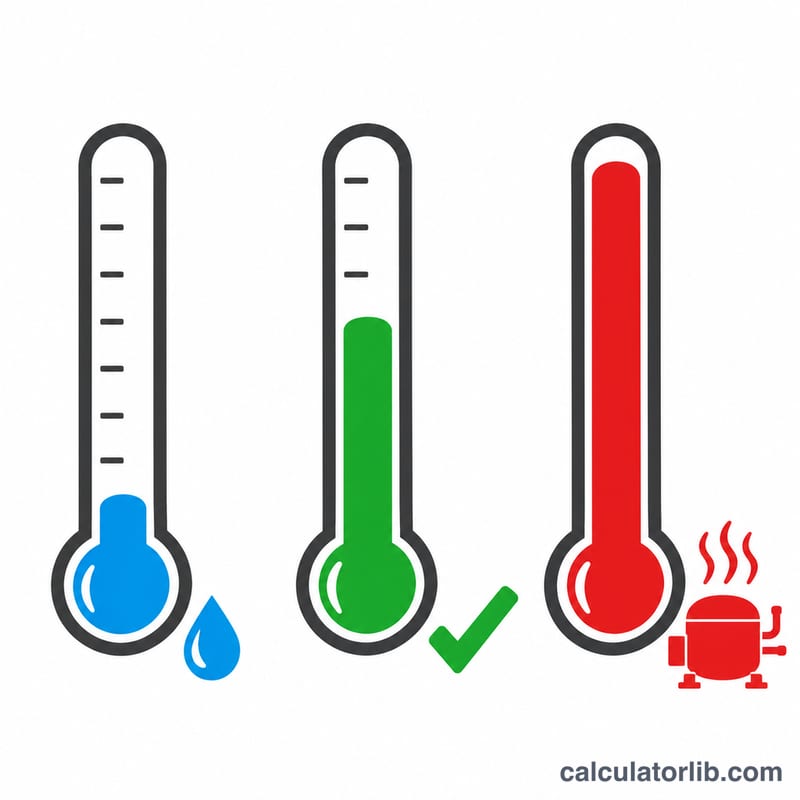
High superheat means what? Too little refrigerant is reaching the evaporator: undercharge, a liquid-line restriction, a starving metering device, or an unusually low indoor load.
Low superheat means what? The evaporator is being overfed, usually overcharge or a stuck-open valve. Below roughly 5 degrees F liquid can return to the compressor and wash out the oil.
Can I use superheat alone to charge a TXV system? No. A TXV holds superheat nearly constant, so charge it by subcooling and use superheat only as a sanity check.