What this calculator does
This tool uses US customary units (gallons, acres, miles per hour, inches), the standard basis for sprayer calibration in North America. It turns three measured numbers — nozzle output, travel speed and nozzle spacing — into the application rate your sprayer is actually delivering, then tells you how many acres one tank covers, how long that tank lasts and how much formulated product to pour into it.
How to use it
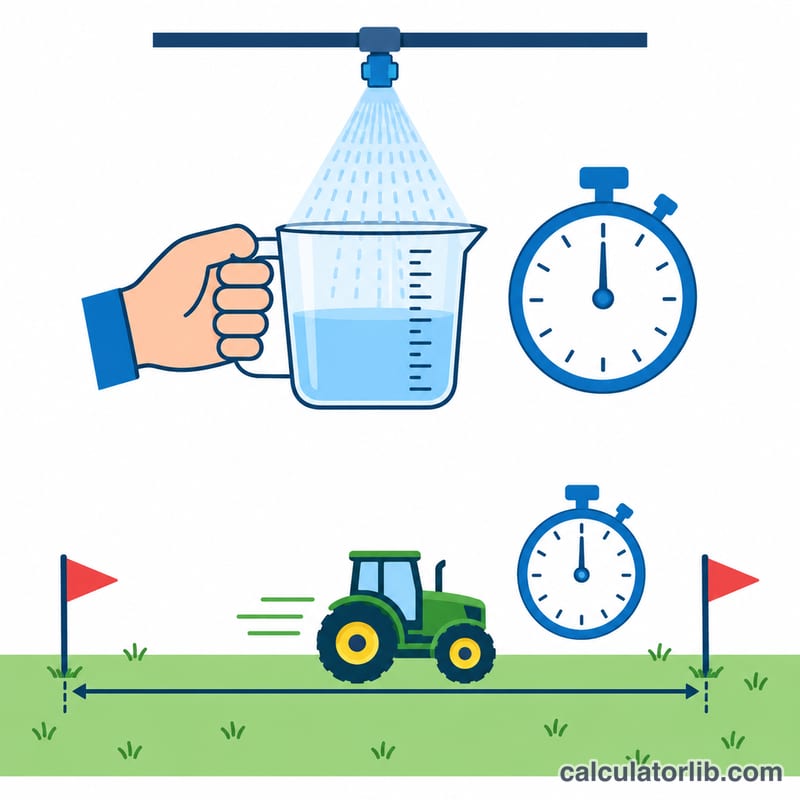
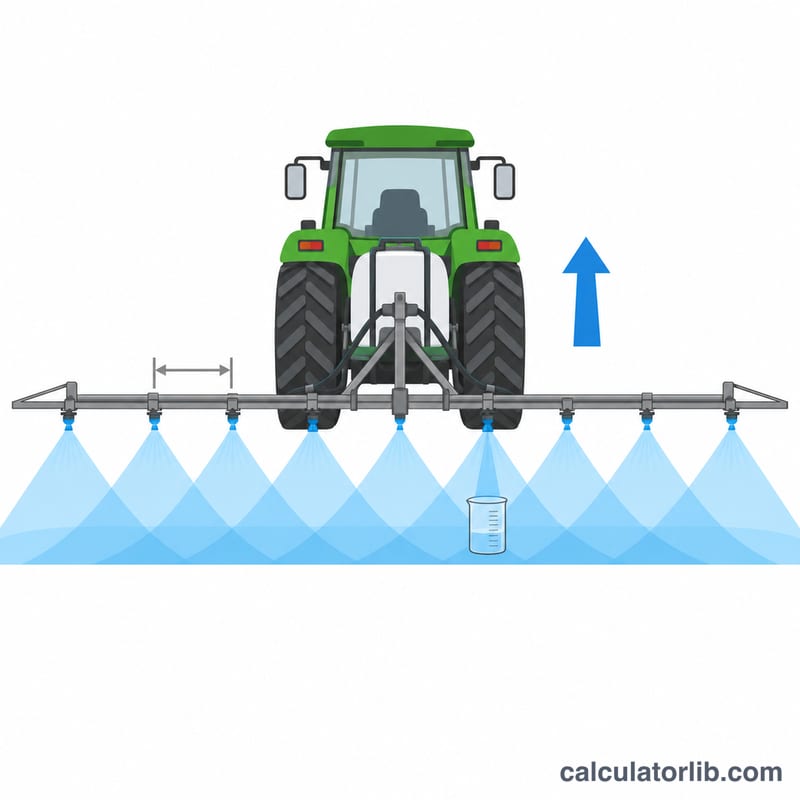
Catch the output of one nozzle in a jug for exactly 60 seconds at your normal spray pressure and measure it in gallons per minute (16 fl oz = 0.125 gal). Measure your true travel speed over a known distance at the throttle and gear you will spray in. Measure spacing centre-to-centre between nozzles. For a single-nozzle backpack wand, enter 1 nozzle and use the swath width you can hold consistently, in inches. Finally enter tank volume and the label rate in fluid ounces per acre.
The formula explained
Broadcast application rate is
$$\text{GPA} = \frac{5940 \times \text{GPM}}{\text{MPH} \times W}$$where \(\text{GPM}\) = output of one nozzle in gallons per minute, \(\text{MPH}\) = travel speed, and \(W\) = nozzle spacing in inches. The 5940 comes from \(43{,}560 \times 12 / 88\): square feet per acre, inches per foot, and feet per minute per mph.
Worked example
A boom with 12 nozzles on 20-inch spacing, each flowing 0.3 GPM at 4 mph:
$$\text{GPA} = \frac{5940 \times 0.3}{4 \times 20} = \frac{1782}{80} = 22.28$$A 200-gallon tank therefore covers
$$A = \frac{200}{22.275} = 8.98\,\text{acres}$$At a label rate of 32 fl oz per acre you add \(32 \times 8.98 = 287.3\) fl oz of product per tank, and the tank empties in \(200 / (12 \times 0.3) = 55.6\) minutes.
Nozzle Tip Flow Rates and Calibration Constants
Every calibration starts with two known quantities: what one nozzle actually puts out, and the geometric constant that converts that output into gallons per acre. The tables below cover both. All figures are US customary (GPM, psi, mph, inches, acres) — the constants 5940 and 495 exist only because of those units, so metric users working in L/ha and km/h need different factors.
Nominal flat-fan flow by ISO/ANSI color code
Flat-fan tips are color-coded by nominal capacity (ISO 10625, mirrored in ANSI/ASABE S572). In the US convention the size number is the flow in GPM at the reference pressure of 40 psi: an 02 tip flows 0.2 GPM, an 05 flows 0.5 GPM. Flow at other pressures follows the square-root orifice rule:
$$\text{GPM}_2 = \text{GPM}_1 \times \sqrt{\frac{p_2}{p_1}}$$Because flow scales with the square root of pressure, you must quadruple pressure to double output — pressure is a fine-tuning tool, not a rate control.
| Color | Size code | 20 psi | 30 psi | 40 psi (nominal) | 60 psi |
|---|---|---|---|---|---|
| Orange | 01 | 0.07 | 0.09 | 0.10 | 0.12 |
| Green | 015 | 0.11 | 0.13 | 0.15 | 0.18 |
| Yellow | 02 | 0.14 | 0.17 | 0.20 | 0.24 |
| Lilac | 025 | 0.18 | 0.22 | 0.25 | 0.31 |
| Blue | 03 | 0.21 | 0.26 | 0.30 | 0.37 |
| Red | 04 | 0.28 | 0.35 | 0.40 | 0.49 |
| Brown | 05 | 0.35 | 0.43 | 0.50 | 0.61 |
| Grey | 06 | 0.42 | 0.52 | 0.60 | 0.73 |
| White | 08 | 0.57 | 0.69 | 0.80 | 0.98 |
| Light blue | 10 | 0.71 | 0.87 | 1.00 | 1.22 |
Example of the scaling rule for a red 04 tip taken from 40 psi down to 30 psi: \(0.40 \times \sqrt{30/40} = 0.40 \times 0.866 = 0.35\) GPM. Treat these as catalog nominal values; a worn or partly plugged tip can be well above them, which is exactly what calibration is meant to catch. Check pressure at the boom end with a gauge, not at the pump.
Calibration constants
| Constant | Used in | Where it comes from |
|---|---|---|
| 5940 | \(\text{GPA} = \dfrac{5940 \times \text{GPM}}{\text{MPH} \times \text{spacing (in)}}\) — broadcast boom, nozzle spacing in inches | \(43{,}560 \times 12 \div 88\) |
| 495 | \(\text{GPA} = \dfrac{495 \times \text{GPM}}{\text{MPH} \times \text{swath (ft)}}\) — single nozzle, band or backpack swath measured in feet | \(43{,}560 \div 88\) (and \(5940 \div 12\)) |
| 88 | Feet per minute per 1 mph | \(5280 \div 60\) |
| 43,560 | Square feet per acre | Definition of the US acre |
| 128 | Fluid ounces per US gallon | US liquid measure |
| 340.3 | Square feet in 1/128 acre — the basis of the "ounces = GPA" shortcut | \(43{,}560 \div 128\) |
Worked check of the 5940 form, using a brown 05 tip on 15-inch spacing at 4 mph: \(\text{GPA} = (5940 \times 0.5) \div (4 \times 15) = 2970 \div 60 =\) 49.5 GPA — a high-volume fungicide setting.
The 1/128-acre (ounce-calibration) method
Spray 1/128 of an acre per nozzle and catch its output for the same number of seconds: because a gallon holds 128 fluid ounces, the fluid ounces caught equal gallons per acre, with no further math. The required course length is \(340.3 \div \text{spacing in feet}\):
| Spacing | Spacing (ft) | Course length (ft) |
|---|---|---|
| 15 in | 1.25 | 272 |
| 18 in | 1.5 | 227 |
| 20 in | 1.67 | 204 |
| 24 in | 2.0 | 170 |
| 30 in | 2.5 | 136 |
| 36 in | 3.0 | 113 |
| 40 in | 3.33 | 102 |
| 48 in | 4.0 | 85 |
| 60 in | 5.0 | 68 |
- Fill the tank with clean water, set your working pressure, and drive the course at your normal field speed; record the seconds with a stopwatch.
- Parked, at the same pressure and throttle, catch one nozzle's discharge for exactly that many seconds.
- Ounces caught = GPA. Repeat on several nozzles across the boom and average them.
If you prefer to measure flow directly instead, time a nozzle for 60 seconds, convert ounces to gallons (divide by 128), and enter that GPM, your speed and spacing above.
Typical Spray Volumes, Pressures and Speeds
Carrier volume, pressure and ground speed are three dials on the same machine: each one changes gallons per acre, and only two of them can be chosen freely once the target rate is fixed. The ranges below are general operating guidelines drawn from common US/Canadian extension-service practice and nozzle-manufacturer catalogs, expressed in US units (GPA, psi, mph). They never override the pesticide label. The label's application rate, and often its minimum carrier volume, droplet-size or spray-quality requirement, is the legally binding instruction in most jurisdictions — including the United States, where label directions are enforceable under FIFRA. Read it first and calibrate to it.
Broadcast carrier volume by job
| Application | Typical GPA | Why |
|---|---|---|
| Post-emergence systemic herbicide | 10–20 | Lower volumes keep deposits concentrated; systemics move in the plant, so total leaf coverage is not required |
| Pre-emergence / soil-applied herbicide | 15–25 | Needs even distribution onto the soil surface, not leaf retention |
| Fungicides and contact insecticides | 20–40+ | Non-mobile products must physically cover the target surface, including lower canopy |
| Backpack spot or banded treatment | 10–30 | Wide span because walking speed and wand technique vary; always calibrate your own walk |
| Dense canopy / late-season row crops | Toward the top of the label range | More water improves penetration past the upper leaves |
Normal operating pressure by tip type
| Tip type | Typical range | Notes |
|---|---|---|
| Standard flat fan | 15–40 psi | Pattern collapses below about 15 psi; fine droplets and drift rise sharply above 40 |
| Extended-range flat fan | 15–60 psi | Holds a usable pattern over a wider window, which is why it is the common all-purpose tip |
| Air-induction / venturi (drift-reduction) | 30–90 psi | Needs higher pressure to aspirate air and form coarse, air-filled droplets |
| Flood, stream bar and solid-stream tips | 10–25 psi | Low-pressure, coarse-droplet designs for fertilizer and soil-applied work |
Always confirm the window printed in the manufacturer's catalog for the exact tip, and stay inside the hose, fitting and pump pressure ratings.
Ground speed
- Tractor or UTV boom: 3–6 mph is the common working band. Faster passes starve coverage and amplify boom bounce and drift.
- Walking with a backpack: 1–3 mph. Remember that 1 mph is exactly 88 ft/min, so 2 mph is 176 ft/min and 3 mph is 264 ft/min — pace yourself against a measured, timed course rather than by feel.
- Consistency beats precision: GPA is inversely proportional to speed, so a pass run 25% faster than calibration applies 20% less product. Note the engine rpm and gear you calibrated in and repeat them.
Calibration tolerance — when to replace tips
- Nozzle uniformity: each nozzle's measured output should be within about ±5% of the boom average. Replace any outlier beyond roughly ±10%; a tip that still deviates after cleaning is worn or damaged.
- Boom average vs. rated flow: if the average output exceeds the tip's catalog flow at your working pressure by more than about 5–10%, the set is worn out — replace all tips at once, not one at a time, so the boom stays uniform.
- Measured GPA vs. target: get within a few percent of the label rate by adjusting speed or pressure; if you cannot reach it inside the tip's pressure window, change tip size instead of running the tip out of range.
- How often: recalibrate at the start of each season, after any tip, pump or speed change, and periodically during heavy use — abrasive formulations wear orifices quickly.
These values are general operating information, not a recommendation for a specific product, crop or site. Follow the product label and your local regulatory requirements, and consult your extension service or a licensed advisor for application decisions.
How Speed, Spacing and Tip Size Change Your Rate
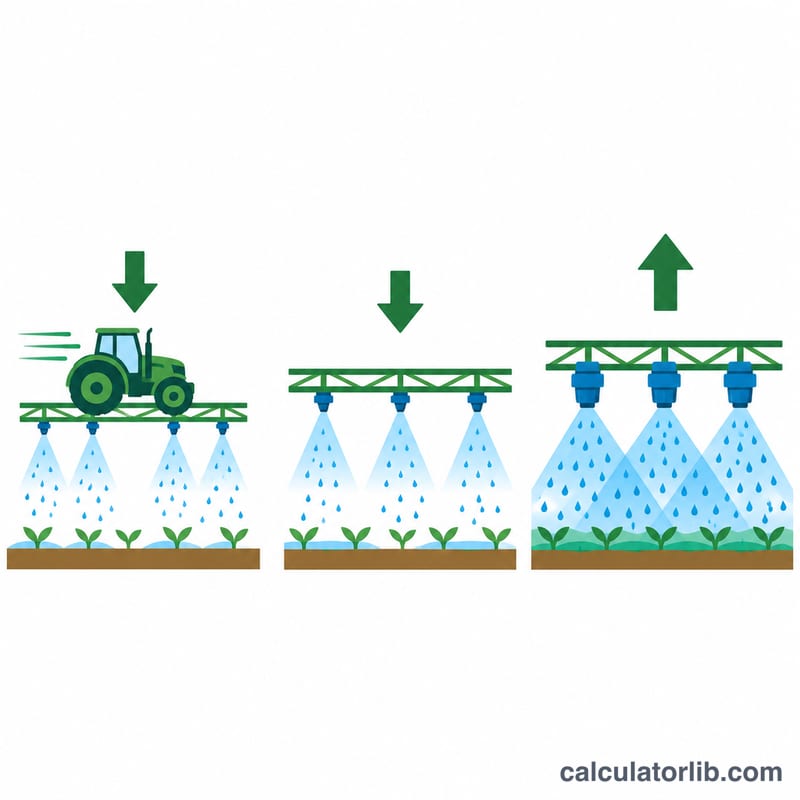
The broadcast relationship \(\text{GPA} = \dfrac{5940 \times \text{GPM}}{\text{MPH} \times \text{spacing (in)}}\) says everything about trade-offs: flow is in the numerator, speed and spacing in the denominator. Double the speed and you halve the rate; go from 20-inch to 30-inch spacing and you cut the rate by a third, because each nozzle now has to cover 50% more ground.
Every row below assumes a 200-gallon tank and a product label rate of 32 fl oz per acre. Acres per tank is \(200 \div \text{GPA}\); product per tank is \(32 \times \text{acres per tank}\). GPA is shown to one decimal so you can verify each row by hand.
| Scenario | Flow (GPM/nozzle) | Speed (mph) | Spacing (in) | GPA | Acres per 200-gal tank | Product per tank (fl oz) |
|---|---|---|---|---|---|---|
| Baseline (blue 03 tip) | 0.30 | 4 | 20 | 22.3 | 9.0 | 287 |
| Baseline, 50% faster | 0.30 | 6 | 20 | 14.9 | 13.5 | 431 |
| Baseline, double speed | 0.30 | 8 | 20 | 11.1 | 18.0 | 575 |
| One tip size up (red 04) | 0.40 | 4 | 20 | 29.7 | 6.7 | 215 |
| Baseline tip on 30-in rows | 0.30 | 4 | 30 | 14.9 | 13.5 | 431 |
| Small tip, narrow spacing (yellow 02) | 0.20 | 5 | 15 | 15.8 | 12.6 | 404 |
| Backpack wand, 30-in swath | 0.25 | 2 | 30 | 24.8 | 8.1 | 259 |
Reading the rows:
- Speed is the strongest lever you can pull without changing hardware. Going 4 → 6 → 8 mph with the same tip drops the rate 22.3 → 14.9 → 11.1 GPA. Note that rows 2 and 5 land on the identical 14.9 GPA by two different routes — 50% more speed, or 50% more spacing.
- Tip size moves the rate proportionally. 0.30 → 0.40 GPM is a 33% flow increase and a 33% rate increase (22.3 → 29.7 GPA). That also shrinks tank coverage from 9.0 to 6.7 acres, so you mix less product per load.
- Pressure is a weak lever. To lift 22.3 GPA to 29.7 GPA by pressure alone you would need \((29.7/22.3)^2 \approx 1.77\) times the pressure — 40 psi becomes about 71 psi, outside the window of a standard flat fan.
- The backpack row works the same way, with "spacing" being the swath the wand actually covers. A 4-gallon backpack at 24.8 GPA covers only \(4 \div 24.8 = 0.16\) acre, so it needs about \(32 \times 0.16 = 5.2\) fl oz of product per fill — measure that with a small graduated cylinder, not by eye.
Two other outputs worth checking before you leave the yard: total boom flow \(Q_t = \text{GPM} \times \text{number of nozzles}\), and tank time \(t = \text{tank} \div Q_t\). A 20-nozzle boom of 04 tips flows \(0.40 \times 20 = 8.0\) GPM, so a 200-gallon tank runs 25 minutes — and at 29.7 GPA covers 6.7 acres, about 16 acres per hour of actual spraying before refills. Plan your mix and your water stops around those numbers, and confirm the final rate against the product label.
FAQ
Why did my rate change when I sped up? Application rate is inversely proportional to speed: at constant pressure, doubling speed halves GPA. Pressure must rise fourfold to double flow, so change nozzle tips rather than chasing big rate changes with pressure.
How often should I recalibrate? At least once a season, after changing tips, pressure, speed or spacing, and whenever worn tips push output more than 10% above the new-tip rating.
Can I use litres and hectares? Not directly — this calculator is built on the 5940 constant for US units. Convert your measurements first (1 L/min = 0.264 GPM, 1 ha = 2.471 ac).