What Is the Egg Production Cost Calculator?
This calculator works out what each egg costs you to produce. You enter your flock size, laying rate, how much feed each hen eats and what it costs, and your labor and overhead for the period. It gives you the cost per egg, the cost per dozen, and the total cost behind it. Backyard keepers can use it to compare home eggs with store prices. Small farms can use it to set a selling price that covers their costs.
How to Use It
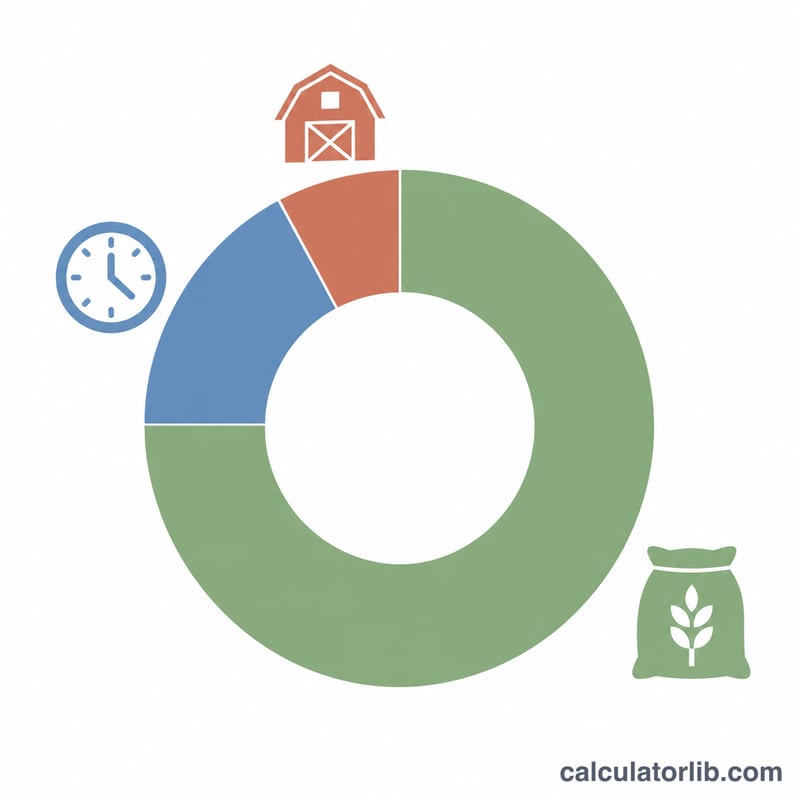
Enter the number of laying hens and your average laying rate. A healthy flock in peak lay usually runs at 75–90%. Pick a period, such as 30 days. Then enter daily feed per hen (often 0.11–0.13 kg) and your feed price per kg. Add the labor cost for that period, plus overhead such as bedding, electricity, vet care, supplements and equipment depreciation.
The Formula
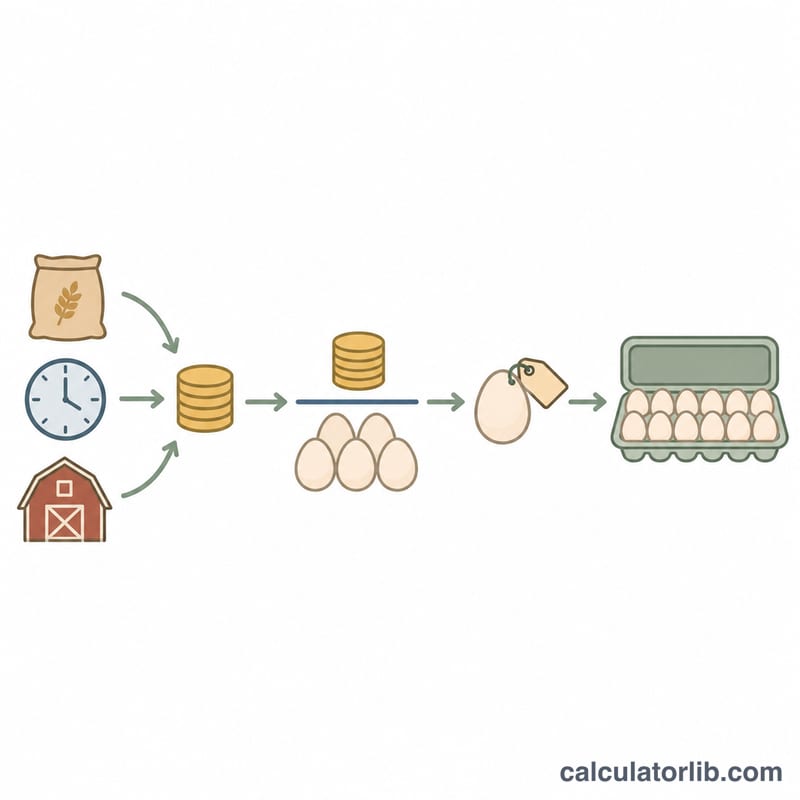
Total eggs and total cost are:
$$E = N \times \frac{r}{100} \times d, \qquad C = N f d p + L + O$$Here \(N\) = hens, \(r\) = laying rate in %, \(d\) = days, \(f\) = feed per hen per day in kg, \(p\) = feed price per kg, \(L\) = labor and \(O\) = overhead. The cost per egg is \(C/E\), and the cost per dozen is 12 times that.
Worked Example
Say you have 50 hens laying at 80% over 30 days. Each hen eats 0.12 kg of feed a day at 0.50 per kg, labor costs 60 and overhead costs 40.
$$E = 50 \times 0.8 \times 30 = 1200 \text{ eggs}$$$$C = 50 \times 0.12 \times 30 \times 0.5 + 60 + 40 = 190$$$$C_{\text{dozen}} = \frac{190}{1200} \times 12 = 1.90$$Each egg costs about 0.158 to produce, or 1.90 per dozen.
How Flock Size, Laying Rate and Feed Price Change Your Cost
The table below runs five scenarios through the calculator's formula over a 30-day period. Every scenario uses a feed intake of 0.12 kg per hen per day. Costs are in generic currency units, so they work for any currency. The base case is 50 hens laying at 80%, with feed at 0.50/kg, labor of 60 and overhead of 40.
Here is the base case worked through in full:
$$E = 50 \times \frac{80}{100} \times 30 = 1200 \text{ eggs}$$$$C = 50 \times 30 \times 0.12 \times 0.50 + 60 + 40 = 90 + 100 = 190$$$$\text{Cost per Dozen} = 12 \times \frac{190}{1200} = 12 \times 0.1583 = 1.90$$| Scenario | Hens | Laying rate | Feed price/kg | Labor | Overhead | Total eggs | Total cost | Cost per egg | Cost per dozen | Feed share of cost |
|---|---|---|---|---|---|---|---|---|---|---|
| 1. Base case | 50 | 80% | 0.50 | 60 | 40 | 1,200 | 190.00 | 0.1583 | 1.90 | 47.4% |
| 2. Winter laying slump | 50 | 55% | 0.50 | 60 | 40 | 825 | 190.00 | 0.2303 | 2.76 | 47.4% |
| 3. Higher feed price | 50 | 80% | 0.65 | 60 | 40 | 1,200 | 217.00 | 0.1808 | 2.17 | 53.9% |
| 4. Backyard flock | 6 | 70% | 0.50 | 0 | 5 | 126 | 15.80 | 0.1254 | 1.50 | 68.4% |
| 5. Larger flock | 500 | 85% | 0.50 | 400 | 300 | 12,750 | 1,600.00 | 0.1255 | 1.51 | 56.3% |
How the figures were worked out: feed cost = hens × 30 × 0.12 × feed price. For example, scenario 3 uses 180 kg × 0.65 = 117, and scenario 5 uses 1,800 kg × 0.50 = 900. Feed share = feed cost ÷ total cost. In the backyard scenario, labor is set to zero, meaning the owner's time is not counted. That is why its cost per dozen comes out low.
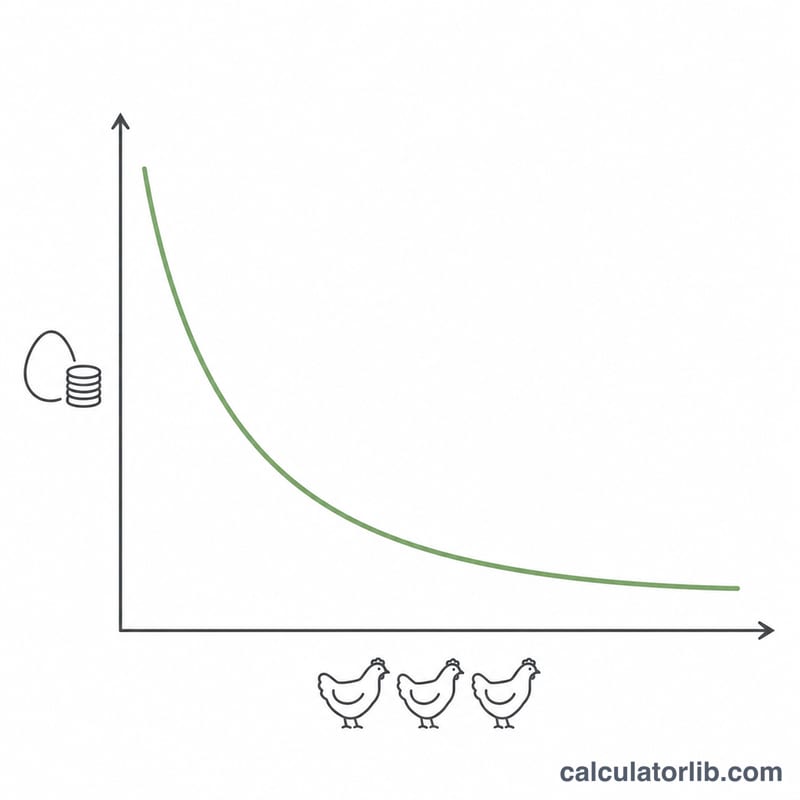
Which input moves the cost the most: the laying rate. Dropping from 80% to 55% raises the cost per dozen by about 45%, from 1.90 to 2.76. That happens because almost every cost, including feed for non-laying hens, keeps running while egg output falls. By comparison, a 30% rise in feed price lifts the cost per dozen by only about 14%, from 1.90 to 2.17. Fixed labor and overhead also matter a lot in small flocks. Spreading them over more eggs is the main reason the 500-hen flock costs less per dozen than the 50-hen base case.
Typical Input Ranges for Laying Hens
Use the values below as a sanity check for your inputs. They are broad, widely published figures, not targets for any particular flock. Real results depend on breed or strain, hen age, housing system, lighting program, feed formulation, health and climate.
| Parameter | Typical range | Notes |
|---|---|---|
| Hen-day laying rate at peak (commercial hybrids) | About 90–95% | Reached in the first months of lay under good management. |
| Hen-day laying rate averaged over a laying cycle (commercial hybrids) | About 75–85% | A realistic figure for long-run cost estimates. |
| Hen-day laying rate for heritage or dual-purpose breeds | Roughly 50–70% | Breeds vary widely. |
| Second-year hens and winter months | Lower than the figures above | Output falls with age, during molt and when days are short unless extra lighting is used. |
| Daily feed intake for light (white-egg) hybrids | About 100–120 g (0.10–0.12 kg) per hen | Rises in cold weather and falls in heat. |
| Daily feed intake for dual-purpose or heavy breeds | About 120–150 g (0.12–0.15 kg) per hen | Larger body size means higher maintenance needs. |
| Feed conversion for commercial layers | Roughly 2.0–2.3 kg feed per kg of eggs | Backyard and heritage flocks usually convert feed less efficiently. |
| Feed as a share of total production cost | Roughly 55–70% | Typical for commercial operations; share shifts with local feed and labor prices. |
If your laying rate or feed intake falls well outside these ranges, check the inputs first. For example, make sure you entered the laying rate as a percentage and feed in kilograms rather than grams. If the inputs are correct, the gap may point to a management issue worth looking into.
If feed comes out well below 55% of your total cost, your labor or overhead may be high relative to flock size. This is common in small flocks; the 50-hen base case above shows it. Sources for these ranges include breed management guides published by layer genetics companies (such as Hy-Line, Lohmann and ISA) and poultry guidance from university agricultural extension services. Check the guide for your specific strain and region where you can.
FAQ
Should I count my own time as labor?
Yes, if you want the true economic cost. If you only want your out-of-pocket cost, enter zero for labor.
Why does my cost rise in winter?
Shorter days lower the laying rate, but the hens eat the same amount or more. The same costs are spread over fewer eggs.
What share of the cost is usually feed?
Feed is usually the largest single cost, often 60–70% of the total. That makes feed price and feed waste the first things to check.