What is the Cocktail ABV Calculator?
The Cocktail ABV Calculator estimates the alcohol by volume of a finished mixed drink. A spirit bottle lists its strength, but once you combine spirits, liqueurs, juices and melting ice, the drink in your glass is weaker than any single ingredient. This tool adds up the pure alcohol from every ingredient and divides it by the total liquid volume so you know how strong the cocktail really is.
How to use it
Enter the volume in millilitres and the ABV percentage for each ingredient. Set the ABV to 0 for non-alcoholic mixers such as juice or soda. Add an estimate of the water from melting ice in the dilution field; a stirred or shaken drink typically gains 20-30 ml. The calculator returns the final ABV, the total volume and the millilitres of pure alcohol.
The formula
Each ingredient contributes pure alcohol equal to its volume times its ABV fraction, \( V_i \times \tfrac{ {\text{ABV}_i}}{100} \). The final strength is the total alcohol divided by the total volume:
$$\text{ABV}_{final} = \frac{\sum V_i \times \tfrac{ {\text{ABV}_i}}{100}}{\sum V_i + V_{ice}} \times 100$$where \( V_i \) = volume of ingredient i and \( V_{ice} \) = water added by dilution.
Worked example
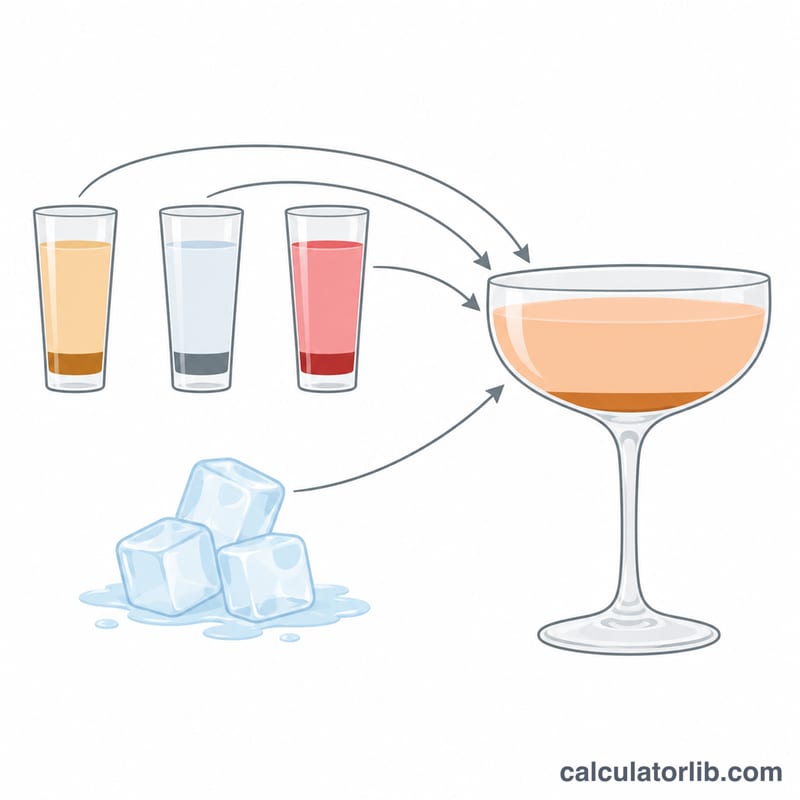
A Negroni uses 30 ml gin (40%), 30 ml Campari (24%) and 30 ml sweet vermouth (16%), with about 30 ml of dilution from stirring over ice:
$$\text{ABV} = \frac{(30\times0.40)+(30\times0.24)+(30\times0.16)}{30+30+30+30}\times100 = \frac{24}{120}\times100 = 20\%$$So the finished Negroni is roughly 20% ABV, about half the strength of the gin it started with.
Typical ABV of Common Cocktail Ingredients
Enter each ingredient's alcohol by volume (ABV) as a percentage. The table below shows typical ranges by ingredient type. Use them as a starting point when you don't have the bottle in front of you. Non-alcoholic mixers count as 0%, but their volume still goes into the total and dilutes the drink.
| Ingredient type | Examples | Typical ABV |
|---|---|---|
| Standard spirits | Vodka, gin, rum, tequila, whisky | 37.5–40% |
| Navy-strength or overproof spirits | Navy-strength gin, overproof rum, cask-strength whisky | 50–75% |
| Absinthe | Absinthe | 45–74% |
| Orange liqueurs | Triple sec (varies widely by brand) | 15–40% |
| Orange liqueurs | Cointreau | 40% |
| Bitter aperitifs | Campari (varies by market) | 20.5–28.5% |
| Bitter aperitifs | Aperol | 11% |
| Vermouth | Sweet (rosso) and dry vermouth | 15–18% |
| Fortified wines | Sherry, port | 15–22% |
| Still wine | Red, white, rosé | 11–14% |
| Sparkling wine | Prosecco, Champagne, cava | 11–12.5% |
| Beer | Lager, pale ale | 4–6% |
| Aromatic bitters | Angostura-style bitters | About 44.7% (used in dashes, so it barely changes the total) |
| Non-alcoholic mixers | Juices, syrups, sodas, tonic | 0% |
Check the label. The same brand can be bottled at different strengths in different countries, and legal minimums vary by country. For example, the EU minimum for vodka and gin is 37.5%, while spirits sold in the United States are commonly bottled at 40% (80 proof). Always enter the ABV printed on your bottle for the most accurate result. A dash of bitters is about 0.6–1 ml, so you can usually leave it out of the calculation.
Typical Strength of Classic Cocktails
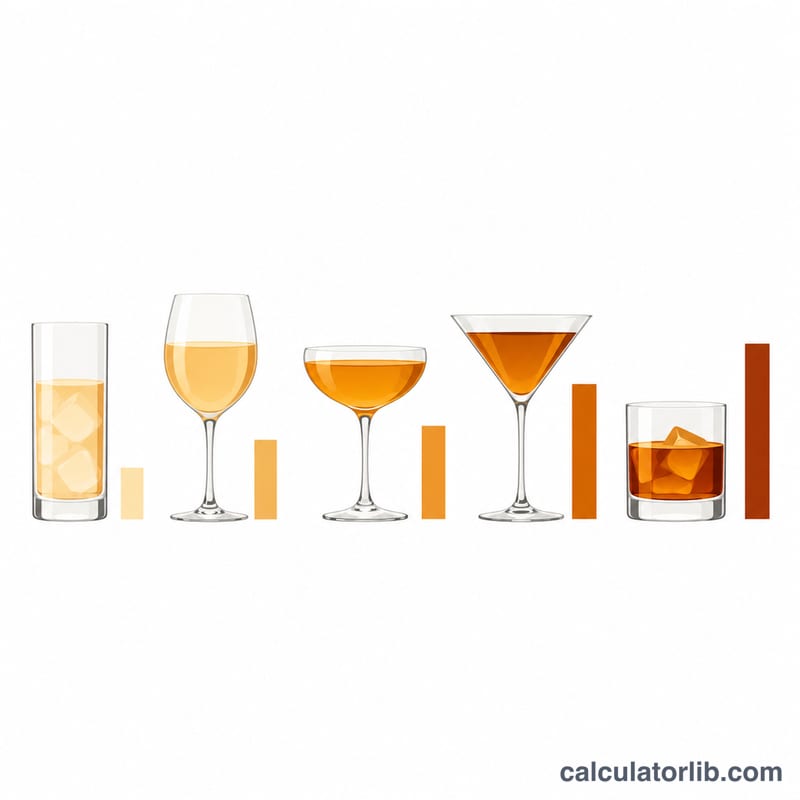
These are approximate finished ABVs, after the drink has been stirred or shaken with ice and the meltwater is included. Real values depend on the recipe, the spirit's strength, how long you stir or shake, and how much soda or tonic you add.
| Drink | Method | Approximate final ABV |
|---|---|---|
| Martini or Manhattan | Stirred | About 28–32% |
| Old Fashioned | Stirred, built over ice | About 30–32% |
| Negroni | Stirred | About 20–25% |
| Daiquiri or Margarita | Shaken | About 15–20% |
| Whiskey Sour | Shaken | About 14–16% |
| Mojito | Built or muddled, topped with soda | About 10–13% |
| Gin and Tonic or other highballs | Built, topped with mixer | About 8–12% |
| Aperol Spritz | Built, with sparkling wine and soda | About 8–11% |
| For comparison: wine | — | About 12% |
| For comparison: beer | — | About 5% |
Example (Daiquiri): 60 ml rum at 40%, 30 ml lime juice at 0%, 15 ml simple syrup at 0%, and about 55 ml of meltwater from shaking:
$$\text{ABV}_{\text{final}} = \frac{60 \times 40 + 30 \times 0 + 15 \times 0}{60 + 30 + 15 + 55} = \frac{2400}{160} = 15\%$$The result is 15%, at the low end of the range for shaken sours.
Example (Negroni): 30 ml gin at 40%, 30 ml Campari at 24%, 30 ml sweet vermouth at 16%, and 30 ml of meltwater from stirring:
$$\text{ABV}_{\text{final}} = \frac{30 \times 40 + 30 \times 24 + 30 \times 16}{30 + 30 + 30 + 30} = \frac{2400}{120} = 20\%$$The result is 20%. A stronger Campari, a higher-proof gin, or less dilution moves it toward 25%.
These figures are approximate. Recipes vary between bars and countries, and dilution can range from about 20% to over 50% of the original volume. Entering your own recipe in the calculator gives a more reliable number.
FAQ
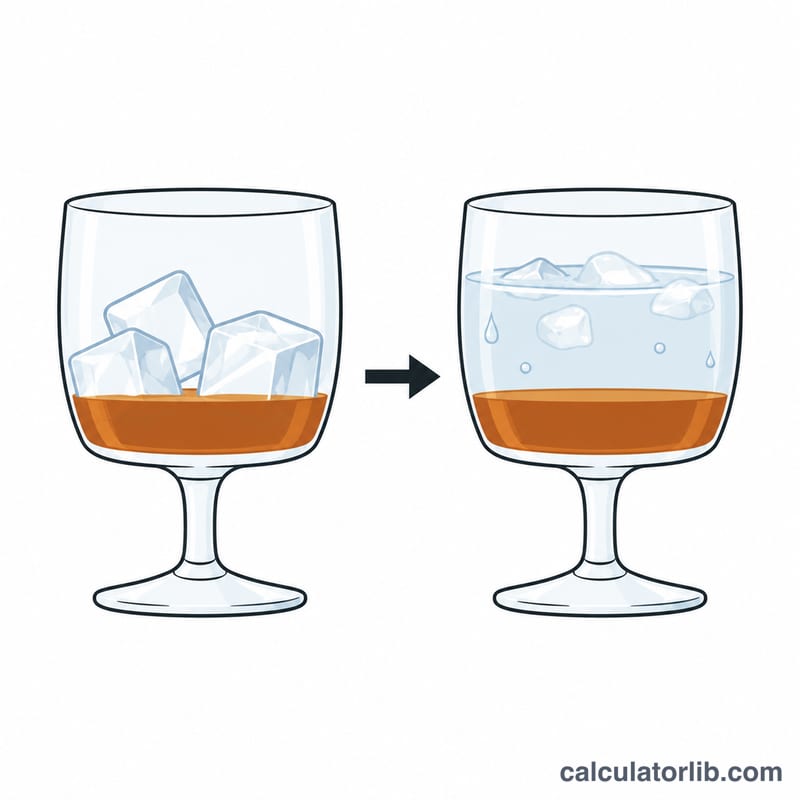
Does ice really matter? Yes. Dilution can lower a stirred drink by several ABV points and is part of good balance, not a flaw.
How much dilution should I add? A quick shake adds about 25-30 ml of water and a short stir around 15-20 ml. Use 0 if the drink is served without ice.
Is this lab accurate? It is a close volumetric estimate. Real mixing causes slight volume contraction, so treat the result as a reliable guide rather than a certified measurement.