
What Is the Fertilizer Cost Calculator?
The Fertilizer Cost Calculator estimates how much you will spend to fertilize a field of any size. By combining the field area, the application rate, and the unit price of your fertilizer, it returns the total quantity required, the full material cost of the job, and a per-area figure that makes budgeting simple.
How to Use It
Enter three values: the field area in acres, the application rate in kilograms per acre, and the price per kilogram of fertilizer. The calculator multiplies them together to show the total fertilizer needed and the total cost for the field.
The Formula Explained
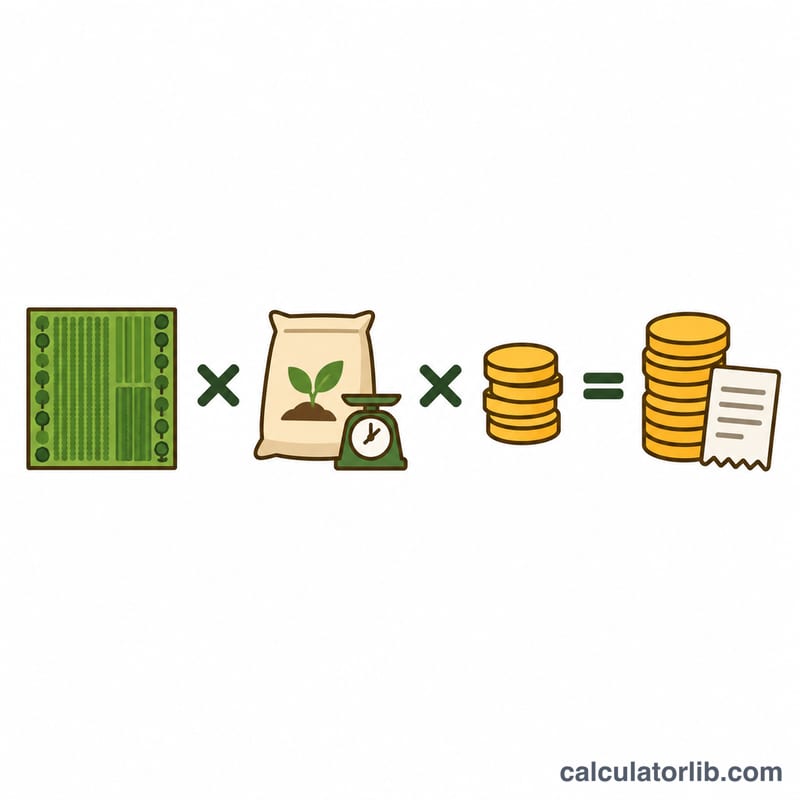
The core relationship is a simple product. Let \(A\) = field area, \(R\) = application rate, and \(P\) = price per unit of fertilizer:
$$\text{Total Cost} = A \times R \times P$$The total fertilizer required is \(A \times R\), and the cost per acre is \(R \times P\).
Worked Example
Suppose you fertilize 10 acres at 50 kg per acre, with fertilizer priced at $2 per kg. The fertilizer needed and total cost are:
$$A \times R = 10 \times 50 = 500\,\text{kg}$$$$\text{Total Cost} = 500 \times \$2 = \$1000$$That works out to $100 per acre, a convenient figure for comparing fields or products.
Nutrient Content of Common Fertilizers
The calculator uses the product application rate in kg per acre. Agronomic recommendations usually give a nutrient rate instead, such as kg of N per acre. To get from one to the other, you need the fertilizer's guaranteed analysis. That is the three numbers on the label, given as percent N, P2O5 and K2O by weight. Most markets, including the US, state phosphorus and potassium in this oxide form. Some countries also print elemental P and K, so check which form your label and recommendation use.
| Fertilizer | Typical analysis (N-P2O5-K2O) | Notes |
|---|---|---|
| Anhydrous ammonia | 82-0-0 | Pressurized gas; injected into soil |
| Urea | 46-0-0 | Highest-N dry fertilizer |
| Ammonium nitrate | 34-0-0 | Dry; sales are restricted in some countries |
| UAN solution | 28-0-0 to 32-0-0 | Liquid urea–ammonium nitrate; grades 28%, 30% and 32% N |
| Ammonium sulfate | 21-0-0 | Also supplies about 24% sulfur |
| Diammonium phosphate (DAP) | 18-46-0 | Supplies both N and P |
| Monoammonium phosphate (MAP) | 11-52-0 | Supplies both N and P |
| Triple superphosphate (TSP) | 0-46-0 | Phosphorus only |
| Muriate of potash (potassium chloride) | 0-0-60 | Most common potassium source |
| Sulfate of potash (potassium sulfate) | 0-0-50 | Also supplies sulfur; contains no chloride |
To convert a nutrient rate into a product rate, divide by the nutrient fraction:
$$\text{Product rate} = \frac{\text{Nutrient rate}}{\text{Nutrient \%} / 100}$$Example: A recommendation of 50 kg N per acre, supplied as urea (46% N), needs:
$$\frac{50}{0.46} \approx 108.7 \text{ kg urea per acre}$$Enter 108.7 as the rate in the calculator, not 50.
Unit Conversions for Rates, Area and Price
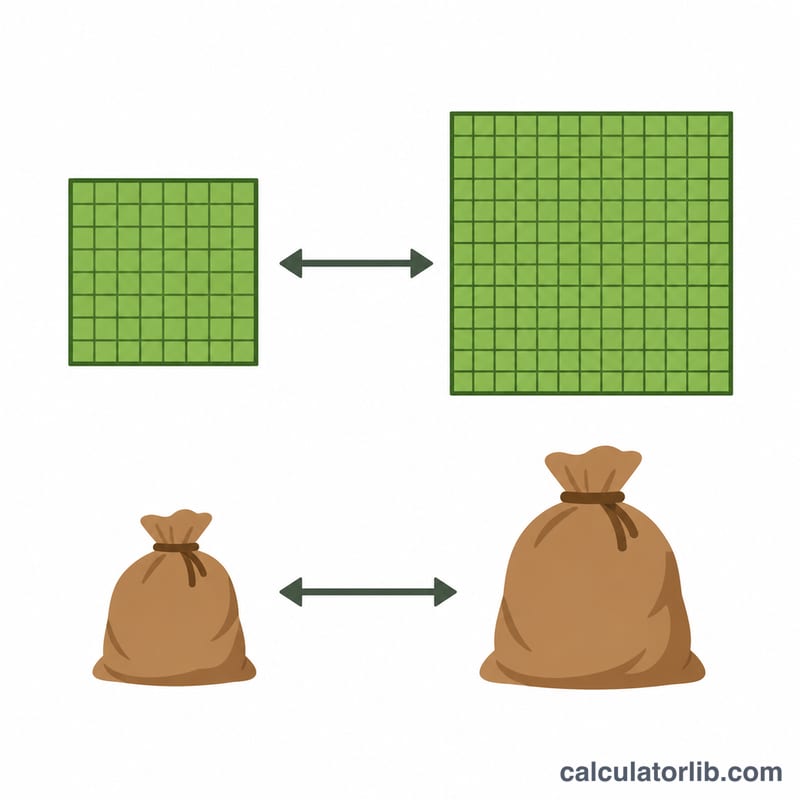
The calculator expects area in acres, rate in kg per acre and price in $ per kg. If your recommendation, field map or price quote uses other units, convert them first with the factors below.
| From | To | Multiply by |
|---|---|---|
| 1 lb | kg | 0.4536 |
| 1 acre | ha | 0.4047 |
| 1 ha | acres | 2.471 |
| 1 lb/acre | kg/ha | 1.121 |
| 1 kg/ha | lb/acre | 0.892 |
| 1 kg/ha | kg/acre | 0.4047 |
| 1 kg/acre | kg/ha | 2.471 |
For example, a rate of 120 kg/ha is \(120 \times 0.4047 \approx 48.6\) kg/acre. A field of 25 ha is \(25 \times 2.471 \approx 61.8\) acres.
| Price quoted as | Price per kg |
|---|---|
| Per metric tonne (1,000 kg) | Price ÷ 1,000 |
| Per short ton (2,000 lb, US) | Price ÷ 907.2 |
| Per 50 kg bag | Price ÷ 50 |
| Per 50 lb bag | Price ÷ 22.68 |
For example, urea quoted at $650 per short ton works out to:
$$\frac{\$650}{907.2} \approx \$0.717 \text{ per kg}$$A price of $700 per metric tonne is \(\$700 / 1000 = \$0.70\) per kg. Don't confuse metric tonnes with short tons: a short ton is about 9% lighter.
Practical Tips for Ordering and Budgeting
- Round up to what you can actually buy. Fertilizer is sold in whole bags or bulk increments. Suppose you apply 108.7 kg/acre of urea to 40 acres at $0.70/kg. The material comes to \(40 \times 108.7 = 4{,}348\) kg and costs \(4{,}348 \times \$0.70 =\) $3,043.60. In 50 kg bags, that is \(4{,}348 / 50 = 86.96\), so you buy 87 bags (4,350 kg), which costs $3,045. Recompute the cost from the quantity you actually order.
- Allow a small margin, and calibrate. Spreader overlap, headlands and calibration error mean the amount applied rarely matches the plan exactly. Budget a small extra margin. Calibrate the spreader or sprayer before application so the actual rate matches the planned rate. A spreader running 10% high raises both the cost and the nutrient rate by 10%.
- Add the other costs separately. The calculator covers the cost of the material only. Delivery or freight, custom application fees, equipment rental, fuel and labor all come on top, so add them yourself for a full per-acre budget.
- Compare products on cost per kg of nutrient. A cheaper product per kg can still be more expensive per unit of nutrient. Divide the price per kg of product by the nutrient fraction:$$\text{Cost per kg N} = \frac{\text{Price per kg product}}{\text{Nutrient \%} / 100}$$For example, take two hypothetical prices. Urea at $0.70/kg gives \(0.70 / 0.46 \approx \$1.52\) per kg N. Ammonium nitrate at $0.60/kg gives \(0.60 / 0.34 \approx \$1.76\) per kg N. So the urea supplies N more cheaply, even though its price per kg of product is higher. When comparing products, also consider secondary nutrients (such as sulfur), losses after application and handling.
- Base rates on a soil test and local guidance. The right rate depends on the crop, the yield goal, the soil's nutrient levels and local conditions. Use a current soil test and the recommendations of your regional agricultural extension service or agronomist. Applying more than the crop needs wastes money and can harm water quality. In some regions, application rates are also limited by regulation.
This is general information to help with cost estimates, not agronomic or financial advice for a specific farm.
FAQ
Can I use different units? Yes. Keep the rate and price in the same mass unit and keep the area unit consistent, and the result scales correctly.
Does it include application labor? No, it covers material cost only. Add labor or equipment costs separately for a full job estimate.
Why show cost per acre? It makes comparing different fields or fertilizer products quick and intuitive.