What Is the Scrap Metal Value Calculator?
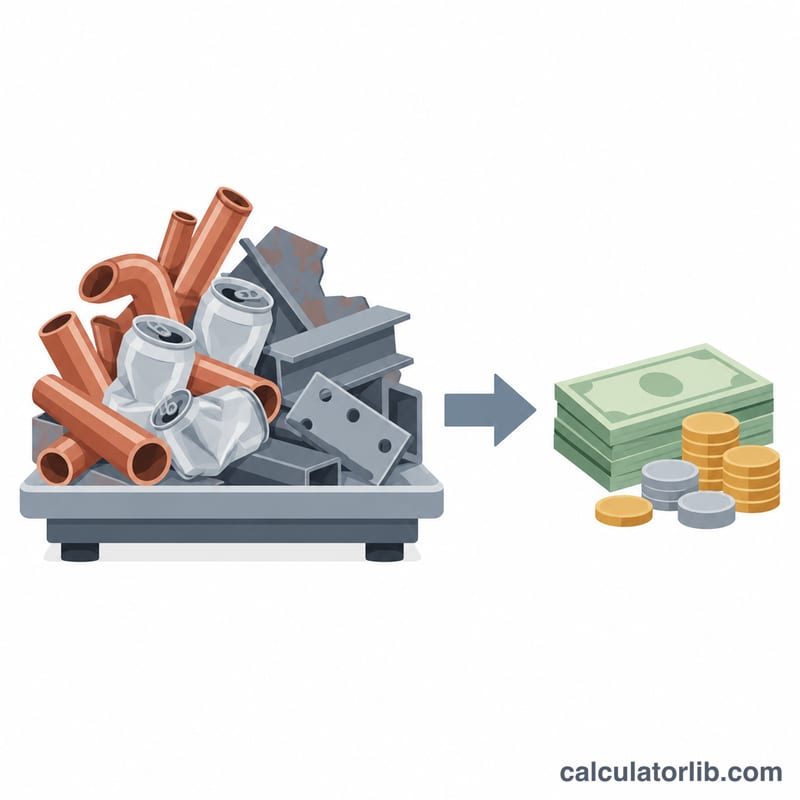
The Scrap Metal Value Calculator estimates how much cash you can expect from a scrap yard for a given quantity of metal. Whether you are recycling copper wire, aluminum cans, steel, or brass, the payout depends on two things: how much the metal weighs and the price buyers currently pay per unit of weight. This tool turns those numbers into an instant dollar estimate so you can decide whether a trip to the yard is worth it.
How to Use It
Enter the total weight of your scrap, the current price per unit weight (for example dollars per pound or per kilogram), and the payout rate the buyer offers as a percentage of the market price. Yards rarely pay the full spot price, so a rate of 80-95% is common. Calculate to see both your gross market value and your actual expected payout.
The Formula
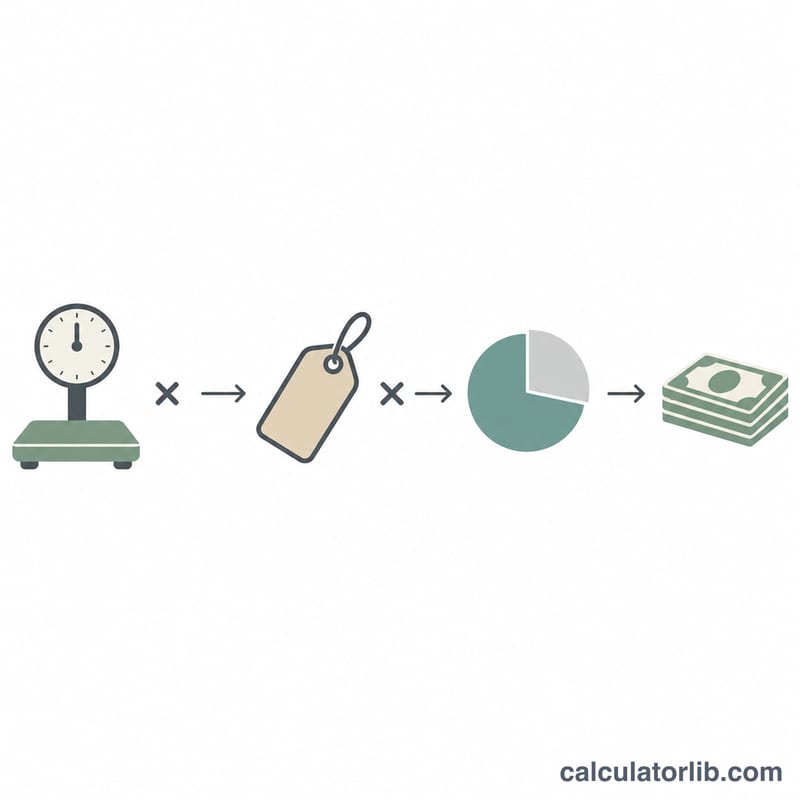
The payout is the weight multiplied by the unit price, scaled by the payout rate:
$$\text{Payout} = W \times P \times \frac{R}{100}$$where \(W\) = weight, \(P\) = price per unit weight, and \(R\) = payout rate as a percent. When \(R = 100\), the payout equals the full gross market value \(W \times P\).
Worked Example
Suppose you bring in 100 lb of copper and the yard pays $2.50 per pound at a full 100% rate. The gross value is \(100 \times 2.50 = \$250\), and because the rate is 100% the payout is:
$$\text{Payout} = 100 \times 2.50 \times \frac{100}{100} = \$250.00$$If the yard instead paid only 80%, your payout would drop to \(\$250 \times 0.80 = \$200\).
Converting Weights and Scrap Prices Between Units
The calculator multiplies weight by price per unit, so the weight and the price must use the same unit. If your scale reads in kilograms but the yard quotes per pound, or a steel price is quoted per ton, convert one of them first. The weight factors below are exact or standard rounded values. They work with any currency. The dollar figures here are only examples.
| Unit | Equivalent | Notes |
|---|---|---|
| 1 pound (lb) | 0.45359237 kg | Exact by international definition |
| 1 kilogram (kg) | 2.20462 lb | Rounded to 5 decimal places |
| 1 short ton | 2,000 lb = 907.185 kg | The "ton" used mainly in the United States |
| 1 metric tonne (t) | 1,000 kg = 2,204.62 lb | Standard in most countries outside the US |
| 1 long ton | 2,240 lb ≈ 1,016.05 kg | Imperial ton, used in the UK in the past and in some shipping trades |
Price conversions go the opposite way to weight conversions. A kilogram is heavier than a pound, so the price per kilogram is higher than the price per pound.
| To convert | Operation |
|---|---|
| $/lb → $/kg | multiply by 2.20462 |
| $/kg → $/lb | divide by 2.20462 |
| $/short ton → $/lb | divide by 2,000 |
| $/tonne → $/kg | divide by 1,000 |
| $/long ton → $/lb | divide by 2,240 |
Example row (an illustrative price, not a market quote):
$$\$2.50/\text{lb} \times 2.20462 = \$5.51/\text{kg}$$Going back the other way, \(\$5.51 \div 2.20462 \approx \$2.50\) per lb. Be careful which ton a quote uses. Short tons, metric tonnes and long tons differ by up to 12%, so mixing them up changes your estimate by the same amount. This page does not list current market prices because scrap prices change daily and vary by region and yard.
More Worked Examples
All prices below are illustrative only. They are not current market prices. Ask your local yard for its actual rates.
Example 1: Weight and price both in kilograms, 85% payout rate
You have 350 kg of copper scrap. The illustrative price is $7.00 per kg, and the yard pays 85% of that value.
- Check the units. Weight is in kg and price is per kg, so no conversion is needed.
- Gross value: $$\text{Gross} = 350 \times \$7.00 = \$2{,}450.00$$
- Apply the payout rate: $$\text{Payout} = \$2{,}450.00 \times \frac{85}{100} = \$2{,}450.00 \times 0.85 = \$2{,}082.50$$
Expected cash: $2,082.50. The yard keeps the other $367.50, which is 15% of the gross value.
Example 2: Steel priced per short ton, 90% payout rate
A load of steel weighs 3,000 lb. The illustrative quote is $240 per short ton (2,000 lb), and the payout rate is 90%. The weight is in pounds but the price is per ton, so convert the price to $/lb first.
- Convert the price to $/lb: $$\frac{\$240}{2{,}000\ \text{lb}} = \$0.12/\text{lb}$$
- Gross value: $$\text{Gross} = 3{,}000 \times \$0.12 = \$360.00$$
- Apply the payout rate: $$\text{Payout} = \$360.00 \times \frac{90}{100} = \$324.00$$
Expected cash: $324.00.
Alternative: convert the weight to tons instead. 3,000 lb ÷ 2,000 = 1.5 short tons. Then 1.5 × $240 = $360.00 gross, and 90% of that is the same $324.00. Both methods work as long as weight and price use the same unit.
FAQ
Why do yards pay less than the spot price? Buyers need a margin to cover sorting, transport, and processing, so they discount the market rate.
What units should I use? Use any consistent pair — pounds with price per pound, or kilograms with price per kilogram. The result follows your inputs.
Is the estimate exact? No. Final payment can vary with metal purity, contamination, and daily market swings, so treat the result as a close estimate.