What Is the Scrap Silver Value Calculator?
This calculator estimates how much your scrap silver is worth based on its weight, purity (fineness), the current spot price of silver, and the payout percentage a dealer offers. Whether you have sterling flatware, old coins, jewelry, or bullion, it gives you a quick, transparent valuation so you can negotiate with confidence.
How to Use It
Enter the total weight of your silver in grams, the fineness as a percentage (e.g. 92.5% for sterling, 99.9% for fine silver), the current silver spot price per troy ounce, and the payout percentage you expect from the buyer. The tool calculates the pure silver content value and the amount you would actually receive.
The Formula Explained
The core equation is:
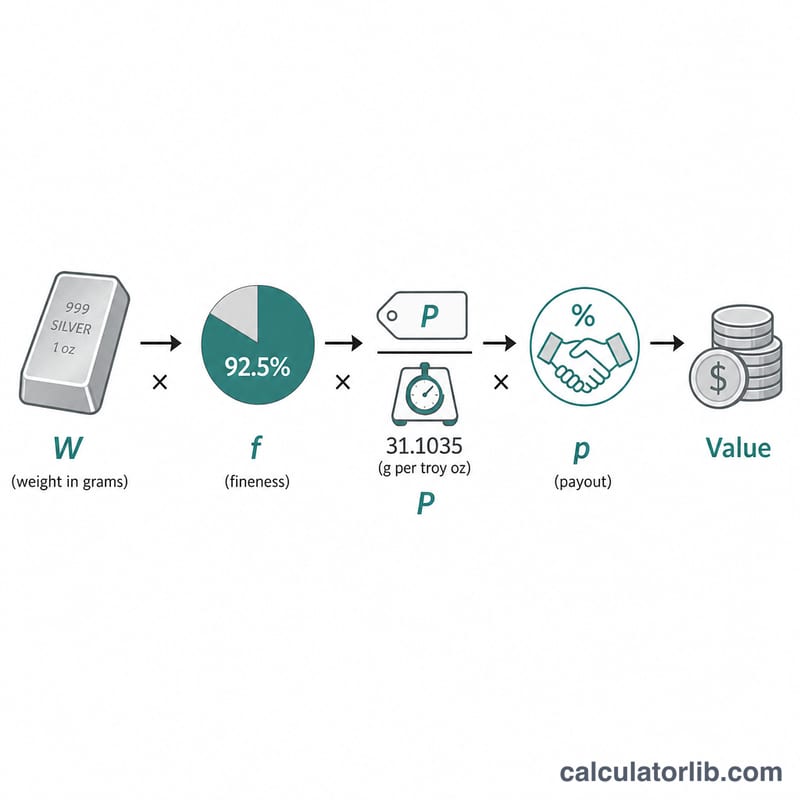
$$\text{Value} = \text{Weight (g)} \times \text{Fineness} \times \frac{\text{Spot Price per oz}}{31.1035} \times \text{Payout \%}$$
There are 31.1035 grams in a troy ounce, the standard unit for precious metals. Dividing the spot price by 31.1035 converts it to a price per gram. Multiplying by weight and fineness gives the value of the actual silver content; multiplying by the payout percentage reflects what a dealer pays after their margin.
Worked Example
Suppose you have 100 grams of sterling silver (92.5% fineness), silver spot is $30.00/oz, and the dealer pays 90%. Price per gram = \(30 \div 31.1035 = \$0.96452\). Silver content value = \(100 \times 0.925 \times 0.96452 = \$89.22\). Payout = \(\$89.22 \times 0.90 = \$80.30\).
Common Silver Fineness and Purity Marks
Fineness is the parts of pure silver per 1,000 parts of metal. Enter it as a percentage in the calculator (for example, 925 becomes 92.5). The marks and typical items below are general; always confirm with a test or a reputable dealer, because stamps can be missing or wrong.
| Type | Fineness | Purity (%) | Typical hallmark / stamp | Typical items |
|---|---|---|---|---|
| Fine silver | 999 | 99.9% | 999, .999 Fine, 999 FS | Bullion bars, rounds, fine-silver wire |
| American Silver Eagle | 999 | 99.9% | "1 oz .999 Fine Silver" | US bullion coins |
| Britannia silver | 958 | 95.8% | 958, lion figure with Britannia mark | Older UK silverware, UK Britannia silver coins (1997–2012) |
| Sterling | 925 | 92.5% | 925, .925, "Sterling", "Ster" | Jewelry, flatware, hollowware, candlesticks |
| Coin silver (US pre-1965) | 900 | 90% | Usually no fineness stamp on coins; some old flatware marked "Coin" or 900 | US dimes, quarters, half dollars before 1965; Morgan and Peace dollars |
| Morgan / Peace dollars | 900 | 90% | None (identified by date and design) | US silver dollars 1878–1935 |
| Mexican / other older standards | Varies (often 900 or 925) | 90–92.5% | 925, "Sterling", "Mexico", eagle assay marks | Mexican jewelry and tableware; check the individual mark |
| Canadian silver coin | 800 | 80% | None (identified by date) | Canadian dimes, quarters, half dollars, 1920–1966 |
| 800 continental silver | 800 | 80% | 800, sometimes with a crescent moon and crown (German) | European flatware, serving pieces, boxes |
| US 40% silver | 400 | 40% | None (identified by date) | Kennedy half dollars 1965–1970 |
Silver-plated items (marked EPNS, "Silverplate", "A1") contain only a thin silver layer and are generally not worth scrapping by weight. Items with weighted or filled parts (such as weighted sterling candlesticks) should not be weighed as solid silver.
Silver Weight Unit Conversions
Silver is priced per troy ounce, which is heavier than the ordinary (avoirdupois) ounce used on kitchen scales and in everyday life. The calculator takes weight in grams, so convert other units first.
| Conversion | Equivalent |
|---|---|
| 1 troy oz | 31.1035 g |
| 1 troy oz | 20 pennyweight (dwt) |
| 1 pennyweight (dwt) | 1.55517 g |
| 1 avoirdupois oz | 28.3495 g |
| 1 troy oz | about 1.09714 avoirdupois oz |
| 1 kg | 32.1507 troy oz |
| 1 troy lb | 12 troy oz = 373.242 g |
Example: a kitchen scale shows 4 oz of flatware. That is avoirdupois ounces, so the weight is \(4 \times 28.3495 = 113.398\) g, not \(4 \times 31.1035\) g. Using the troy factor by mistake would overstate the weight by about 9.7%.
Scenario Comparison: Payout Percentage and Spot Price
All rows use 100 g of sterling silver (92.5% fineness). Melt value is the full silver content at spot; payout is the melt value times the dealer's payout percentage:
$$\text{Payout} = 100 \times \frac{92.5}{100} \times \frac{\text{Spot}}{31.1035} \times \frac{\text{Payout \%}}{100}$$
At a $30/oz spot, pure silver is worth about $0.9645 per gram, so 92.5 g of fine silver is worth about $89.22. The spot prices here are illustrative, not current market prices.
| Spot ($/oz) | Payout % | Melt value | Expected payout |
|---|---|---|---|
| $30 | 70% | $89.22 | $62.45 |
| $30 | 80% | $89.22 | $71.37 |
| $30 | 90% | $89.22 | $80.29 |
| $30 | 95% | $89.22 | $84.76 |
| $25 | 90% | $74.35 | $66.91 |
| $35 | 90% | $104.09 | $93.68 |
Takeaway: moving from a 70% to a 95% payout adds about $22.31 on this lot, a larger difference than a $5 move in spot price at 90% payout (about $13.38 per $5). Comparing dealer offers is worth the effort.
FAQ
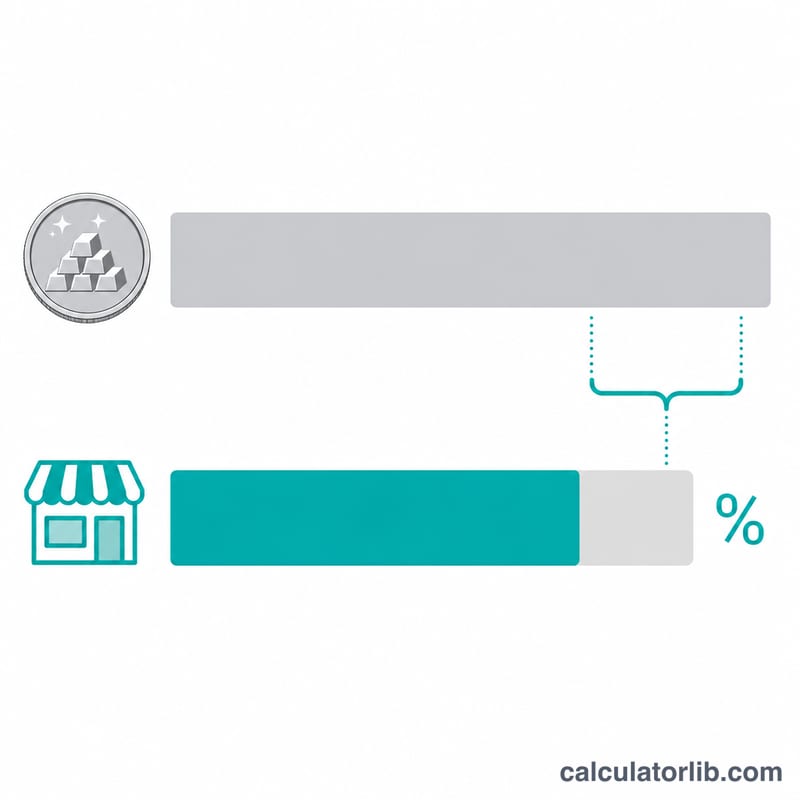
What is sterling silver fineness? Sterling silver is 92.5% pure, so enter 92.5. Fine silver bullion is 99.9 (enter 99.9), and coin silver is often 90.
Why divide by 31.1035? Silver is priced per troy ounce, which equals 31.1035 grams. This converts the per-ounce price to a per-gram price.
Is the payout the same as spot? No. Dealers pay a percentage of melt value (the payout %) to cover refining and profit, so your actual return is usually below full melt value.