
What Is the Simple Savings Calculator?
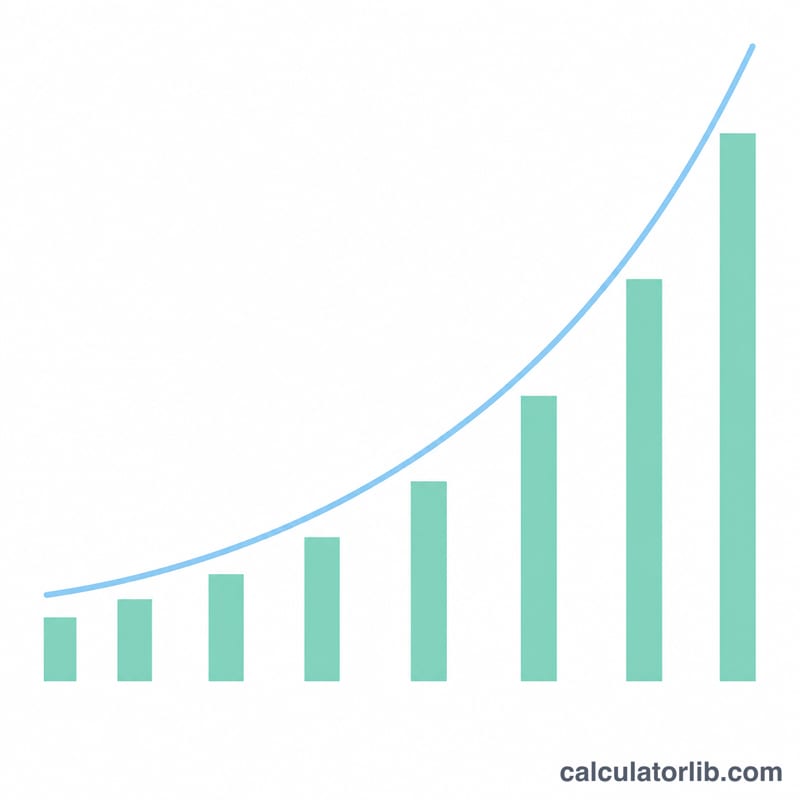
This calculator estimates how much a one-time savings deposit will grow over time when it earns compound interest. By reinvesting the interest you earn, your balance grows faster than it would with simple interest because you earn "interest on interest." Enter your initial deposit, the annual interest rate, the number of years, and how often interest is compounded to see your projected future value.
How to Use It
1. Enter your initial deposit — the lump sum you put into the account today. 2. Enter the annual interest rate as a percentage (e.g. 5 for 5%). 3. Enter the number of years you plan to leave the money untouched. 4. Pick the compounding frequency — how often the bank adds interest to your balance. The result shows the total future value, your original deposit, and the interest earned.
The Formula Explained
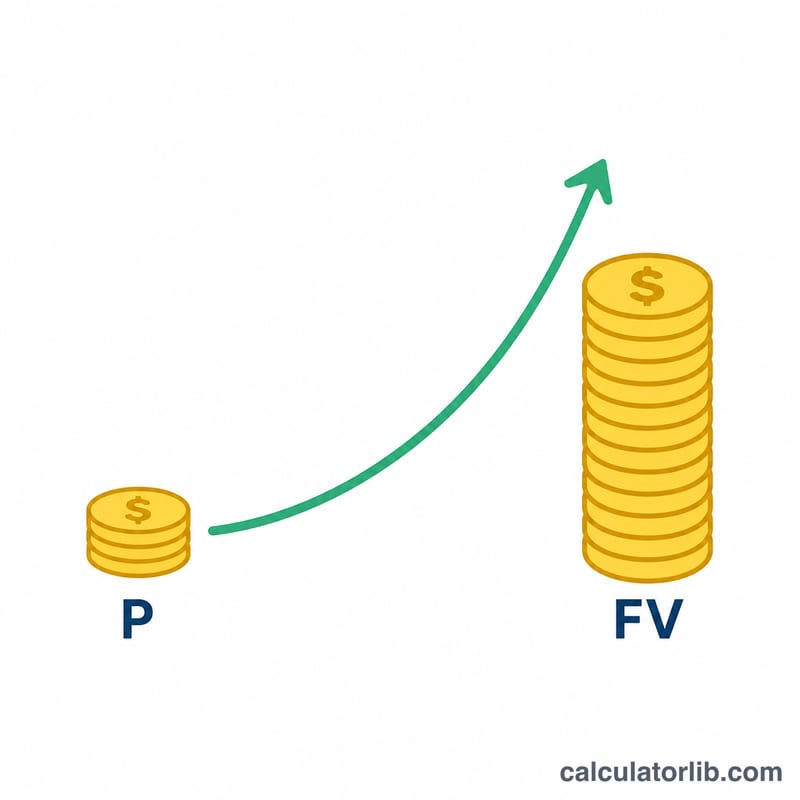
The future value is calculated with the compound interest formula $$FV = P(1 + r)^{n}$$ Here \(P\) is your initial deposit, \(r\) is the periodic interest rate (the annual rate divided by the number of compounding periods per year), and \(n\) is the total number of compounding periods (frequency × years). More frequent compounding produces a slightly larger balance for the same nominal rate.
Worked Example
Suppose you deposit $1,000 at a 5% annual rate, compounded monthly, for 10 years. The periodic rate is \(r = 0.05 \div 12 = 0.0041667\) and the number of periods is \(n = 12 \times 10 = 120\). So $$FV = 1000 \times (1.0041667)^{120} \approx \$1{,}647.01$$ meaning you earned about $647.01 in interest.
FAQ
Does this include monthly contributions? No — this tool models a single lump-sum deposit. For recurring deposits, use a savings-with-contributions calculator.
What compounding frequency should I choose? Use the one your bank states. Many savings accounts compound daily or monthly.
Are taxes or inflation included? No. The result is a pre-tax, nominal figure; real purchasing power may be lower after inflation.