
What is the R-Value & U-Value Calculator?
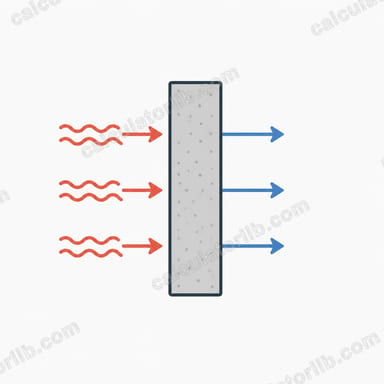
This universal tool computes the thermal performance of building insulation using SI units. The R-value measures a material's resistance to heat flow — higher is better insulation. The U-value (thermal transmittance) is its inverse and describes how readily heat passes through an assembly — lower is better. Both are central to energy-efficient design worldwide.
How to Use It
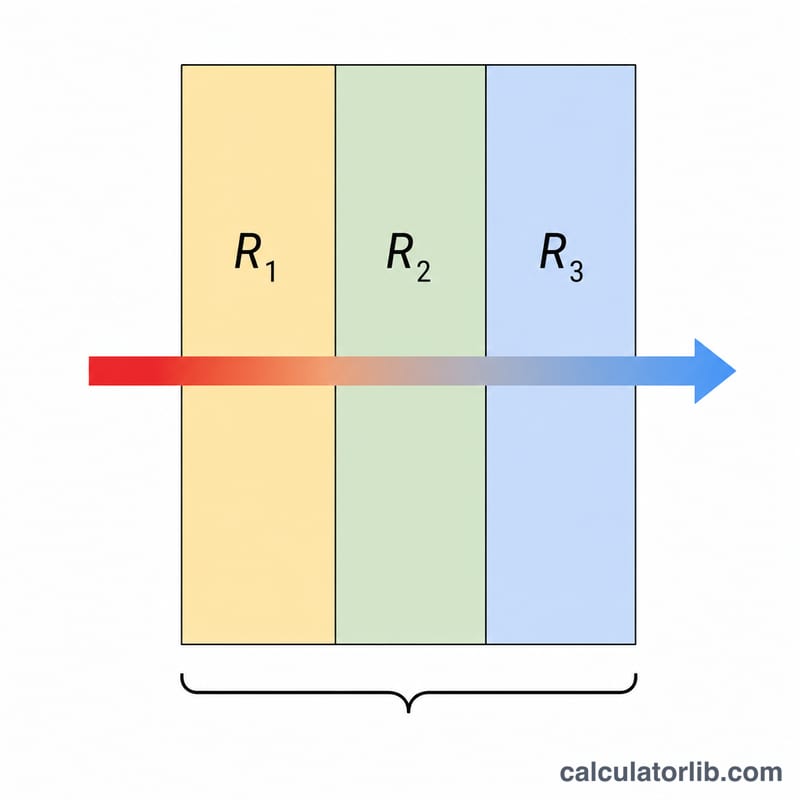
Enter the material's thickness in metres and its thermal conductivity k in W/m·K (found on product data sheets). The calculator returns the layer R-value, then adds any optional R-value from other layers (such as surface air films, cladding, or a second insulation board) to give the total R, and finally the overall U-value.
The Formula Explained
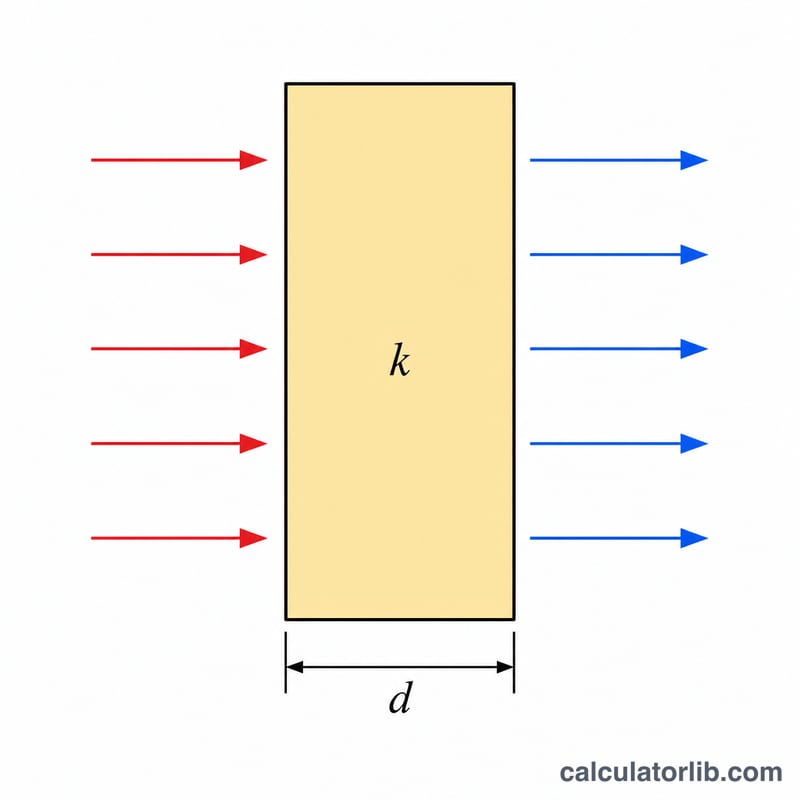
For a single layer, $$R = \frac{d}{k}$$ where d is thickness in metres and k is conductivity. Multiple layers add in series: $$R_{\text{total}} = \sum R_i$$ The transmittance is then $$U = \frac{1}{R_{\text{total}}}$$ Units of R are \(\text{m}^2\cdot\text{K/W}\) and units of U are \(\text{W/m}^2\cdot\text{K}\).
Worked Example
A 0.10 m mineral-wool board has k = 0.04 W/m·K. Its R-value is $$\frac{0.10}{0.04} = 2.5 \ \text{m}^2\cdot\text{K/W}$$ If surrounding layers add another 0.5 m²·K/W, total R = 3.0 m²·K/W, so $$U = \frac{1}{3.0} = 0.333 \ \text{W/m}^2\cdot\text{K}$$
FAQ
Is a higher R-value better? Yes — more resistance means less heat loss and lower energy bills.
What is a good U-value for a wall? Many modern codes target 0.2–0.3 W/m²·K or lower for walls, though requirements vary by region and climate.
How do I convert to imperial R-value? Multiply the SI R-value (m²·K/W) by about 5.678 to get the US R-value (ft²·°F·h/BTU).