
What this calculator does
This tool builds a day-by-day table of sunrise, solar noon (the moment the Sun crosses the local meridian, also called solar transit or culmination) and sunset for any place on Earth. You give it a latitude, longitude, altitude and UTC offset, pick a start date and a range of 1 week to 2 months, and it returns one row per day with local clock times. It is universal astronomy: the same equations work in London, Tokyo or the Antarctic.
How to use it
Enter latitude in degrees (positive North, negative South) and longitude in degrees (positive East, negative West). Add an observer altitude in meters if you are on a mountain or tall building. Set the UTC offset including any summer-time shift (for example +1 for British Summer Time, +9 for Japan). Choose the start year, month and day, then select how many consecutive days to list. Times shown are local civil time = UTC + your offset.
The formula explained
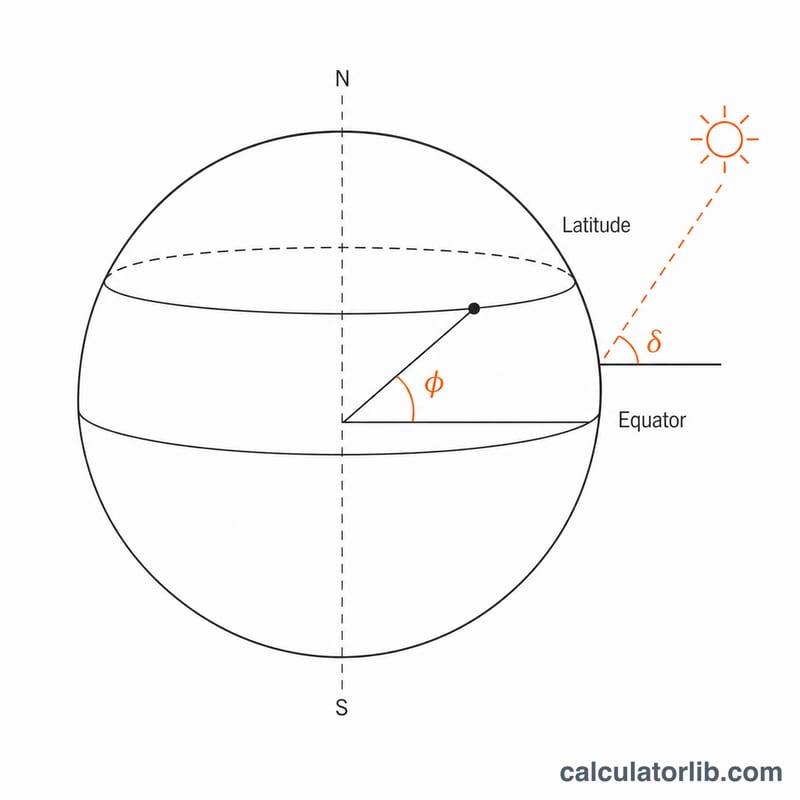
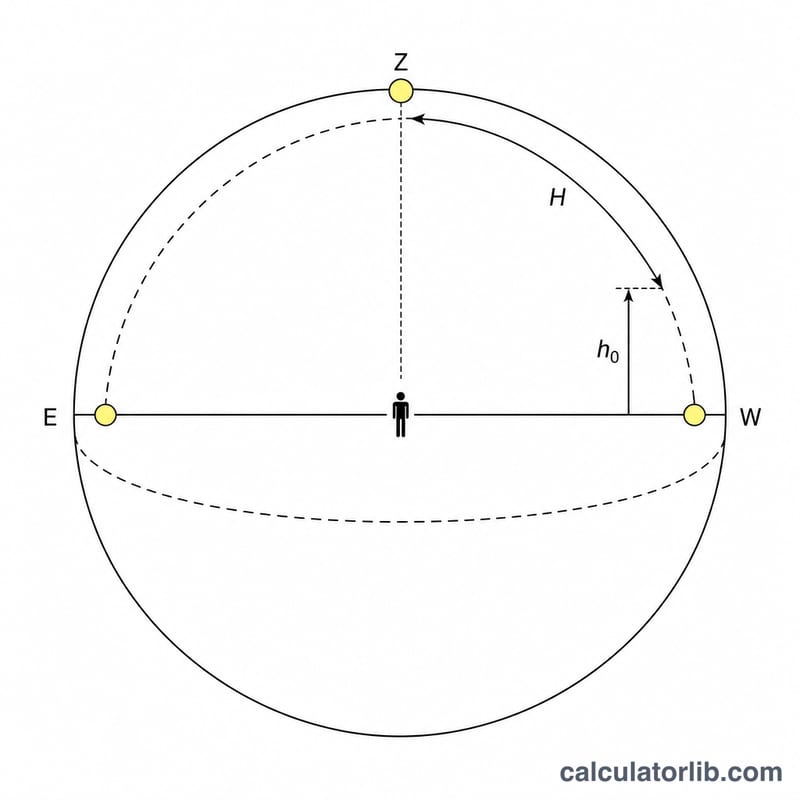
For each day the calculator finds the Julian Date, the Sun's mean anomaly M, the equation of center C and the ecliptic longitude lambda. Declination follows from $$\delta = \arcsin\!\big(\sin\lambda\,\sin 23.4397^\circ\big).$$ The hour angle of sunrise/sunset comes from the sunrise equation $$\cos H = \frac{\sin h_0 - \sin\varphi\,\sin\delta}{\cos\varphi\,\cos\delta},$$ where the horizon depression \(h_0\) is \(-0.833^\circ\) (refraction plus the Sun's semidiameter) plus an altitude correction. Sunrise is the transit time minus \(\omega_0/360\) of a day, sunset is transit plus that amount.
Worked example
London (\(\varphi = 51.5074\), \(\lambda = -0.1278\)), altitude 0, UTC offset +1, date 2026-06-15. The model gives a solar declination near \(23.28^\circ\) (just past the summer solstice), sunrise about 04:46, solar noon about 13:04 and sunset about 21:22 in British Summer Time, matching published values to within a minute or two.
FAQ
Why "polar night" or "midnight sun"? When \(|\cos H|\) exceeds 1 the Sun never crosses the horizon that day, so there is no sunrise or sunset; the table reports the polar condition but still shows solar noon.
How accurate is it? It uses the NOAA low-precision algorithm, accurate to roughly 1-2 minutes, which is fine for a planning table.
What time zone are the results in? Local civil time equal to UTC plus the offset you entered; the offset must already include daylight-saving time if it applies on those dates.