
What is the Golden Ratio Side Calculator?
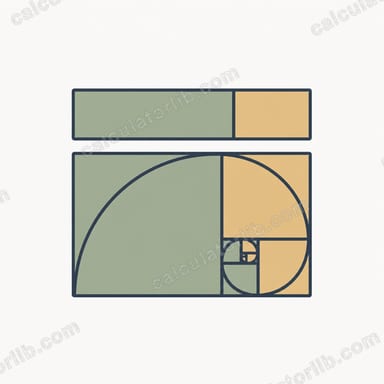
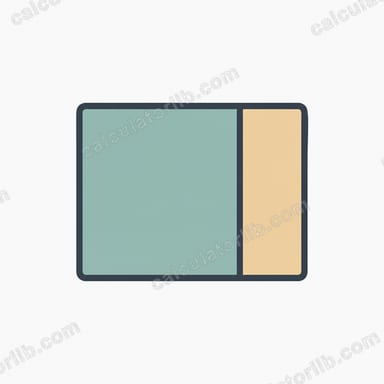
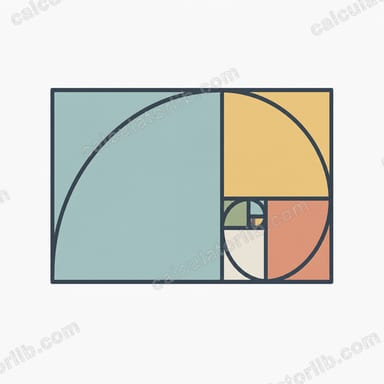
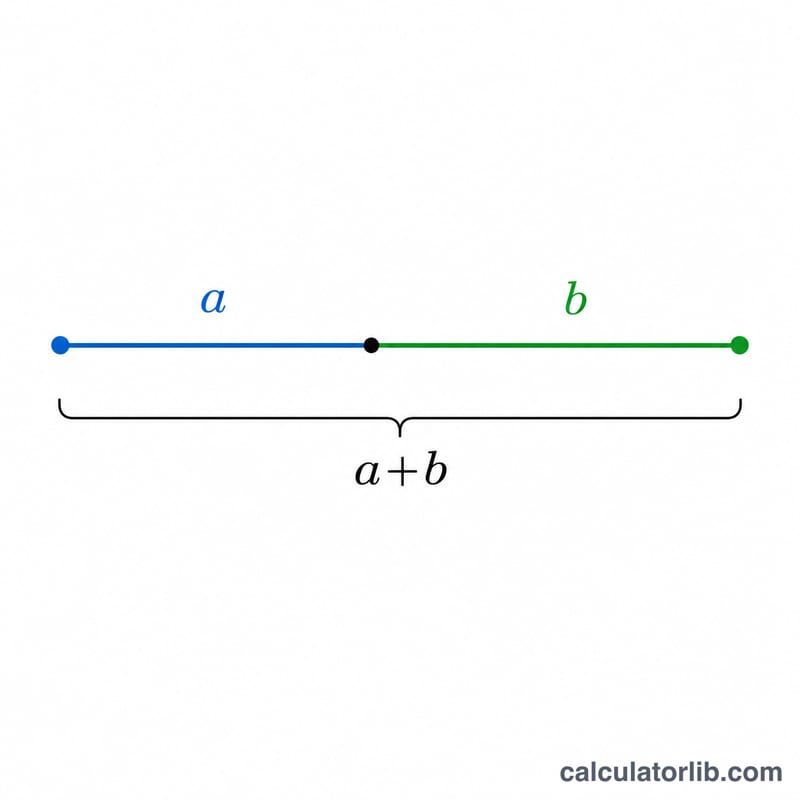
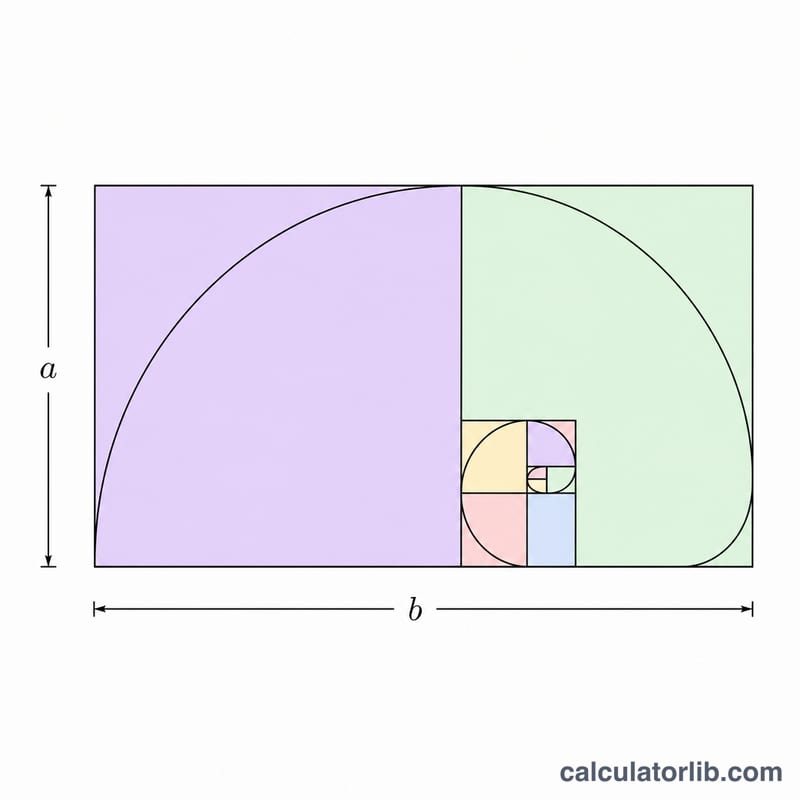
This tool divides a line or rectangle according to the golden ratio (also called the golden section). The golden ratio, written as the Greek letter phi, is the constant \(\varphi = (1 + \sqrt{5}) / 2 \approx 1.6180339887\). A length is split into a short side a and a long side b such that the long part relates to the short part the same way the whole relates to the long part. In symbols, \(b / a = (a + b) / b = \varphi\). This calculator is unit-agnostic: enter pixels, millimetres, inches or any consistent unit, and every output is in that same unit.
How to use it
Pick which length you already know — the short side a, the long side b, or the whole length a+b — then enter that value. The calculator returns all three lengths plus the value of \(\varphi\) used. Because each output is simply the input multiplied or divided by \(\varphi\), the results scale linearly and no unit conversion is needed.
The formula explained
The three lengths follow the proportion $$a : b : (a+b) = 1 : \varphi : \varphi^2,$$ where \(\varphi^2 = \varphi + 1\). If you know the short side a, then \(b = a\cdot\varphi\) and \(a+b = a\cdot(\varphi+1)\). If you know the long side b, then \(a = b / \varphi\) and \(a+b = b\cdot\varphi\). If you know the whole a+b, then \(b = (a+b) / \varphi\) and \(a = (a+b) / \varphi^2\). A handy identity is \(1/\varphi = \varphi - 1 \approx 0.6180339887\).
Worked example
Suppose the whole length \(a+b = 10\). Then $$b = 10 / \varphi \approx 6.18034 \quad\text{and}\quad a = 10 / \varphi^2 \approx 3.81966.$$ Check: \(a + b = 3.81966 + 6.18034 = 10\), and \(b / a \approx 1.61803 = \varphi\). So a golden rectangle 10 units long is split into a 3.81966 short part and a 6.18034 long part.
FAQ
Does the input need a unit? No. Use any unit you like; every output is expressed in that same unit because the relationships are purely proportional.
Why must the side be greater than zero? A length of zero produces all zeros, and a negative length has no geometric meaning, so non-positive inputs are rejected.
What is \(\varphi^2\) used for? \(\varphi^2 = \varphi + 1\) is the ratio of the whole to the short side, so dividing the whole by \(\varphi^2\) directly gives the short side.