What is a compounding rate?
Banks and brokers usually quote a nominal annual rate, but interest is often added monthly, daily or even continuously. Each time interest is added, it starts earning interest of its own, so the real yearly growth, called the effective annual rate (EAR) or APY, is higher than the quoted number. This calculator converts a nominal rate into its effective rate and shows how much an investment grows over time.
How to use the calculator
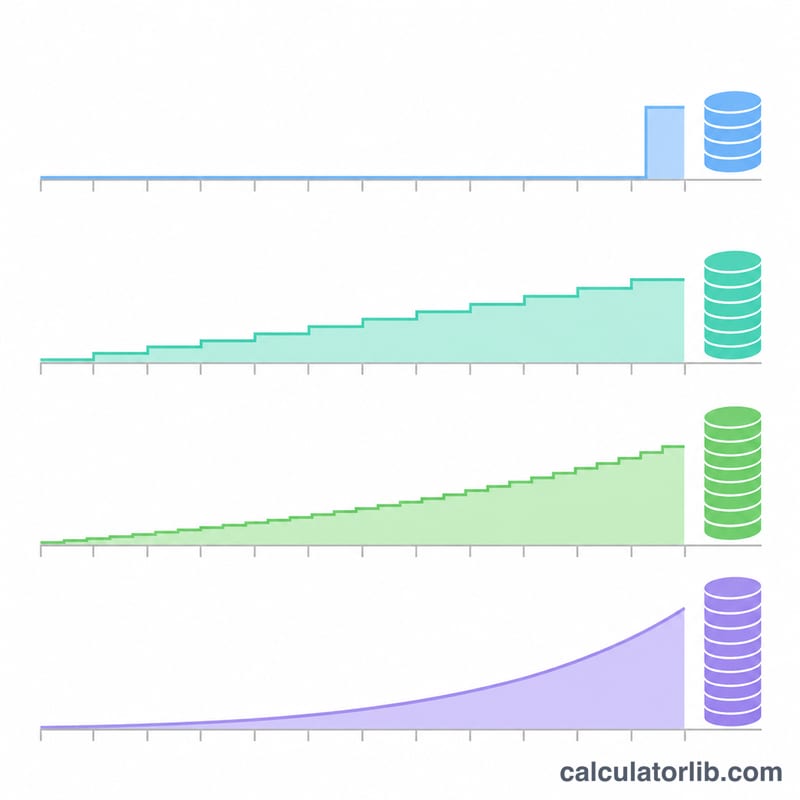
Enter your initial investment, the nominal annual rate in percent, how often interest compounds, and how many years you plan to hold the investment. The result shows the effective annual rate, the future value, the total interest earned and the growth multiple (how many times your money multiplies).
The formula
For \(n\) compounding periods per year:
$$\text{EAR} = \left(1 + \frac{r}{n}\right)^{n} - 1, \qquad FV = P\left(1 + \frac{r}{n}\right)^{nt}$$Here \(P\) is the principal, \(r\) is the nominal rate as a decimal, \(n\) is the number of compounding periods per year, and \(t\) is the number of years. With continuous compounding the limit becomes \(\text{EAR} = e^{r} - 1\) and \(FV = Pe^{rt}\).
Worked example
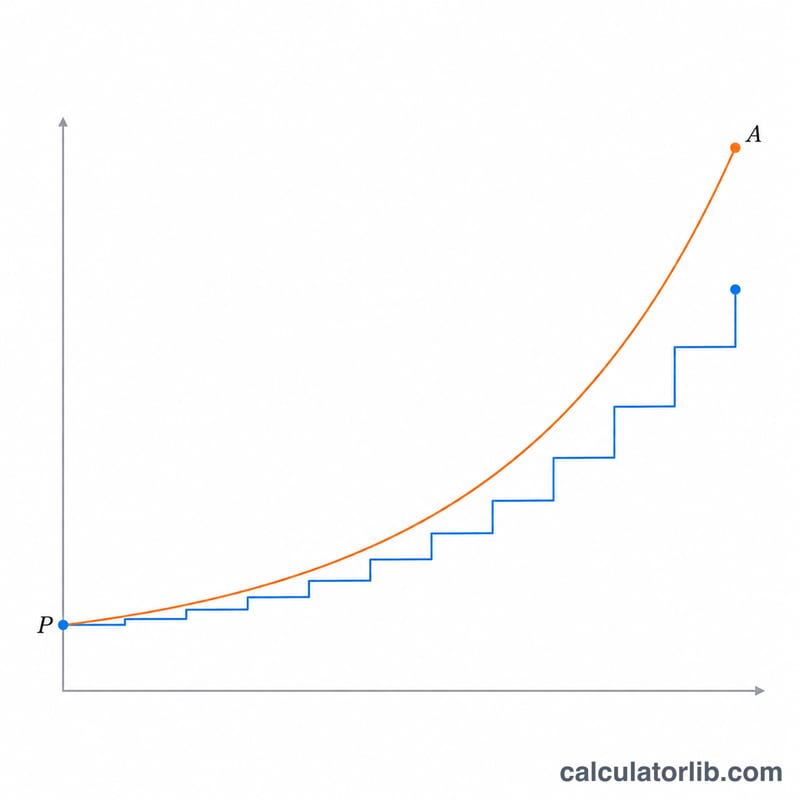
Say you invest $10,000 at 6% compounded monthly for 10 years:
$$\text{EAR} = \left(1 + \frac{0.06}{12}\right)^{12} - 1 = 1.005^{12} - 1 \approx 6.1678\%$$$$FV = 10000 \times 1.005^{120} \approx 18{,}193.97$$You earn about $8,193.97 in interest, and your money grows about 1.82 times.
How Compounding Frequency Changes the Effective Rate
The effective annual rate (EAR) is the rate you actually earn in a year once interest is added to the balance and starts earning interest itself. For a nominal rate \(r\) compounded \(n\) times a year, the formula is \(r_{\text{eff}} = \left(1+\frac{r}{n}\right)^{n} - 1\). As \(n\) grows without limit you get continuous compounding, where \(r_{\text{eff}} = e^{r} - 1\). The table compares the EAR for three nominal rates at each frequency. All values are rounded to 4 decimal places.
| Nominal rate | Annual (n = 1) | Quarterly (n = 4) | Monthly (n = 12) | Daily (n = 365) | Continuous (\(e^{r}-1\)) |
|---|---|---|---|---|---|
| 3% | 3.0000% | 3.0339% | 3.0416% | 3.0453% | 3.0455% |
| 6% | 6.0000% | 6.1364% | 6.1678% | 6.1831% | 6.1837% |
| 10% | 10.0000% | 10.3813% | 10.4713% | 10.5156% | 10.5171% |
| Future value of $10,000 at 6% for 10 years | $17,908.48 | $18,140.18 | $18,193.97 | $18,220.29 | $18,221.19 |
Here is how two of the 6% figures are calculated. With monthly compounding the EAR is \(\left(1+\frac{0.06}{12}\right)^{12} - 1 = 1.005^{12} - 1 \approx 0.061678\), or 6.1678%. The future value is \(A = 10{,}000 \times 1.005^{120} \approx 10{,}000 \times 1.8193967 = 18{,}193.97\). With continuous compounding the future value is \(A = 10{,}000 \times e^{0.06 \times 10} = 10{,}000 \times e^{0.6} \approx 18{,}221.19\).
Each step up in frequency adds less than the one before. At 6%, going from annual to quarterly compounding adds about 0.14 percentage points, but going from daily to continuous adds less than 0.001 points.
FAQ
Is EAR the same as APY?
Yes. Both describe the actual annual return after compounding. APR, by contrast, is usually the nominal rate before compounding.
Does compounding more often always help?
It does, but the benefit gets smaller each time. Going from annual to monthly makes a noticeable difference. Going from daily to continuous adds only a tiny fraction of a percent.
Can I compare two offers with this?
Yes. Convert each quoted rate to its EAR and compare those. The higher EAR gives the better return, whatever the compounding schedule.