What Is a Spray Foam Board Foot?
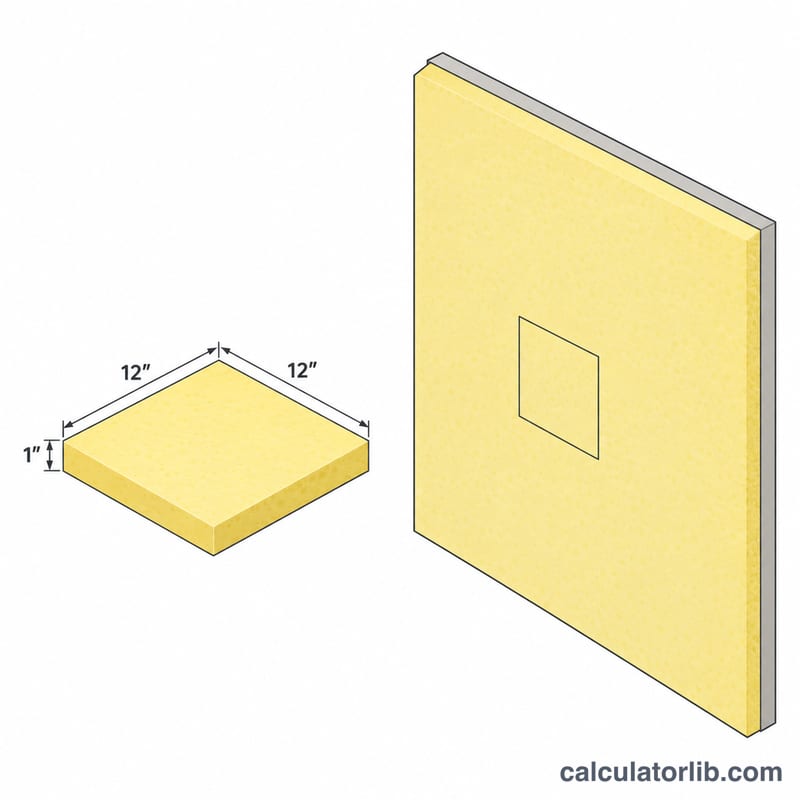
A board foot is the core unit used to size spray polyurethane foam insulation. One board foot equals an area of one square foot sprayed to a thickness of one inch. Because foam is estimated and sold by board feet, converting your project's surface area and target depth into board feet is the first step toward ordering the right number of material sets and pricing the job accurately.
The Formula
The board-foot volume is the surface area multiplied by the thickness in inches, adjusted for a waste factor that covers overspray, trimming, and uneven substrates:
$$\text{BF} = A \times T \times \left(1 + \frac{w}{100}\right)$$where \(A\) = area in square feet, \(T\) = thickness in inches, and \(w\) = waste percentage. The number of sets is the board feet divided by the yield of one set, \(Y\):
$$\text{Sets} = \frac{\text{BF}}{Y}$$and the material cost is \(\text{BF} \times c\), where \(c\) is the cost per board foot.
How to Use It
Enter the total area you plan to cover, the finished thickness, and an optional waste factor (10% is a common starting point). Adjust the yield per set to match your product — high-yield open-cell kits can approach 4,800 board feet, while closed-cell kits yield less. Add your cost per board foot to see the estimated total spend.
Worked Example
Suppose you are coating \(1{,}000\) square feet at a \(2\) inch depth with a 10% waste factor, a set yield of 4,800, and a cost of $1.20 per board foot:
$$\text{BF} = 1000 \times 2 \times 1.10 = 2200$$ $$\text{Sets} = \frac{2200}{4800} \approx 0.46, \quad \text{Cost} = 2200 \times \$1.20 = \$2{,}640$$So you would need just under half of one 4,800 board-foot set and budget about $2,640 in foam.
Typical Set Yields and R-Value per Inch by Foam Type
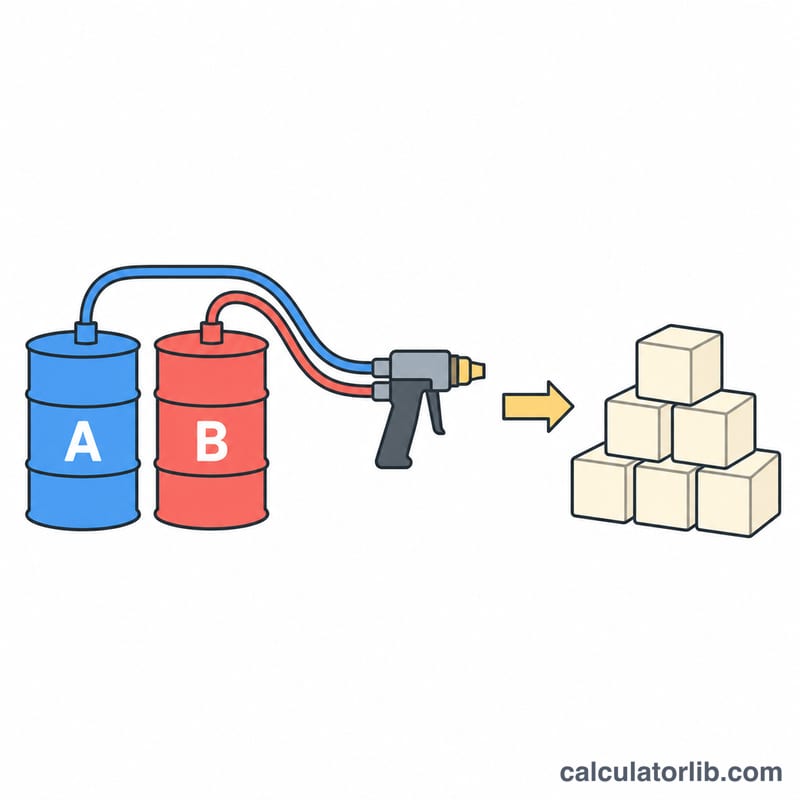
Spray foam is sold in "sets": an A-side (isocyanate) and a B-side (resin). A set's yield is the board feet (BF) it covers in theory. One board foot is 1 sq ft at 1 in thick. The figures below are typical ranges stated by manufacturers. They are not guarantees.
| Foam type | Approx. density | Package | Typical stated yield per set (BF) | Approx. R-value per inch |
|---|---|---|---|---|
| Open-cell | about 0.5 lb/ft³ | Drum set (two 55-gal drums) | about 14,000–20,000 | R-3.5 to R-3.8 |
| Open-cell | about 0.5 lb/ft³ | Large low-pressure kit | about 4,000–5,000 | R-3.5 to R-3.8 |
| Closed-cell | about 2 lb/ft³ | Drum set (two 55-gal drums) | about 4,000–6,000 | R-6 to R-7 |
| Closed-cell | about 2 lb/ft³ | Small DIY kit | about 200 or 600 (sold by nominal size) | R-6 to R-7 |
To get total R-value, multiply R-value per inch by installed thickness. For example, 3 in of closed-cell foam at R-6.5 per inch gives about \(3 \times 6.5 = 19.5\), or roughly R-19.5.
Note: Stated yields assume ideal conditions. Real yield can be lower for several reasons:
- the chemicals or the substrate are too cold
- the surface is damp or very porous
- the spray-rig temperature or pressure settings are off
- the applicator oversprays, trims a lot of foam, or lays passes unevenly
Check the product's technical data sheet for its rated yield and application temperatures. Then enter a realistic yield, plus a waste allowance, in the calculator.
Typical Spray Foam Thickness by Application
The ranges below are common in residential practice. The approximate R-values use the per-inch figures above: open-cell about R-3.5 to R-3.8, closed-cell about R-6 to R-7. Treat them as rough planning figures, not code requirements.
| Application | Foam type | Typical installed thickness | Approx. R-value |
|---|---|---|---|
| 2x4 wall (3.5 in cavity) | Open-cell | 3–3.5 in | about R-11 to R-13 |
| 2x4 wall (3.5 in cavity) | Closed-cell | 1.5–3 in | about R-9 to R-21 |
| 2x6 wall (5.5 in cavity) | Open-cell | 5–5.5 in | about R-18 to R-21 |
| 2x6 wall (5.5 in cavity) | Closed-cell | 2–3 in (often combined with batts, called "flash and batt") | about R-12 to R-21 (foam only) |
| Rim joist | Closed-cell | 2–3 in | about R-12 to R-21 |
| Unvented roof deck or attic | Open-cell | 5.5–10 in | about R-19 to R-38 |
| Unvented roof deck or attic | Closed-cell | 3–6 in or more | about R-18 to R-42 |
| Crawlspace or basement wall | Closed-cell (usually preferred below grade) | 1.5–3 in | about R-9 to R-21 |
Codes: In the United States, the International Energy Conservation Code (IECC) sets minimum insulation R-values by climate zone. Wall, attic, and foundation requirements differ, and hotter and colder zones have different minimums. The code your local jurisdiction has adopted, and any amendments to it, is what actually applies. Other countries have their own energy codes. Spray foam usually also needs an approved thermal or ignition barrier where it stays exposed, and US model codes require this.
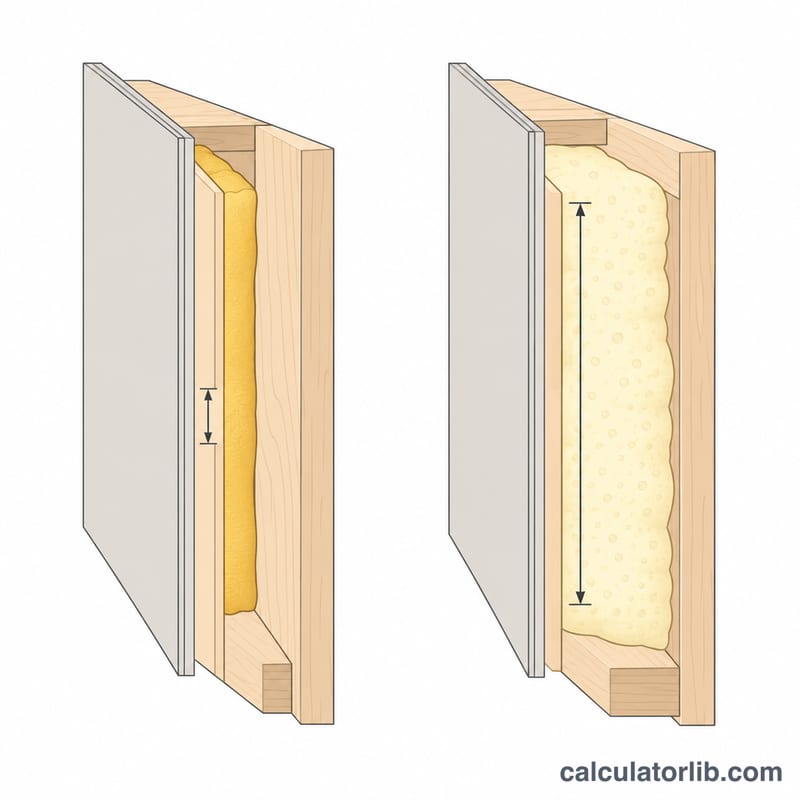
Lift limits: Closed-cell foam is normally sprayed in passes, or "lifts," of about 1.5–2 in each. Each pass must cool before the next one goes on. A single lift that is too thick can overheat, which may cause shrinkage, poor adhesion, or a fire risk. Follow the manufacturer's maximum pass thickness and the wait time between passes. Open-cell foam can generally be sprayed in thicker passes, but the data sheet limits still apply.
Board Feet, Sets and Cost Across Common Jobs
Every job below includes a 10% waste allowance. Board feet are calculated as:
$$BF = A \times t \times \left(1 + \frac{10}{100}\right) = A \times t \times 1.1$$The yield and price figures are example values only:
- Open-cell: 16,000 BF per drum set at $0.55 per BF
- Closed-cell: 5,000 BF per drum set, or 200 BF DIY kits, at $1.25 per BF
Actual prices vary widely by region, supplier, and whether the job is DIY or installed by a contractor.
| Job | Area (sq ft) | Thickness (in) | Board feet (with 10% waste) | Yield per set used (BF) | Sets needed (rounded up) | Example cost |
|---|---|---|---|---|---|---|
| Wall, open-cell | 1,000 | 3 | 3,300 | 16,000 (drum set) | 1 (0.21 of a set) | $1,815 at $0.55/BF |
| Wall, closed-cell | 1,000 | 2 | 2,200 | 5,000 (drum set) | 1 (0.44 of a set) | $2,750 at $1.25/BF |
| Roof deck, open-cell | 1,500 | 6 | 9,900 | 16,000 (drum set) | 1 (0.62 of a set) | $5,445 at $0.55/BF |
| Rim joist, closed-cell | 200 | 2 | 440 | 200 (DIY kit) | 3 (2.2 kits) | $550 at $1.25/BF |
Example arithmetic for the roof deck:
$$1500 \times 6 \times 1.1 = 9900\ \text{BF}, \qquad \frac{9900}{16000} \approx 0.62\ \text{sets}, \qquad 9900 \times \$0.55 = \$5{,}445$$Some points to keep in mind:
- The calculator's cost is board feet × price per BF. That price reflects only the foam actually used.
- If you buy whole sets or kits, you pay for the full package. For example, three 200 BF kits supply 600 BF even though the rim joist needs only 440 BF.
- A contractor's price per BF usually already includes labor, equipment, and leftover material.
- Comparing the two 1,000 sq ft walls, open-cell is cheaper per board foot. Closed-cell gives more R-value per inch and acts as a vapor retarder.
FAQ
Does thickness really multiply the board feet? Yes. Doubling thickness doubles the board feet, because each inch of depth over one square foot adds one more board foot.
What waste factor should I use? Most contractors add 5–15% for overspray and irregular surfaces. Use a higher value for complex cavities and tight framing.
Why round sets up? Foam sets cannot be split, so in practice you order the next whole set above the calculated figure.