What this calculator does
The Tree Board Foot Volume Calculator estimates how much usable lumber a standing tree or felled log will yield, measured in board feet (BF), where one board foot equals a piece of wood 12 inches by 12 inches by 1 inch thick. Because sawmills historically disagreed on how to account for saw kerf, slabs, and taper, three different log rules remain in use. This tool reports all three side by side so you can compare the Doyle, Scribner, and International 1/4-inch estimates from a single pair of measurements.
How to use it
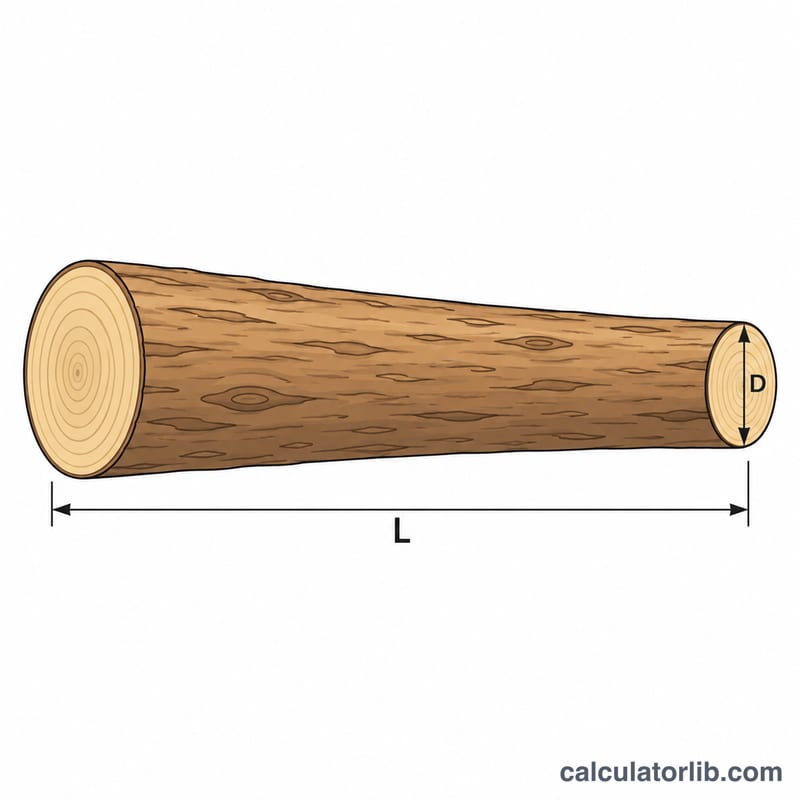
Enter the small-end diameter inside bark \(D\) in inches and the merchantable length \(L\) in feet. The merchantable length is the straight, defect-free portion suitable for lumber. The calculator instantly returns the volume predicted by each rule.
The formulas explained
The Doyle rule is the simplest and is widely used in the eastern United States:
$$\text{BF}_{\text{Doyle}} = \left(\frac{D-4}{4}\right)^2 \times L$$The Scribner rule, \(\text{BF} = (0.79\,D^2 - 2D - 4)\times \tfrac{L}{16}\), tends to give higher values for small logs. The International 1/4-inch rule is considered the most accurate; it sums 4-foot sections with a half-inch taper allowance per section using \(0.22\,d^2 - 0.71\,d\).
Worked example
For a log with \(D = 16\) inches and \(L = 16\) feet, the Doyle estimate is:
$$\left(\frac{16-4}{4}\right)^2 \times 16 = 3^2 \times 16 = 144\ \text{BF}$$The same log scales to about 166 BF by Scribner and 200 BF by the International rule, showing why rule choice matters.
Doyle vs Scribner vs International 1/4-inch: Log Size Comparison
The three log rules below are North American rules used in the United States and Canada. Which one is legal or customary depends on the state, province or buyer. Doyle is common in the US South and Midwest, Scribner in the West, and International 1/4-inch in research and many Northeastern markets. The table shows board-foot volume for a 16-ft log at each small-end diameter inside bark. Doyle uses \(V = \left(\frac{D-4}{4}\right)^2 L\), which for 16 ft simplifies to \((D-4)^2\). Scribner uses the formula version \(0.79D^2 - 2D - 4\), not the rounded Decimal C tables. International 1/4-inch is calculated in four 4-ft sections with 1/2 inch of taper per section and the 0.905 kerf factor. Published International tables round to the nearest 5 board feet, so they show 40, 95, 180 and 425 where this table shows 39, 97, 181 and 424.
| Small-end DIB (in) | Doyle (BF) | Scribner, formula (BF) | International 1/4-in (BF) | Doyle below International |
|---|---|---|---|---|
| 8 | 16 | 31 | 39 | 59% |
| 10 | 36 | 55 | 65 | 44% |
| 12 | 64 | 86 | 97 | 34% |
| 16 | 144 | 166 | 181 | 20% |
| 20 | 256 | 272 | 290 | 12% |
| 24 | 400 | 403 | 424 | 6% |
| 30 | 676 | 647 | 674 | about 0% (Doyle about 0.3% higher) |
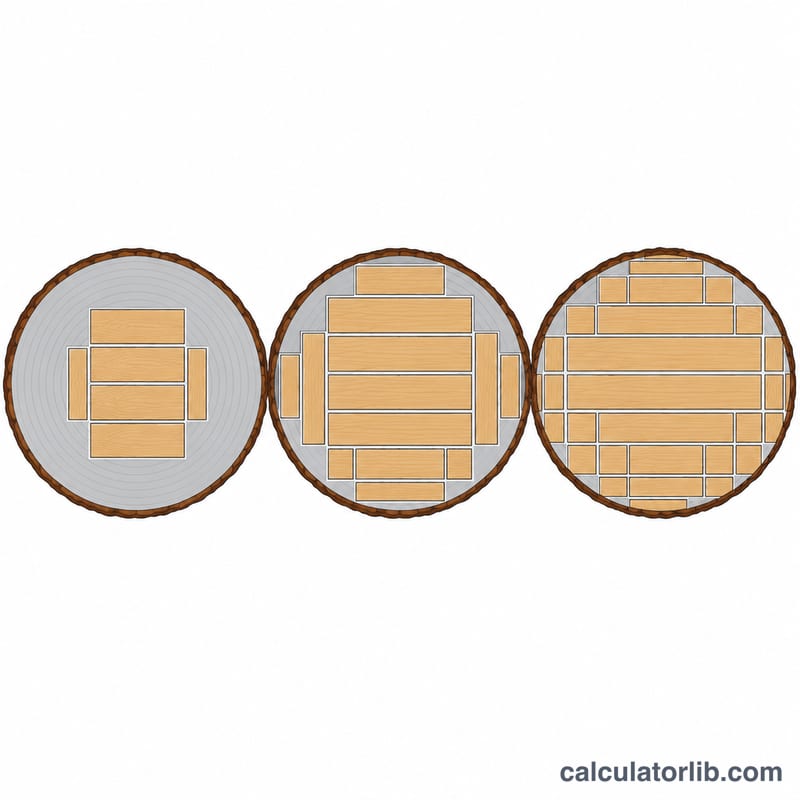
Doyle subtracts a fixed 4 inches from the diameter as a slab allowance. That deduction takes a large share of a small log but only a small share of a large one. As a result, Doyle gives an 8-inch log less than half the International volume. The gap shrinks to about 12% at 20 inches and about 6% at 24 inches, and the rules are roughly equal near 30 inches. Above about 30 inches, Doyle can scale more than the other rules. When you sell small or medium logs, the log rule in the contract can change the volume you are paid for by a third or more. Compare prices only when they use the same rule.
How to Compute the International 1/4-inch Rule by Hand
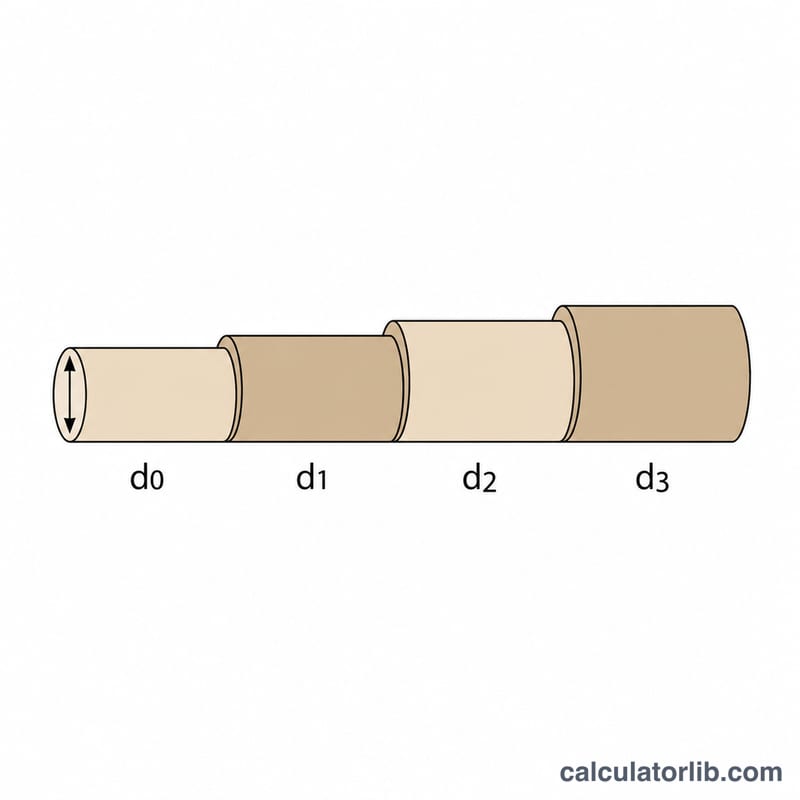
The International rule treats a log as a series of 4-ft sections. Each section is slightly larger than the one before it because of taper. The basic section formula, \(0.22d^2 - 0.71d\), gives board feet for a 4-ft section sawn with a 1/8-inch kerf. The 1/4-inch version of the rule multiplies the total by 0.905.
- Split the length into 4-ft sections. A 16-ft log has four full sections. Any length not divisible by 4 leaves a shorter final piece.
- The first section uses the small-end diameter. Set \(d_0 = D\), the small-end diameter inside bark in inches.
- Add 0.5 inch of taper for each later section. \(d_i = D + 0.5\,i\), so the sections are D, D + 0.5, D + 1.0, D + 1.5 and so on.
- Find the volume of each section with \(v_i = 0.22\,d_i^2 - 0.71\,d_i\). This is board feet for a 4-ft section at a 1/8-inch kerf.
- Add up the sections.
- Multiply by 0.905 to convert from a 1/8-inch kerf to a 1/4-inch kerf.
- Round. Published tables round to the nearest 5 board feet. Field tallies often round to the nearest whole board foot.
Worked example: 16-inch × 16-ft log
The sections have diameters of 16, 16.5, 17 and 17.5 inches:
$$\begin{aligned} v_0 &= 0.22(16)^2 - 0.71(16) = 56.32 - 11.36 = 44.96 \\ v_1 &= 0.22(16.5)^2 - 0.71(16.5) = 59.895 - 11.715 = 48.18 \\ v_2 &= 0.22(17)^2 - 0.71(17) = 63.58 - 12.07 = 51.51 \\ v_3 &= 0.22(17.5)^2 - 0.71(17.5) = 67.375 - 12.425 = 54.95 \end{aligned}$$$$\sum v_i = 44.96 + 48.18 + 51.51 + 54.95 = 199.60 \text{ BF (1/8-in kerf)}$$$$V_{1/4} = 199.60 \times 0.905 = 180.64 \approx 180 \text{ BF}$$The published International 1/4-inch table lists 180 BF for this log.
Handling leftover lengths under 4 ft
Scale a leftover piece in proportion to its length. Use the next diameter in the taper sequence and multiply that section's volume by \(s/4\), where \(s\) is the leftover length in feet. For a 16-inch × 18-ft log, the first four sections total 199.60 BF as above. The fifth section is 2 ft long with \(d_4 = 16 + 0.5 \times 4 = 18\) inches:
$$v_4 = \left(0.22(18)^2 - 0.71(18)\right)\frac{2}{4} = (71.28 - 12.78)(0.5) = 29.25$$$$V_{1/4} = (199.60 + 29.25) \times 0.905 = 228.85 \times 0.905 = 207.1 \approx 207 \text{ BF}$$Some official tables treat odd lengths slightly differently, for example by applying taper per full 4 ft only. Expect hand results to differ from a printed table by a few board feet. Logs are usually bucked in even-foot lengths with trim allowance, typically 3 to 6 inches, which is not counted in the scaled length.
Log Scaling Terms
These terms come mainly from North American (US and Canadian) timber practice.
- Board foot (BF)
- A volume of lumber 12 in × 12 in × 1 in (144 cubic inches) of nominal size. Log rules estimate how many board feet of lumber a log will yield, not the solid wood volume of the log.
- Small-end diameter inside bark (DIB)
- The diameter of the log's smaller end, measured without the bark. It is usually rounded down to the nearest inch, and two measurements are averaged if the end is not round. All three log rules use this diameter.
- DBH (diameter at breast height)
- The diameter of a standing tree measured outside the bark at 4.5 ft above the ground on the uphill side, which is the US convention. Many other countries use 1.3 m. DBH is not the same as log DIB. It includes bark, and it is taken lower on the stem, where the trunk is thicker. The small end of the first log is higher up and narrower, so entering DBH as the log diameter overstates volume.
- Merchantable length
- The usable length of the stem from stump height to a minimum top diameter or to the first large limb or defect. It is usually expressed as a number of 16-ft logs or half-logs.
- Saw kerf
- The width of wood the saw blade turns into sawdust. The International rule's name refers to an assumed 1/4-inch kerf. A thinner kerf gives more lumber.
- Taper
- The decrease in diameter from the butt to the top of a log. The International rule assumes 1/2 inch of taper per 4 ft. Doyle and Scribner ignore taper and treat the log as a cylinder at its small-end diameter.
- Slab and edging allowance
- The wood lost as rounded slabs and edgings when the round log is squared into boards. Doyle's \(D - 4\) term is a fixed slab deduction of 4 inches, which is why it under-scales small logs.
- Sweep and defect deduction
- Volume subtracted from the gross scale for crook or sweep, rot, splits, shake, seams and other defects that make wood unusable. Net scale = gross scale − deductions.
- Log rule
- A formula, diagram or table that predicts board-foot yield from log diameter and length. Doyle, Scribner and International 1/4-inch are the most common rules in the US, and different rules give different volumes for the same log.
- Overrun and underrun
- The difference between the lumber a mill actually saws (mill tally) and the scaled log volume, expressed as a percentage of the scale. Overrun means the mill got more lumber than the scale predicted. This is common with Doyle on small logs. Underrun means it got less.
- Girard form class
- A measure of stem taper used in standing-tree volume tables such as the Mesavage–Girard tables. It equals DIB at the top of the first 16-ft log, about 17.3 ft above the ground, divided by DBH outside bark, as a percentage. A higher form class means less taper and more board feet for the same DBH and height. Values in the high 70s to low 80s are typical for many species.
FAQ
Why do the three rules disagree? Each was built on different assumptions about kerf and taper, so Doyle under-measures small logs while International is closest to actual sawn yield.
Which should I use? Use the rule your local mill or timber buyer specifies; many eastern US buyers use Doyle.
Is this exact? No. It is an estimate; defects, sweep, and sawing practice change real yield.