What it is
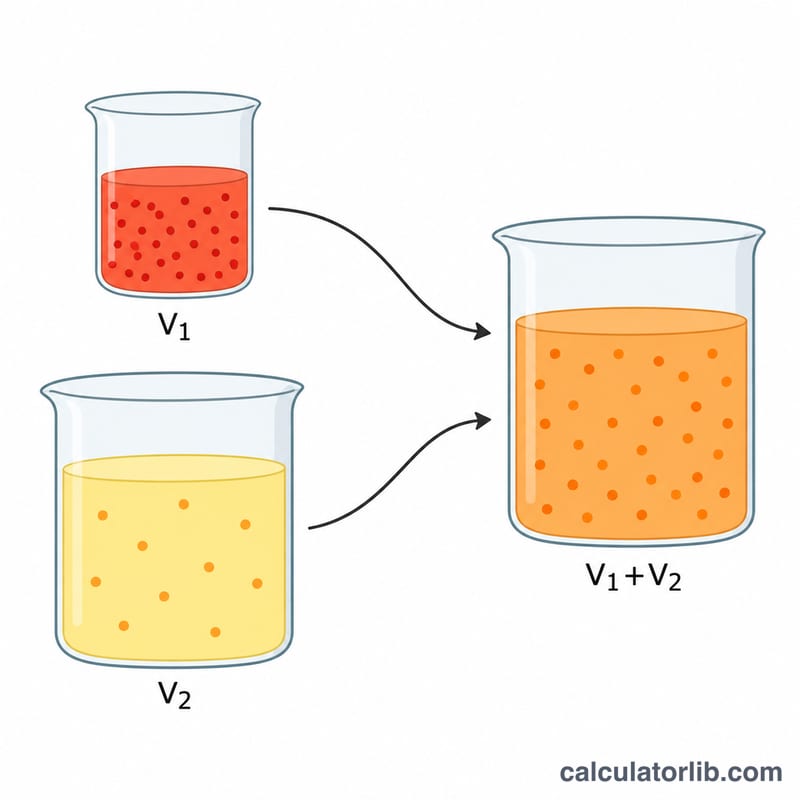
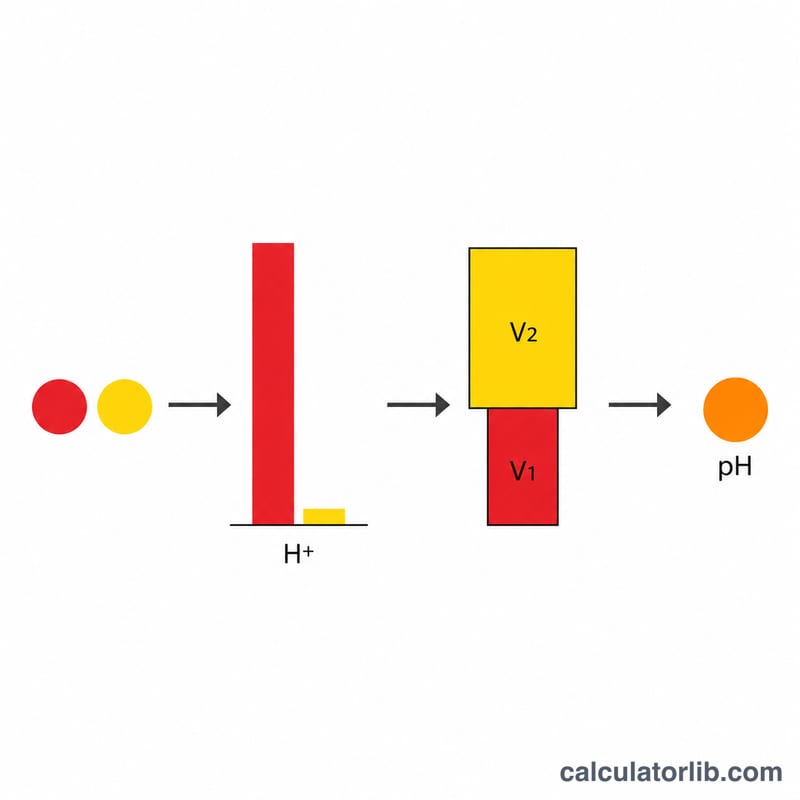
This pH Calculator for Mixed Solutions estimates the pH you get when you combine two acidic solutions that have different pH values and different volumes. Instead of a simple average of the two pH numbers, which is chemically wrong, it works with the underlying hydrogen ion concentration so the answer reflects how acids really combine.
How to use it
Enter the pH and volume of each solution. Use the same volume unit for both (milliliters or liters) because the units cancel. Press calculate to see the resulting pH of the mixture and its hydrogen ion concentration \([H^+]\) in mol/L.
The formula explained
First convert each pH to a hydrogen ion concentration with \([H^+] = 10^{-\text{pH}}\). Then combine the moles of hydrogen ions and divide by the total volume:
$$\text{pH}_{mix} = -\log_{10}\left(\frac{[H^+]_1 V_1 + [H^+]_2 V_2}{V_1 + V_2}\right)$$Here \(V_1\) and \(V_2\) are the two volumes and \([H^+]_1\), \([H^+]_2\) are the concentrations. The model assumes strong, non-buffering acids with no neutralization.
Worked example
Mix 100 mL of pH 3 with 100 mL of pH 5:
$$[H^+]_1 = 10^{-3} = 0.001,\quad [H^+]_2 = 10^{-5} = 0.00001$$$$[H^+]_{mix} = \frac{0.001 \times 100 + 0.00001 \times 100}{100 + 100} = \frac{0.101}{200} = 0.000505$$$$\text{pH}_{mix} = -\log_{10}(0.000505) \approx 3.30$$The result sits close to the more acidic solution, as expected.
More Worked Examples
Both examples assume that each solution is a strong acid in water. That means the acid is fully dissociated, there is no buffering and no neutralization reaction (no base is present), and the volumes simply add together. Under these conditions the hydrogen ions from each solution are just pooled and then spread through the combined volume.
Example A: 50 mL of pH 2 mixed with 450 mL of pH 4
- Convert each pH to hydrogen ion concentration using \([\text{H}^+] = 10^{-\text{pH}}\):
$$[\text{H}^+]_1 = 10^{-2} = 0.01\ \text{M}, \qquad [\text{H}^+]_2 = 10^{-4} = 0.0001\ \text{M}$$ - Convert volumes to litres: \(V_1 = 50\ \text{mL} = 0.050\ \text{L}\) and \(V_2 = 450\ \text{mL} = 0.450\ \text{L}\).
- Find moles of H+ in each solution with \(n = [\text{H}^+] \times V\):
$$n_1 = 0.01 \times 0.050 = 0.0005\ \text{mol}, \qquad n_2 = 0.0001 \times 0.450 = 0.000045\ \text{mol}$$ - Add the moles and divide by the total volume:
$$[\text{H}^+]_{\text{mix}} = \frac{0.0005 + 0.000045}{0.050 + 0.450} = \frac{0.000545}{0.5} = 0.00109\ \text{M}$$ - Convert back to pH:
$$\text{pH}_{\text{mix}} = -\log_{10}(0.00109) \approx 2.96$$
Result: the mixture has a pH of about 2.96. Even though the pH 4 solution makes up 90% of the volume, the result stays close to 3, not 4. The pH 2 solution has 100 times more H+ per litre, so it controls the result.
Example B: 1 L of pH 3 mixed with 1 L of pH 3
- Hydrogen ion concentrations: \([\text{H}^+]_1 = [\text{H}^+]_2 = 10^{-3} = 0.001\ \text{M}\).
- Moles in each: \(n_1 = n_2 = 0.001 \times 1 = 0.001\ \text{mol}\).
- Combined concentration:
$$[\text{H}^+]_{\text{mix}} = \frac{0.001 + 0.001}{1 + 1} = \frac{0.002}{2} = 0.001\ \text{M}$$ - pH: \(\text{pH}_{\text{mix}} = -\log_{10}(0.001) = 3.00\)
Result: the pH stays at 3.00. Mixing two solutions with the same pH doubles both the moles of H+ and the volume, so the concentration and the pH do not change. This holds for any volumes, as long as both solutions have the same pH.
How Mixing Ratio Affects the Final pH
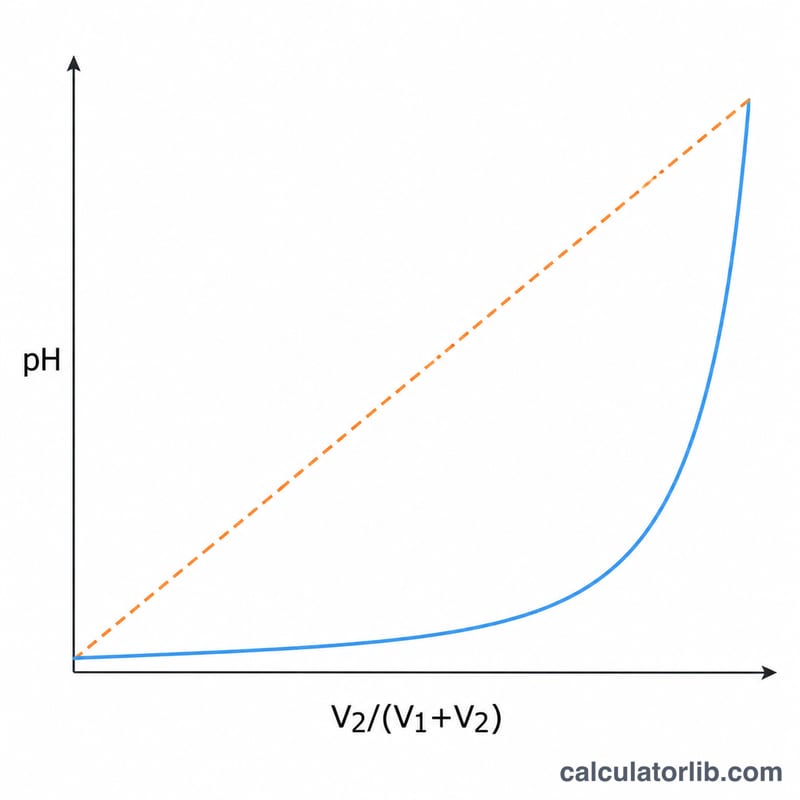
The table below mixes a pH 2 solution (\([\text{H}^+] = 0.01\ \text{M}\)) with a pH 5 solution (\([\text{H}^+] = 0.00001\ \text{M}\)) to make 1000 mL in total. The combined concentration is \([\text{H}^+]_{\text{mix}} = (0.01\,V_1 + 0.00001\,V_2)/(V_1 + V_2)\). The last column shows the naive volume-weighted average of the two pH values, for contrast. That shortcut is not a valid way to combine pH.
| Ratio (V1:V2) | V1 (pH 2), mL | V2 (pH 5), mL | Combined [H+] (M) | Resulting pH | Naive average pH (incorrect) |
|---|---|---|---|---|---|
| 1:9 | 100 | 900 | 0.001009 | 3.00 | 4.70 |
| 1:3 | 250 | 750 | 0.0025075 | 2.60 | 4.25 |
| 1:1 | 500 | 500 | 0.005005 | 2.30 | 3.50 |
| 3:1 | 750 | 250 | 0.0075025 | 2.12 | 2.75 |
| 9:1 | 900 | 100 | 0.009001 | 2.05 | 2.30 |
Because pH is on a logarithmic scale, the more acidic solution controls the mixture. With only 10% pH 2 solution, the mixture already reaches pH 3.00, while the naive average predicts 4.70. The pH 5 solution adds very little H+, so in practice it mostly acts as a diluent. When you dilute a strong acid tenfold, its pH rises by about one unit.
Note: this model is valid only for strong, fully dissociated acids with no buffering. It does not apply if a base is present, because neutralization consumes H+. It also does not apply to weak acids or buffered solutions, which shift their dissociation equilibrium when diluted. In those cases you need an equilibrium or neutralization calculation. The model also ignores water's own ionization, which only matters for solutions near pH 7.
FAQ
Can I average the two pH values? No. Because pH is logarithmic, averaging the numbers gives the wrong result; you must average the concentrations.
Does it work for bases? It is built for acidic solutions. For strong bases or buffers, acid-base neutralization must be modeled separately.
Do volume units matter? Only that they match. Any consistent unit works because volume appears in both numerator and denominator.