What Is the Marine Fuel Cost Calculator?
The Marine Fuel Cost Calculator helps boaters, captains, and anglers estimate how much they will spend on fuel for a trip before leaving the dock. By combining your engine fuel burn rate with your cruising speed, the distance you plan to travel, and the current price of fuel, it turns four simple numbers into a clear dollar figure. This makes budgeting a day on the water, a fishing charter, or a long passage far more predictable.
How to Use It
Enter four values: your fuel consumption in gallons per hour (check your engine manual or a fuel-flow gauge), your typical cruising speed in knots, the total trip distance in nautical miles, and the price you pay per gallon. The calculator returns the trip time, the total gallons burned, and the estimated fuel cost.
The Formula Explained
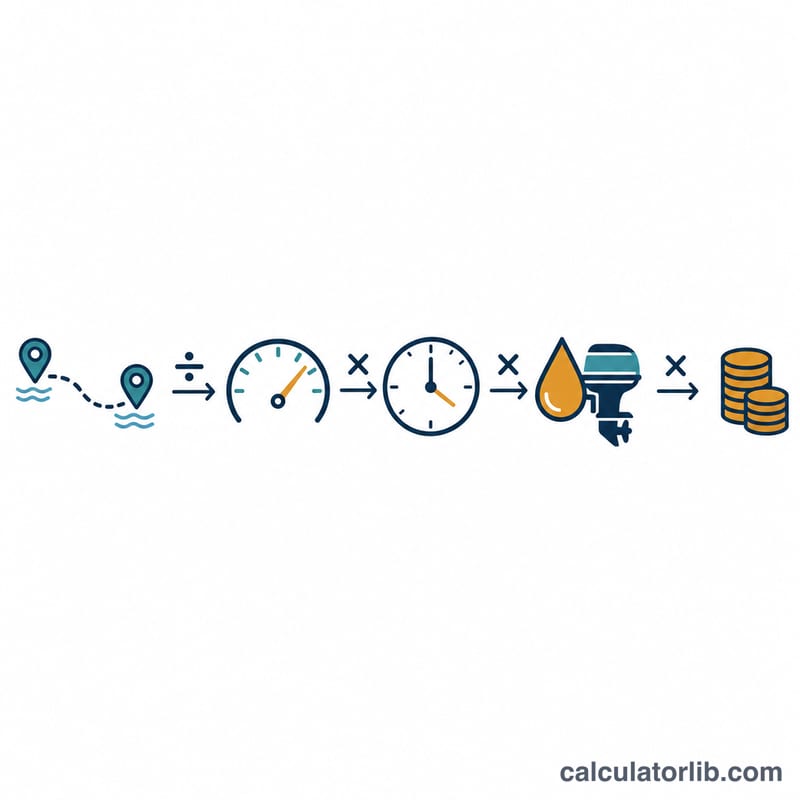
Because marine fuel consumption is measured per hour, the calculator first converts distance into time, then multiplies by burn rate and price:
$$\text{Cost} = \frac{d}{v} \times C \times P$$
where \(d\) = distance in nautical miles, \(v\) = cruising speed in knots, \(C\) = consumption in gallons per hour, and \(P\) = fuel price per gallon. The term \(\frac{d}{v}\) gives the hours underway.
Worked Example
Suppose you cruise 100 nautical miles at 25 knots, burning 20 gallons per hour, with fuel at $4.50 per gallon. First find the time, then the fuel, then the cost:
$$t = \frac{100}{25} = 4\ \text{hours}$$ $$\text{Fuel} = 20 \times 4 = 80\ \text{gallons}$$ $$\text{Cost} = 80 \times \$4.50 = \$360$$
The trip will cost about $360 in fuel.
Fuel Cost Across Different Trip Scenarios
Each row below applies the same formula the calculator uses:
$$\text{Cost} = \frac{d}{v} \times C \times P$$Here \(d\) is the distance in nautical miles, \(v\) is the speed in knots, \(C\) is the fuel burn in US gallons per hour and \(P\) is the price per gallon. Hours are \(d/v\) and gallons are \(d/v \times C\). Every row uses a fuel price of $5.00/gal. The burn rates are illustrative only. They describe a hypothetical planing powerboat, not any specific hull or engine. Use your own engine data or a measured fuel-flow reading.
| Scenario | Distance (nm) | Speed (knots) | Burn (gal/h) | Price ($/gal) | Hours | Gallons | Cost | Gal per nm (C/v) |
|---|---|---|---|---|---|---|---|---|
| 100 nm at displacement (hull) speed | 100 | 8 | 5 | 5.00 | 12.5 | 62.5 | $312.50 | 0.625 |
| 100 nm at planing cruise | 100 | 25 | 20 | 5.00 | 4.0 | 80.0 | $400.00 | 0.800 |
| 100 nm at wide-open throttle | 100 | 40 | 45 | 5.00 | 2.5 | 112.5 | $562.50 | 1.125 |
| Short hop | 20 | 20 | 15 | 5.00 | 1.0 | 15.0 | $75.00 | 0.750 |
| Long passage at cruise | 250 | 25 | 20 | 5.00 | 10.0 | 200.0 | $1,000.00 | 0.800 |
Here is the full substitution for the planing-cruise row: \(\frac{100}{25} \times 20 \times \$5.00 = 4 \times 20 \times \$5.00 = \$400.00\).
The last column, gallons per nautical mile (\(C/v\)), is the number to compare when you choose a speed. Cost per mile is simply \(C/v \times P\). In this example, wide-open throttle saves 1.5 hours over planing cruise but burns 40% more fuel per mile (1.125 vs. 0.800 gal/nm). The slow displacement-speed run is the cheapest per mile but takes three times as long as cruise. On real boats the least efficient speed is often the transition zone, where the hull is pushing up but not yet fully on plane. Fuel-flow readings across your rpm range are the best way to find your boat's most economical cruise speed.
Unit Conversions for Marine Fuel Planning
The calculator uses nautical miles, knots and US gallons. If your chart, engine data or fuel dock uses other units, convert them first with these factors:
| From | To | Multiply by |
|---|---|---|
| 1 nautical mile | kilometres | 1.852 (exact) |
| 1 nautical mile | statute miles | 1.15078 |
| 1 knot | km/h | 1.852 (exact) |
| 1 knot | mph | 1.15078 |
| km or km/h | nm or knots | ÷ 1.852 |
| statute miles or mph | nm or knots | ÷ 1.15078 |
| 1 US gallon | litres | 3.78541 |
| 1 imperial gallon | litres | 4.54609 (exact) |
| 1 imperial gallon | US gallons | 1.20095 |
| Litres per hour | US gal/h | ÷ 3.78541 |
| Price per litre | price per US gallon | × 3.78541 |
Price per litre to price per US gallon: multiply by the number of litres in a US gallon. For example, fuel at 1.80 per litre costs
$$1.80 \times 3.78541 = 6.81 \text{ per US gallon}$$Fuel burn works the same way. An engine rated at 60 L/h burns \(60 \div 3.78541 = 15.85\) US gal/h. A 50 km leg is \(50 \div 1.852 = 27.0\) nm.
Imperial gallons: engine manuals, fuel-flow gauges and dealer data in the UK and some Commonwealth countries may quote imperial gallons. An imperial gallon is about 20% larger than a US gallon. Convert to US gallons before using the calculator, for example \(10 \text{ imp gal/h} \times 1.20095 = 12.01\) US gal/h. If you use the imperial figure unconverted, the calculator will underestimate how much fuel you need. You can also keep every input in one consistent unit system, such as litres with a price per litre. The cost will still be correct, but the result labels will read "gallons".
Planning Your Fuel Load and Reserve
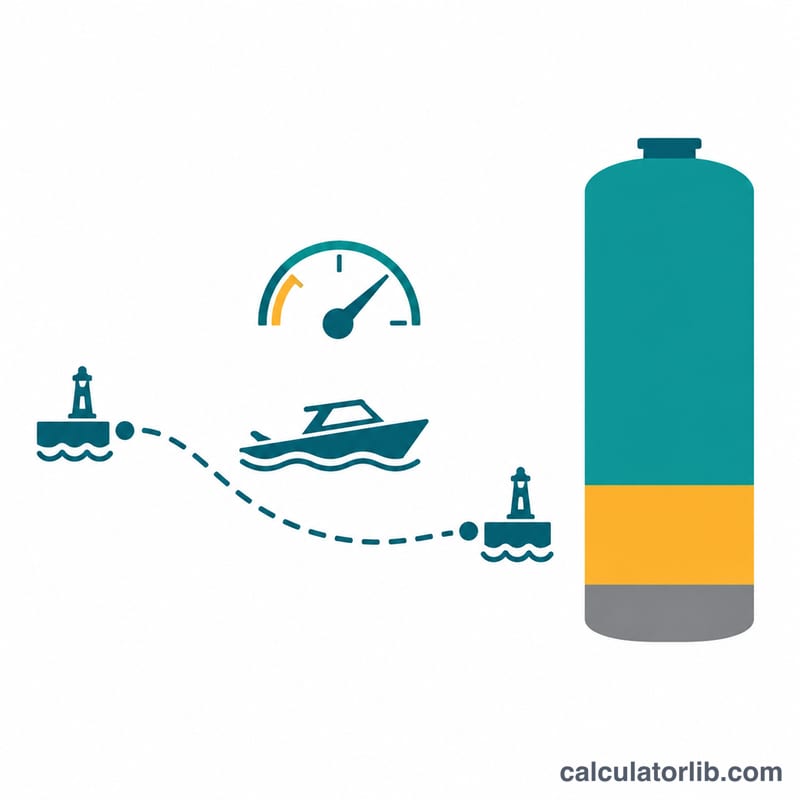
The calculator gives the fuel you will burn under the conditions you enter. It does not tell you how much fuel to carry. Boating safety courses widely teach the rule of thirds: use one-third of your fuel going out, one-third coming back, and keep one-third in reserve.
To apply it, treat the calculated round-trip gallons as two-thirds of the fuel you need on board. In the planing-cruise example, 80 gal covers the run out and back, so:
$$\text{Fuel on board} = 80 \times \frac{3}{2} = 120 \text{ gal}$$For a one-way passage, the calculated figure is the "out" third, so you would carry three times that amount, or plan a refuelling stop.
Add extra fuel on top of the formula when conditions are worse than a calm, steady cruise:
- Head seas and wind. Slamming into waves raises burn and often forces you to slow down off plane, where fuel per mile can rise sharply.
- Current. The formula assumes your entered speed is your speed toward the destination. A foul current lowers speed over ground and stretches running time.
- Heavy loads. Extra passengers, gear, water and full fuel tanks all increase burn.
- Idling, trolling and manoeuvring. Time spent fishing, waiting at bridges or docking burns fuel without covering the planned distance. Add these hours separately at the matching low-speed burn rate.
- A fouled hull or damaged propeller. Marine growth and prop damage reduce efficiency, so your logged burn rates may no longer apply.
Check against usable tank capacity. Compare the fuel you need with your usable capacity, not the nominal tank rating. Pickup tube position, tank shape and trim mean some fuel can never be drawn. Check the manufacturer's data or your own records for the true usable figure. If the required load is more than you can carry, plan refuelling stops. Confirm that those fuel docks are open, sell the right fuel type (gasoline or diesel), and leave you enough reserve to reach an alternative if a dock is closed.
This is general planning guidance only. It does not replace your boat and engine manufacturer's data, your local regulations or your own judgement about conditions on the day. Always file a float plan and check the weather before departure.
FAQ
Should I include the return trip? Yes. Enter the total distance you will travel, including the return leg, unless you only want a one-way estimate.
Why does cruising speed matter? Fuel burn is per hour, so a slower speed means more hours but often far less fuel for the same distance. Finding an efficient cruise speed can cut costs significantly.
Is the estimate exact? It is a planning estimate. Sea state, current, wind, load, and throttle changes all affect real consumption, so add a safety margin.