What this herbicide dilution calculator does
Herbicide labels give a product rate (how much concentrate goes on each hectare or acre) and a recommended spray volume (how much total liquid, product plus water, goes on that same area). Your sprayer has a fixed tank size. This calculator puts those three numbers together and tells you how much concentrate to pour into each full tank, how much water to add, how much ground each tank covers, and how many tank loads the whole job needs.
How to use it
Enter the label product rate, your calibrated spray volume, your tank capacity and the total area to treat. Stick to one unit system: litres and hectares, or US gallons and acres. If your label gives the rate in mL or fl oz, convert it to litres or gallons first. Always calibrate your sprayer so the spray volume you enter is the volume you actually apply.
The formula
One tank covers the tank size divided by the spray volume. Multiply that area by the product rate:
$$P_{tank} = \frac{T}{V} \times R$$Here \(T\) is the tank size, \(V\) is the spray volume per unit area, and \(R\) is the product rate per unit area. Water per tank is \(T - P_{tank}\). The number of loads is \(N = A \div (T/V)\), where \(A\) is the total area.
Worked example
A label calls for 2 L/ha of product in 200 L/ha of water, with a 600 L tank and a 10 ha field:
$$\frac{600}{200} = 3\,\text{ha per tank}, \quad P_{tank} = 3 \times 2 = 6\,\text{L}$$Fill with about 594 L of water and 6 L of concentrate, which gives a 1% mix. The field needs \(10 \div 3 \approx 3.33\) tank loads and 20 L of product in total.
Converting Label Rates to Litres or Gallons
The calculator works in any consistent unit system. Enter the product rate and spray volume in the same volume-per-area unit (L/ha with L/ha, or gal/ac with gal/ac) and the tank size in the matching volume unit. US labels usually give rates in fluid ounces, pints or quarts per acre, so convert them to gallons per acre before you enter them. The gallon, quart, pint and fluid ounce values below are US customary units. Imperial (UK) gallons and fluid ounces are different sizes, so do not mix the two.
| Unit | Equivalent |
|---|---|
| 1 L | 1000 mL |
| 1 US gal | 128 US fl oz = 3.785 L |
| 1 US fl oz | 29.57 mL |
| 1 US qt | 32 fl oz = 0.25 gal |
| 1 US pt | 16 fl oz |
| 1 ha | 2.471 ac |
| 1 ac | 0.4047 ha |
| Rate | Equivalent |
|---|---|
| 1 L/ha | 0.107 gal/ac (≈ 13.7 fl oz/ac) |
| 1 gal/ac | 9.354 L/ha |
| 1 fl oz/ac | 73.08 mL/ha |
Example: A label rate of 32 fl oz/ac becomes gallons per acre by dividing by 128 fl oz per gallon:
$$32\ \text{fl oz/ac} \div 128\ \text{fl oz/gal} = 0.25\ \text{gal/ac}$$This equals 1 qt/ac. In metric it is \(0.25 \times 9.354 \approx 2.34\) L/ha.
More Worked Examples
1) US units: 85 acres with a 300-gallon sprayer
The label rate is 32 fl oz/ac, which is 0.25 gal/ac. The sprayer is calibrated at 15 gal/ac, the tank holds 300 gal and the field is 85 ac.
- Acres per tank: \(T / V = 300 \div 15 = 20\) ac per tank.
- Product per tank: $$P = \frac{T}{V} \times R = \frac{300}{15} \times 0.25 = 20 \times 0.25 = 5\ \text{gal}$$ Product per full tank: 5 gal.
- Water per tank: \(300 - 5 = 295\) gal. Fill the tank to 300 gal in total.
- Loads needed: \(A \div (T/V) = 85 \div 20 = \) 4.25 loads.
- Total product: \(A \times R = 85 \times 0.25 = 21.25\) gal.
2) Working out the partial last load
The 4.25 loads are 4 full tanks plus a quarter-tank. Use the same rate-per-area relationship for the last load.
- Area left: 4 full tanks cover \(4 \times 20 = 80\) ac, so \(85 - 80 = 5\) ac remain. This is the same as \(0.25 \times 20 = 5\) ac.
- Product needed: \(5 \times 0.25 = 1.25\) gal.
- Total mix needed: \(5 \times 15 = 75\) gal. This matches \(P = \frac{75}{15} \times 0.25 = 1.25\) gal.
- Water needed: \(75 - 1.25 = 73.75\) gal.
Check: \(4 \times 5 + 1.25 = 21.25\) gal of product, which matches the total above.
Practical Mixing Tips
The product label always takes priority. Its rates, mixing order, adjuvant instructions, buffer zones and safety requirements override any figure from this calculator. Product labels and pesticide rules also differ by country, so follow the label and the regulations where you spray.
- Mix only what the last load needs. For a fractional final load, use part-load product = area left × R and water = area left × V − product. That way no mix is left over to dispose of.
- Round the load count up when you plan. 4.25 loads means 5 fill trips. Plan water supply, time and transport for 5 fills, even though the last one is small.
- Measure concentrate with a graduated jug or a calibrated measuring device, not by estimating from container marks.
- Recheck the numbers after you recalibrate. Any change in nozzles, pressure or ground speed changes the spray volume (V), which changes the area per tank and the product per tank.
- Allow for dead volume and rinsate. Sprayer pumps, lines and booms hold liquid that cannot be sprayed. Follow the label's instructions for using or disposing of tank rinsate.
- Buy to the nearest container size. Round the total product (for example 21.25 gal) up to whole containers so you don't run short partway through the field.
This is general information to help with mixing arithmetic, not professional agronomic or regulatory advice.
FAQ
Should I add the product to a full tank?
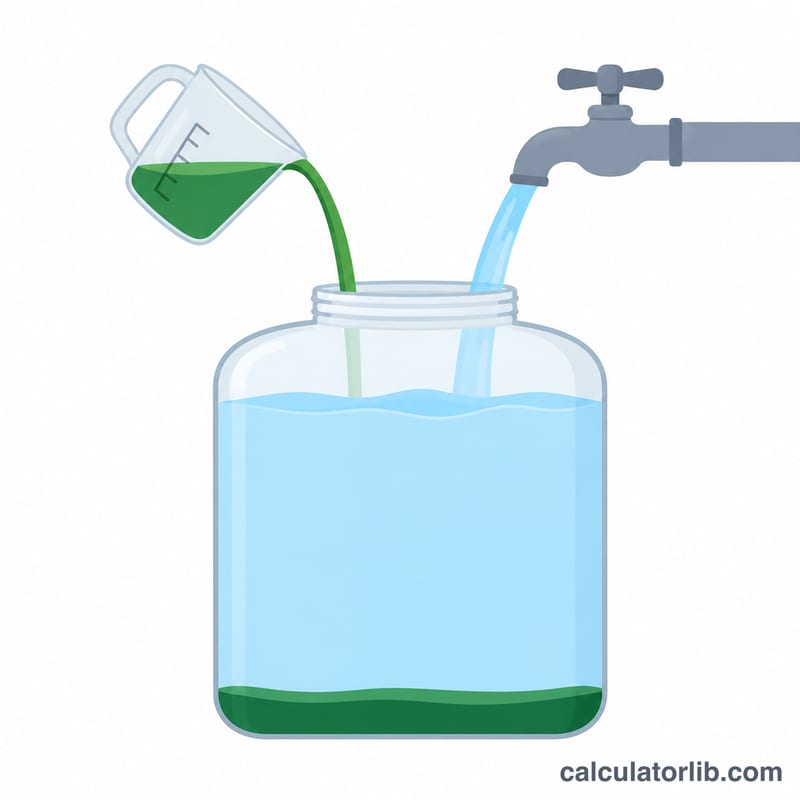
Usually not. Fill the tank half to three-quarters with water, add the product while it agitates, then top up. Follow the mixing order on the label when you tank-mix several products.
What if my spray volume changes?
A higher spray volume means each tank covers less ground, so each tank needs less product. The rate per hectare stays the same. Recalculate whenever you change nozzles, pressure or speed.
Does this replace the label?
No. The product label is the legal guide to rates, adjuvants and safety. This tool only does the mixing arithmetic.