
What is a fold dilution?
A fold dilution (written as "X-fold" or "1:X") describes how many times more dilute a solution becomes after you add solvent. A 10-fold dilution means the final solution is one tenth as concentrated as the original stock. Fold dilutions are the everyday language of biology, chemistry, and clinical labs, where serial dilutions, reagent preparation, and assay setups all depend on getting the factor exactly right.
How to use this calculator
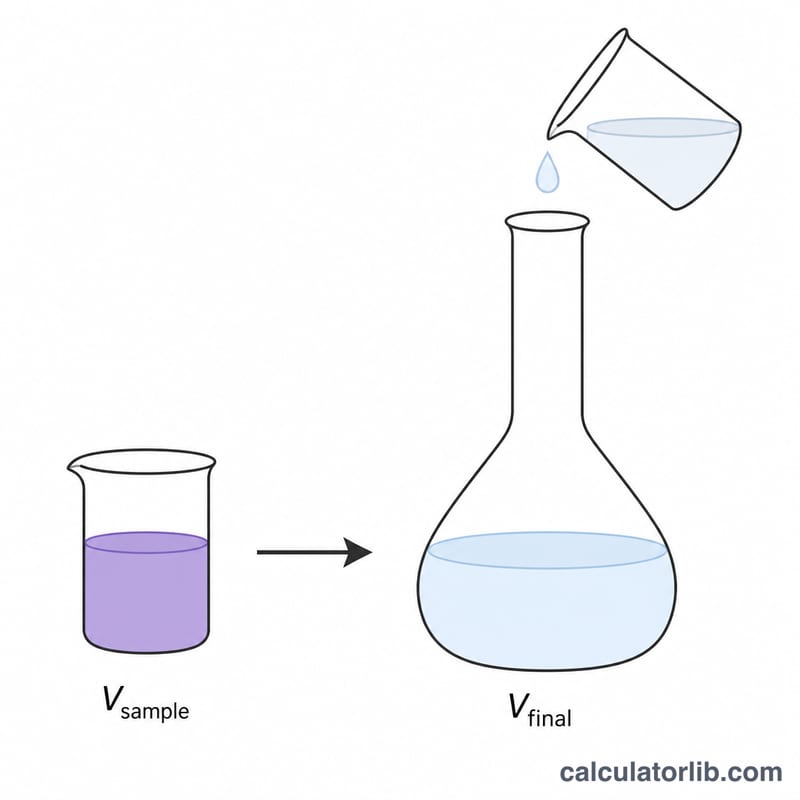
Enter the volume of sample (or stock) you are starting with and the final total volume you want after dilution. Both numbers must use the same unit — millilitres, microlitres, or litres, it does not matter as long as they match. The calculator returns the fold dilution factor and the amount of diluent you need to add (final volume minus sample volume).
The formula explained
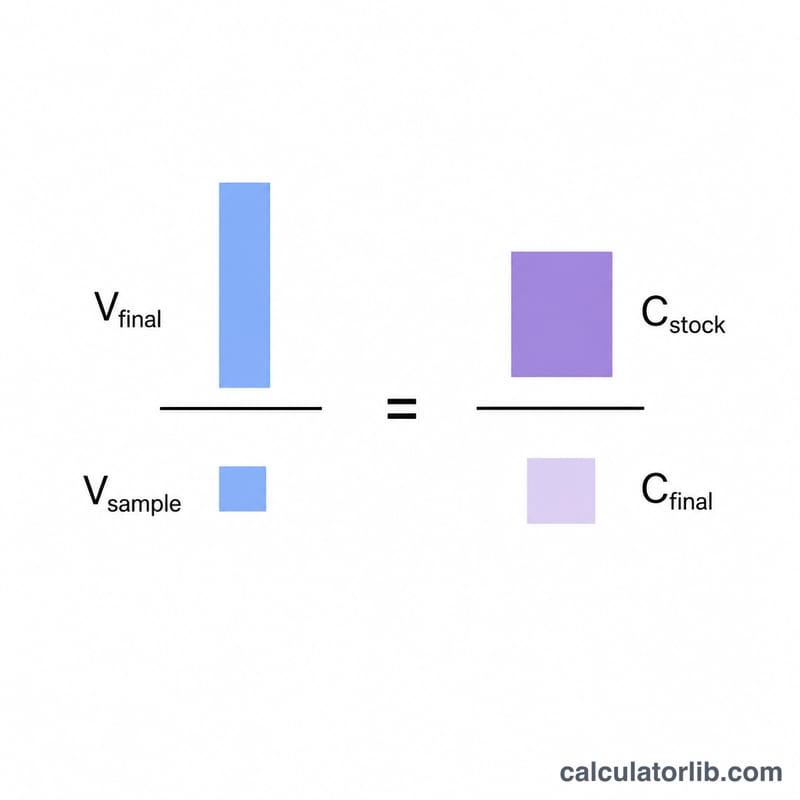
The dilution factor is simply the ratio of final volume to sample volume: $$\text{fold} = \frac{V_{\text{final}}}{V_{\text{sample}}}$$ Because diluting does not change the amount of solute, this ratio also equals the concentration ratio \( C_{\text{stock}} / C_{\text{final}} \). So a 5-fold dilution drops the concentration to one fifth. The diluent volume needed is just \( V_{\text{final}} - V_{\text{sample}} \).
Worked example
Suppose you pipette 2 mL of stock and bring it up to a total of 50 mL. The fold dilution is $$50 / 2 = 25\text{-fold}$$ (a 1:25 dilution). You add \( 50 - 2 = 48 \) mL of diluent. If your stock was 100 mg/mL, the final concentration is \( 100 / 25 = 4 \) mg/mL.
FAQ
Is a "1:10 dilution" the same as 10-fold? In most lab usage yes — 1 part sample to a final 10 parts total, giving a 10-fold dilution. Be careful: some people write "1:10" to mean 1 part sample plus 10 parts diluent (an 11-fold dilution). This tool uses final total volume, so enter the total.
Can I work out the final concentration? Yes: divide your stock concentration by the fold factor shown.
What units should I use? Any volume unit works as long as both inputs use the same one — the fold factor is dimensionless.