
What this calculator does
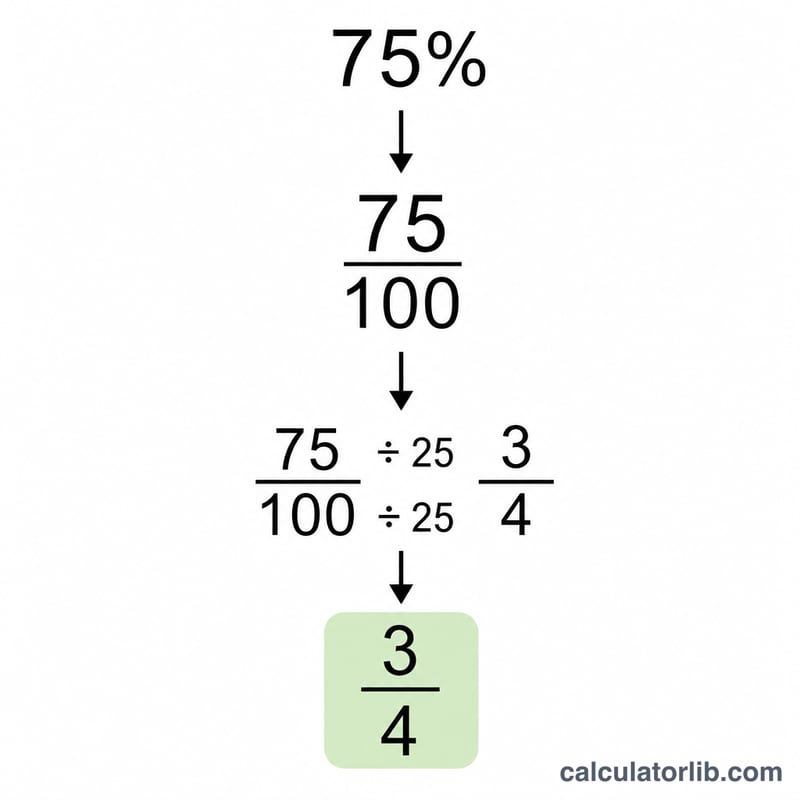
This tool converts any percentage into a fraction expressed in its simplest (lowest) form. A percent literally means "per hundred," so every percentage starts life as a fraction over 100. By dividing both the numerator and denominator by their greatest common divisor (GCD), the fraction is reduced until the top and bottom share no common factor other than 1.
How to use it
Type a percent value into the box and submit. Whole numbers like 40 and decimals like 12.5 both work. The calculator shows the unreduced fraction (over 100, or a larger power of ten for decimals), the fully simplified fraction, and the equivalent decimal value so you can double-check your answer.
The formula explained
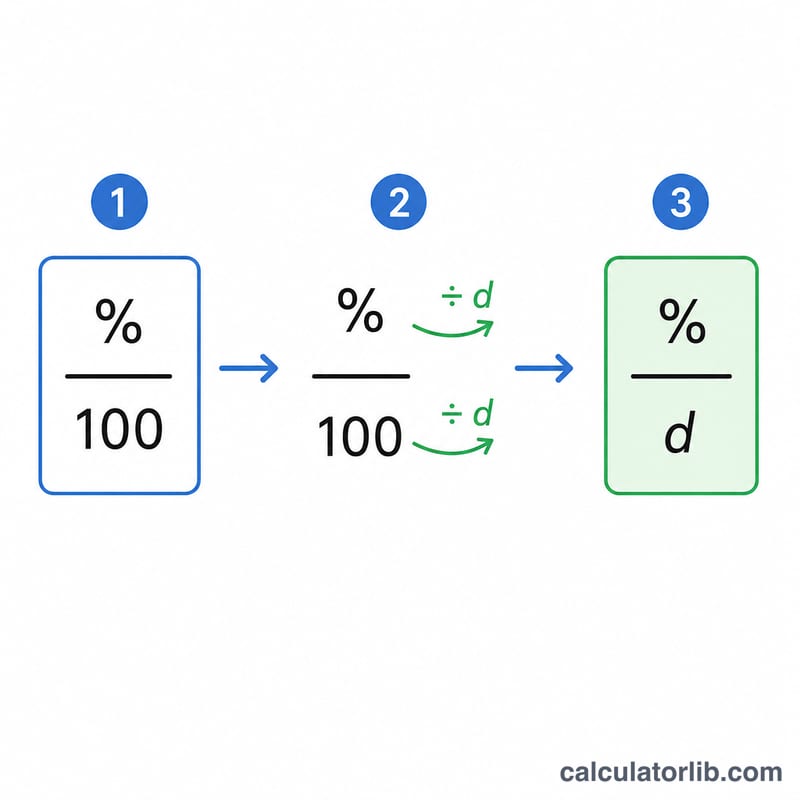
For a percent p, the starting fraction is \(\frac{p}{100}\). The calculator computes \(g = \gcd(p, 100)\) and divides both parts by \(g\). When the percent has decimal places, the numerator and denominator are first scaled by a power of ten so both stay whole numbers — for example 12.5% becomes \(\frac{125}{1000}\) before reducing.
$$\text{Fraction} = \frac{\text{Percent} \times 10^{d}}{100 \times 10^{d}} \div \gcd$$
Worked example
Convert 40% to a fraction. Start with \(\frac{40}{100}\). The GCD of 40 and 100 is 20. Dividing gives \(40 \div 20 = 2\) and \(100 \div 20 = 5\), so \(40\% = \frac{2}{5}\). As a decimal that is 0.4, which checks out.
FAQ
How do I convert a decimal percent like 12.5%? Multiply top and bottom to clear the decimal: \(\frac{12.5}{100} = \frac{125}{1000}\), then reduce by \(\gcd(125,1000)=125\) to get \(\frac{1}{8}\).
What if the percent is over 100? It still works — 150% becomes \(\frac{150}{100} = \frac{3}{2}\), an improper fraction.
Why use the GCD? Dividing by the greatest common divisor in one step guarantees the fraction is in lowest terms with no further reduction possible.