
What is this calculator?
This tool answers the everyday question: what percentage is one number of another? You provide a "this" value (the part) and a "that" value (the whole or total), and it returns the proportion as a percentage. It works for test scores, budgets, discounts, statistics, completion progress, and any situation where you need to express one quantity relative to another.
How to use it
Enter the first number in the "This value" box — this is the amount you are measuring. Enter the second number in the "That value (total)" box — this is the reference total. The calculator instantly shows what percentage the first number is of the second. For example, if you scored 45 out of 60 on a quiz, "this" is 45 and "that" is 60.
The formula explained
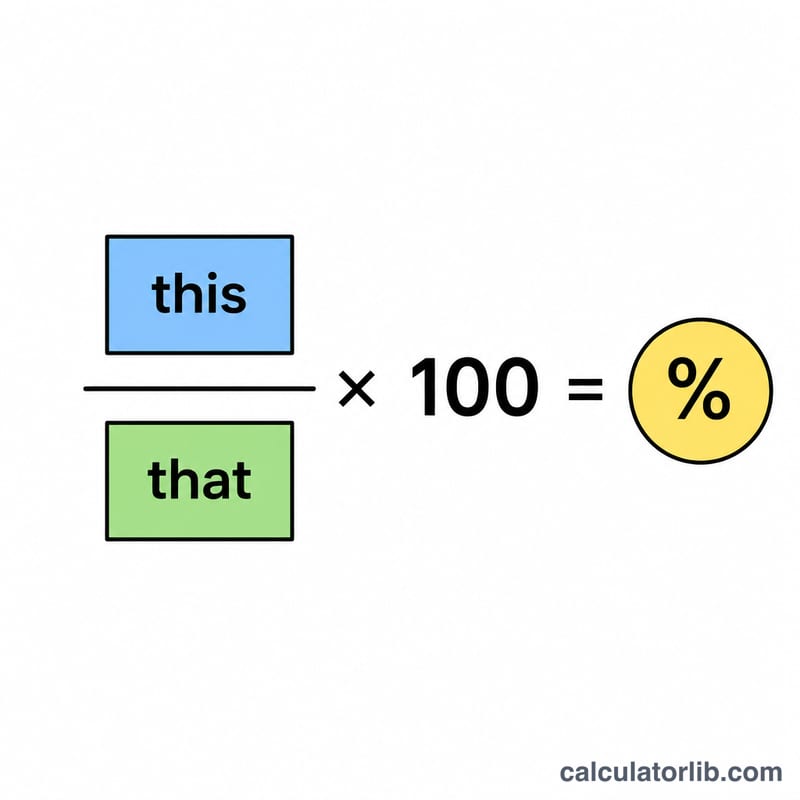
The math is simple division scaled to 100:
$$\text{pct} = \left(\frac{\text{this}}{\text{that}}\right) \times 100$$
Dividing "this" by "that" gives a decimal fraction between 0 and 1 (for values where the part is smaller than the whole). Multiplying by 100 converts that fraction into a percentage. If "this" is larger than "that", you simply get a result above 100%.
Worked example
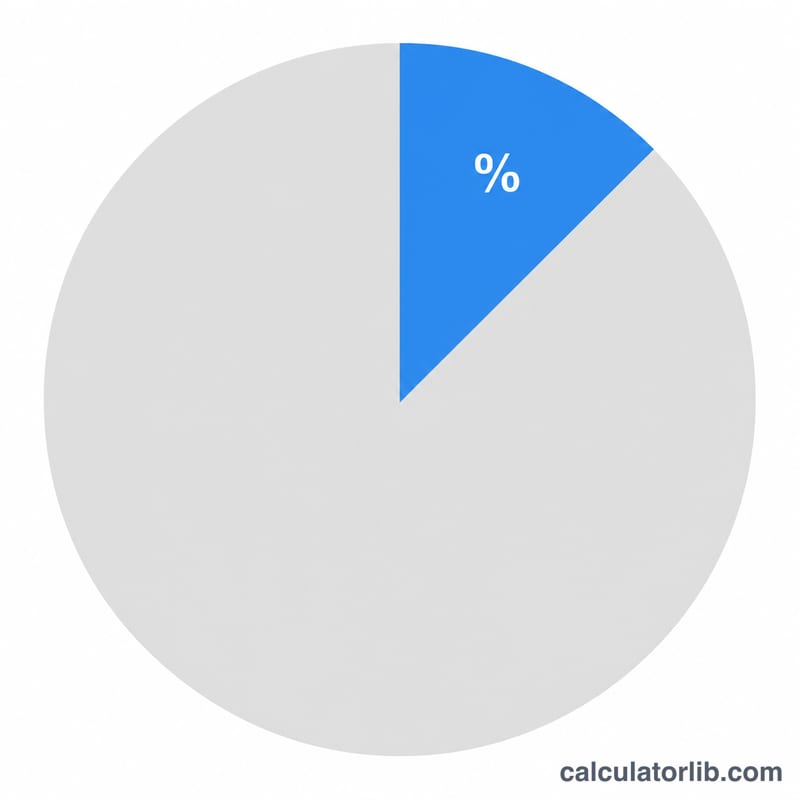
Suppose you want to know what percentage 25 is of 200. Plug in the numbers: \(25 \div 200 = 0.125\). Multiply by 100 to get 12.5%. So 25 represents 12.5% of 200.
FAQ
What if "this" is bigger than "that"? The result will simply exceed 100%. For instance, 150 is 300% of 50.
What happens if "that" is zero? Division by zero is undefined, so the calculator returns 0. Make sure your total is a non-zero number.
Can I use decimals? Yes. Both fields accept decimal values, so you can compute percentages from any real numbers.