
What Is the Pool Chemistry Calculator?
The Pool Chemistry Calculator helps you review the three most important measurements in your swimming pool water: pH, total alkalinity, and free chlorine. By entering your test results along with your pool volume in gallons (the units commonly used in the United States), you get an at-a-glance summary of whether each level sits inside the recommended range. Keeping these values balanced protects swimmers, prevents cloudy or irritating water, and helps your equipment and pool surfaces last longer.
How to Use It
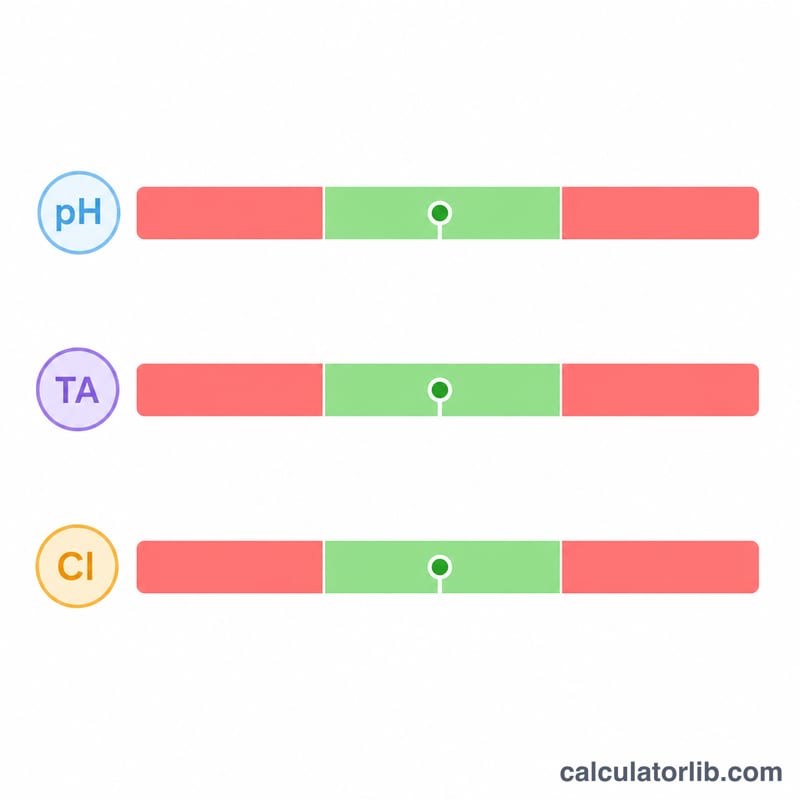
- pH: Enter the reading from your test kit or strips. The ideal range is 7.2 to 7.8.
- Total Alkalinity (TA): Enter your result in parts per million (ppm). Aim for 80 to 120 ppm.
- Free Chlorine: Enter the ppm reading. Most pools target 1 to 3 ppm.
- Pool Volume: Enter the total gallons of water so you can scale chemical additions accurately.
Test your water at least two or three times a week during the swimming season, and after heavy rain or heavy use.
Understanding the Values
These three readings work together rather than in isolation:
- Total alkalinity acts as a buffer that keeps pH stable. If TA drifts too low, pH bounces unpredictably; balance alkalinity first.
- pH affects how effectively chlorine sanitizes. At high pH, chlorine becomes sluggish even when levels look fine.
- Free chlorine is the active sanitizer that kills bacteria and algae. Too little allows growth; too much causes eye and skin irritation.
Pool volume matters because chemical dosing is proportional to water quantity. A rough estimate: \(\text{length} \times \text{width} \times \text{average depth} \times 7.5\) gives gallons for a rectangular pool.
Worked Example
Suppose a 15,000-gallon pool tests at pH 8.0, alkalinity 70 ppm, and free chlorine 0.5 ppm. The calculator flags all three as out of range: pH is high, alkalinity is low, and chlorine is too low. The practical plan would be to raise alkalinity, lower pH toward 7.4, then add chlorine to reach 1–3 ppm.
The amount of chemical needed for each adjustment follows the same general pattern:
$$\text{Adjustment (oz)} = \frac{\left|\text{Ideal} - \text{Current}\right| \times \text{Volume (gal)} \times f}{10000}$$For pH:
$$\text{pH Adj (oz)} = \frac{\left|\,7.4 - \text{pH}\,\right| \times \text{Volume (gal)} \times 0.108}{10000}$$For alkalinity:
$$\text{Alk Adj (oz)} = \frac{\left|\,100 - \text{Alkalinity (ppm)}\,\right| \times \text{Volume (gal)} \times 0.0128}{10000}$$For chlorine:
$$\text{Cl Adj (oz)} = \frac{\left|\,3.0 - \text{Chlorine (ppm)}\,\right| \times \text{Volume (gal)} \times 0.00013}{10000}$$FAQ
How often should I test? Two to three times weekly, and always after storms or pool parties.
Which do I fix first? Adjust total alkalinity, then pH, then chlorine, since each step affects the next.
Why is my chlorine disappearing fast? High sunlight, heavy bather load, or high pH can all reduce chlorine effectiveness quickly.