
What Is the Prime Factorization Calculator?
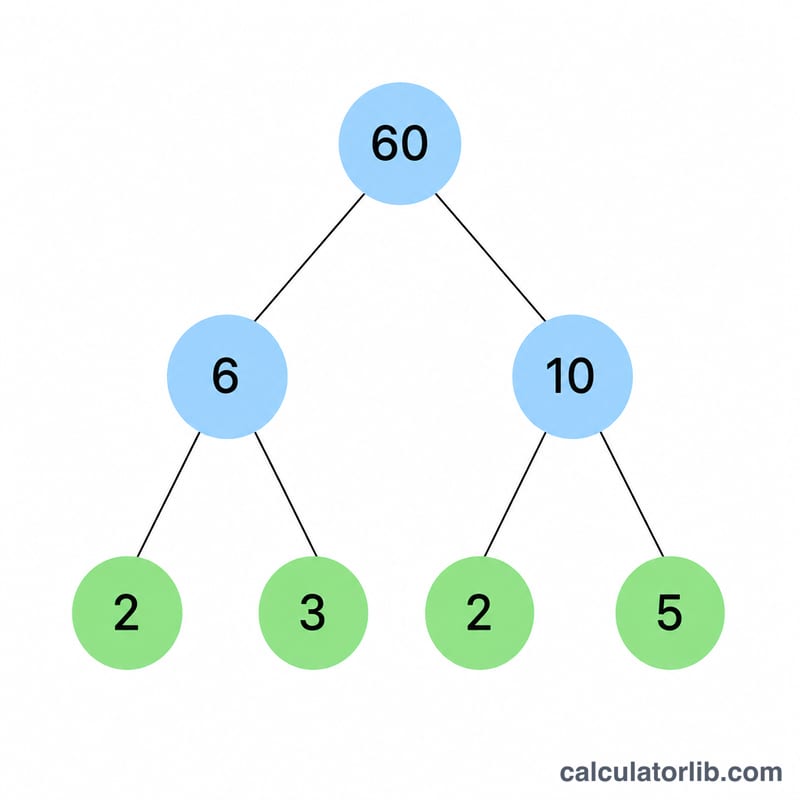
The Prime Factorization Calculator breaks any positive whole number down into the prime numbers that multiply together to produce it. A prime number is a whole number greater than 1 with no divisors other than 1 and itself (2, 3, 5, 7, 11, and so on). Every integer greater than 1 has exactly one set of prime factors — a fact known as the Fundamental Theorem of Arithmetic. This tool finds that unique set for you and presents it in clean exponent form.
How to Use It
There is a single input field: Enter a positive integer. Type any whole number greater than 1 and submit. The calculator returns:
- The full list of prime factors, including repeats (for example 2, 2, 3).
- The frequency of each prime — how many times it appears.
- A tidy factorization string using exponents, such as \(2^2 \times 3\).
If you enter 1 (or leave the box empty), the result is empty, because 1 has no prime factors.
The Formula and Method
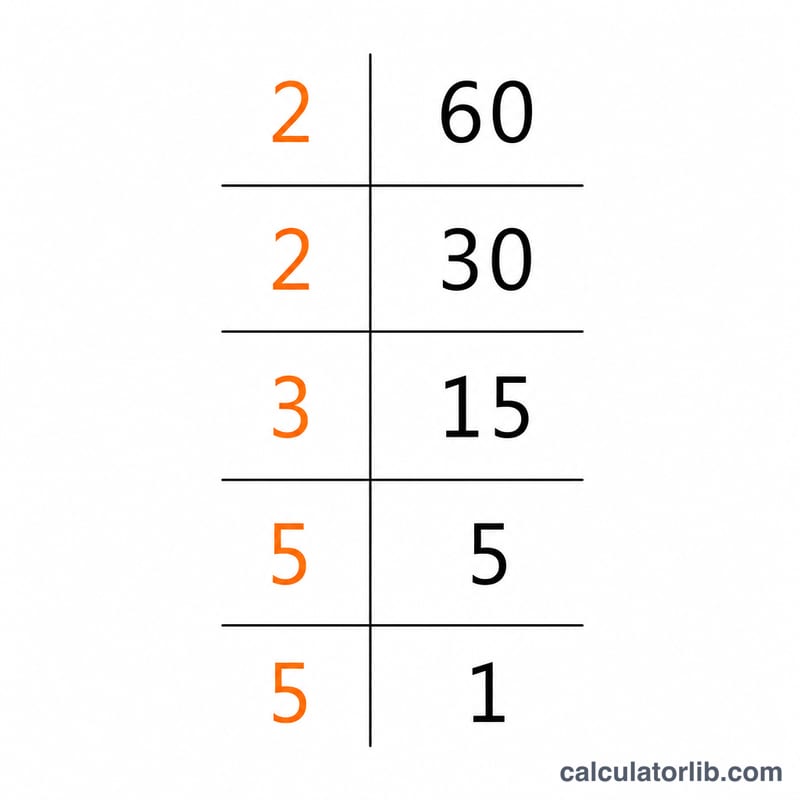
The calculator uses trial division. Starting at the smallest prime, 2, it repeatedly divides the number by each candidate i while the division is exact, recording i as a factor each time. It only needs to test divisors up to the square root of the current number (the loop condition \(i \times i \le n\)), which keeps it fast. If anything greater than 1 remains after the loop, that leftover value is itself prime and gets added to the list. The repeated factors are then grouped to build the exponent notation.
$$\text{N} = p_1^{a_1} \times p_2^{a_2} \times \cdots \times p_k^{a_k}$$
Worked Example
Suppose you enter 360:
- \(360 \div 2 = 180\), \(\div 2 = 90\), \(\div 2 = 45\) → three 2s.
- \(45 \div 3 = 15\), \(\div 3 = 5\) → two 3s.
- 5 is prime and remains → one 5.
Prime factors: 2, 2, 2, 3, 3, 5. Frequency: 2 appears 3 times, 3 appears twice, 5 once. The factorization string is \(2^3 \times 3^2 \times 5\). Multiplying back: $$8 \times 9 \times 5 = 360. \checkmark$$
Frequently Asked Questions
What happens if I enter a prime number? The result is just that number itself, since a prime cannot be broken down further — for example, 17 returns "17".
Can it factor very large numbers? Yes, within the range of a 64-bit integer. Because it tests divisors only up to the square root, even large values resolve quickly unless the number is a product of two enormous primes.
Why are prime factorizations useful? They are essential for finding greatest common divisors and least common multiples, simplifying fractions, and underpin modern cryptography.