What Is the Pool Salt Calculator?
Saltwater pools use a salt chlorine generator that converts dissolved salt into chlorine. To work properly, the water typically needs a salt concentration around 2,700–3,400 ppm (check your generator's manual). This calculator tells you exactly how many pounds and kilograms of salt to add to move from your current level to your target level.
How to Use It
Enter your pool volume in gallons, your current salt reading in ppm (use a test strip or your generator's display, or 0 for a new fill), and your target ppm. The calculator returns the salt needed in pounds, kilograms, and the number of standard 40 lb bags.
The Formula Explained
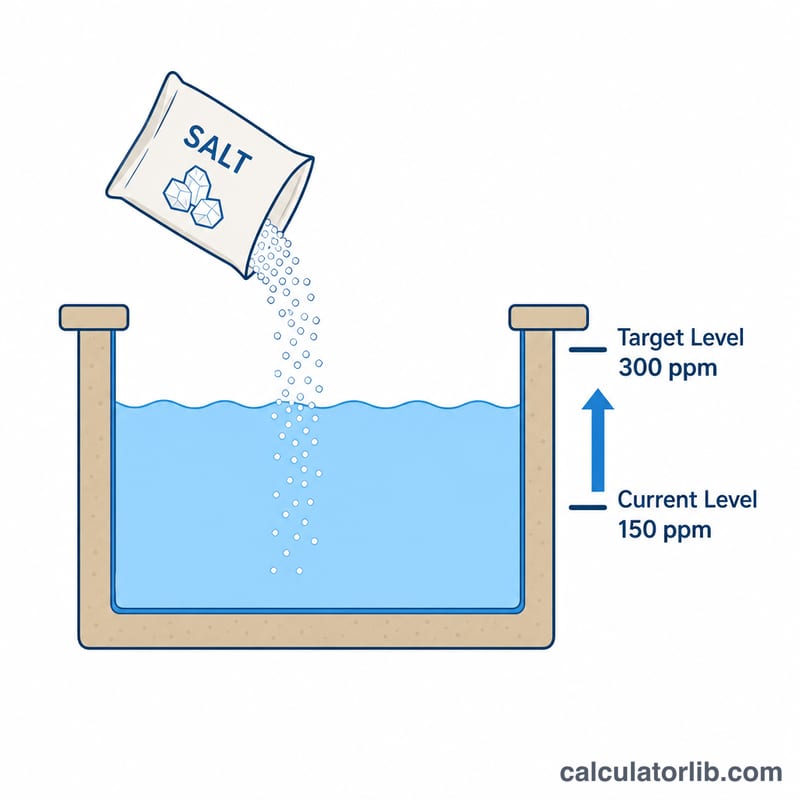
The core equation is $$\text{salt (lbs)} = \text{volume} \times (\text{target} - \text{current}) \times 8.345 \times 10^{-6}$$ One gallon of water weighs about 8.345 pounds, so one ppm (one milligram per kilogram, or part per million by weight) of salt in a gallon equals \(8.345 \times 10^{-6}\) pounds. Multiplying by the volume and the ppm gap gives the total salt to add.
Worked Example
For a 15,000-gallon pool currently at 0 ppm aiming for 3,200 ppm: $$15{,}000 \times 3{,}200 \times 8.345 \times 10^{-6} = \textbf{400.56 lbs}$$ or about 181.7 kg — roughly ten 40 lb bags.
Salt Needed by Pool Size and Target Level
The table uses the calculator's formula, \(\text{Salt (lb)} = \text{gal} \times \Delta\text{ppm} \times 8.345 \times 10^{-6}\), with 1 lb = 0.45359 kg and 40 lb bags. The first three data columns assume a fill from 0 ppm to 3,200 ppm. The last column is a top-up from 2,000 ppm to 3,200 ppm. Real tap or source water usually already contains some dissolved solids, so the actual need may be a little lower.
| Pool volume (US gal) | 0 → 3,200 ppm: lb | 0 → 3,200 ppm: kg | 0 → 3,200 ppm: 40 lb bags | 2,000 → 3,200 ppm: lb / kg / bags |
|---|---|---|---|---|
| 10,000 | 267.04 | 121.1 | 6.68 | 100.14 lb / 45.4 kg / 2.50 |
| 15,000 | 400.56 | 181.7 | 10.01 | 150.21 lb / 68.1 kg / 3.76 |
| 20,000 | 534.08 | 242.2 | 13.35 | 200.28 lb / 90.8 kg / 5.01 |
| 30,000 | 801.12 | 363.4 | 20.03 | 300.42 lb / 136.3 kg / 7.51 |
Worked example: a 20,000 gal pool going from 0 to 3,200 ppm needs \(20{,}000 \times (3{,}200 - 0) \times 8.345 \times 10^{-6} = \) 534.08 lb, which is about 13.35 bags.
Top-up example: a 15,000 gal pool reading 2,000 ppm that needs to reach 3,200 ppm requires \(15{,}000 \times 1{,}200 \times 8.345 \times 10^{-6} = \) 150.21 lb, about 3.76 bags. In practice, buy 4 bags and add them in stages, retesting between additions.
Recommended Salt Levels (ppm)
Most salt chlorine generators (salt cells) operate in a range of about 2,700–3,400 ppm, with an ideal target near 3,200 ppm. Manufacturers differ. Some models specify roughly 3,000–3,500 ppm, and others use lower or wider ranges. The owner's manual for your specific cell and controller takes precedence over any general figure, including the ones here.
| Condition | Typical salt level | Likely effects |
|---|---|---|
| Low salt | Below about 2,700 ppm (check your manual) | Reduced chlorine output, low-salt warnings or cell errors, weaker sanitizing, and a greater risk of algae. Over time, low salt can also shorten cell life and contribute to corrosion problems. |
| Target range | About 2,700–3,400 ppm (ideal near 3,200 ppm) | Normal chlorine production and a water taste that is generally not noticeably salty. |
| High salt | Above about 3,400–3,500 ppm (check your manual) | A noticeably salty taste, high-salt error codes or shutdowns, and possible corrosion of metal fittings and some stonework. |
Source: salt chlorine generator manufacturer guidance (varies by brand and model). If the level is too high, the usual fix is to partially drain the pool and refill with fresh water, since salt does not evaporate. Test with a reliable salt test kit or strips, or have the water tested at a pool store. Cell temperature and water temperature can affect readings and output.
Salt Conversion Quick Reference
| Quantity | Equivalent |
|---|---|
| 1 US gallon | 3.78541 L |
| 1,000 L | 264.172 US gal |
| 1 m³ | 264.172 US gal (1,000 L) |
| 1 lb | 0.45359 kg |
| 1 kg | 2.20462 lb |
| 40 lb bag | 18.14 kg |
| 1 ppm | ≈ 1 mg/L = 0.0001% salinity (approx.) |
Metric formula: $$\text{Salt (kg)} = \frac{ \text{Liters} \times \Delta\text{ppm} }{1{,}000{,}000}$$
Example: a 75,000 L pool going from 0 to 3,200 ppm needs \(75{,}000 \times 3{,}200 \div 1{,}000{,}000 = 240\) kg, about 13.2 bags of 18.14 kg. Here ppm is treated as mg/L, which is a close approximation for pool water at these concentrations.
FAQ
What if my current level is already above the target? You don't need to add salt; the result is shown as 0. To lower salt you must dilute by partially draining and refilling.
How fast does salt dissolve? Run the pump for 24 hours with the generator off so the salt fully dissolves and circulates before testing again.
What salt should I use? Use pure, food-grade or pool-grade sodium chloride (NaCl) that is at least 99% pure and contains no anti-caking or iodine additives.